QUESTION IMAGE
Question
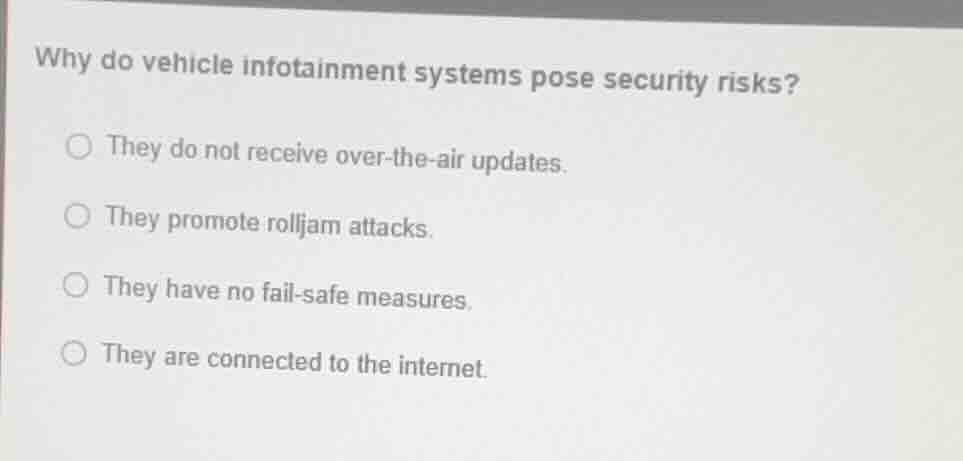
why do vehicle infotainment systems pose security risks?
they do not receive over-the-air updates.
they promote rolljam attacks.
they have no fail-safe measures.
they are connected to the internet.
Analyze the system connectivity
Using the In-Vehicle Infotainment and Automotive Technology knowledge points, we examine how modern vehicle systems operate. Modern infotainment systems are integrated with cellular, Wi-Fi, and Bluetooth capabilities to provide navigation, streaming, and hands-free services.
Evaluate the security implications
This active internet connectivity creates an external attack surface. If a system is connected to the internet, remote attackers can potentially exploit software vulnerabilities to gain unauthorized access to the vehicle's internal networks.
Assess the given options
- "They do not receive over-the-air updates": Incorrect, as many modern systems do receive these updates to patch vulnerabilities.
- "They promote rolljam attacks": Incorrect, as rolljam attacks target wireless keyless entry systems (key fobs), not the infotainment system.
- "They have no fail-safe measures": Incorrect, critical driving systems are typically isolated with safety-critical fail-safes.
- "They are connected to the internet": Correct, internet connectivity is the primary vector that exposes these systems to remote cyber threats.

Snap & solve any problem in the app
Get step-by-step solutions on Sovi AI
Photo-based solutions with guided steps
Explore more problems and detailed explanations
- (A) They do not receive over-the-air updates.
- (B) They promote rolljam attacks.
- (C) They have no fail-safe measures.
- (D) They are connected to the internet. (Correct answer)