QUESTION IMAGE
Question
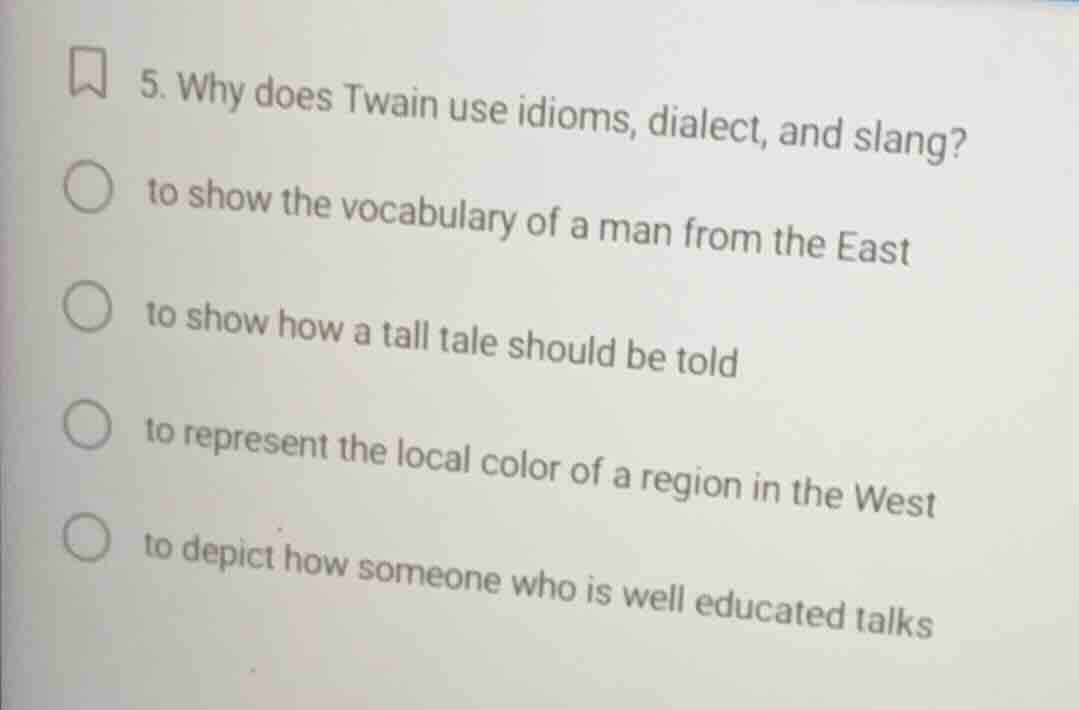
- why does twain use idioms, dialect, and slang?
to show the vocabulary of a man from the east
to show how a tall tale should be told
to represent the local color of a region in the west
to depict how someone who is well educated talks
🆕 New Concept Discovered: Local Color Literary Movement
Capturing the unique speech, customs, and flavor of a specific region.
Step 1: Understand the literary terms
Mark Twain is famous for using regional language features in his writing:
- Idioms: Expressions natural to a specific group of people (e.g., "kick the bucket").
- Dialect: A particular form of a language peculiar to a specific region or social group.
- Slang: Very informal words and phrases, common in speech rather than writing.
These elements are used to capture the authentic voice of everyday people living in specific geographic areas.
Step 2: Connect to the literary movement
During the late 19th century, Mark Twain was a leading figure in the Local Color (or regionalism) literary movement.
- What this means: Writers of this movement aimed to depict the unique character of a specific region—including its speech, customs, dress, and landscapes.
- Since Twain's famous stories (like The Celebrated Jumping Frog of Calaveras County) are set in the American West, using Western idioms, dialect, and slang directly serves to represent the authentic "local color" of that Western region.
Step 3: Evaluate the options
- "to show the vocabulary of a man from the East": Incorrect. Eastern speech at the time was typically portrayed as more formal and standardized, not characterized by Western slang and dialect.
- "to show how a tall tale should be told": Incorrect. While Twain wrote tall tales, the specific use of dialect and slang is a tool for regional realism rather than a structural rule for all tall tales.
- "to represent the local color of a region in the West": Correct. This directly matches Twain's literary goal of capturing the authentic atmosphere, speech, and culture of the Western frontier.
- "to depict how someone who is well educated talks": Incorrect. Standardized, formal English—not regional slang and dialect—was associated with formal education during this era.

Snap & solve any problem in the app
Get step-by-step solutions on Sovi AI
Photo-based solutions with guided steps
Explore more problems and detailed explanations
to represent the local color of a region in the West