QUESTION IMAGE
Question
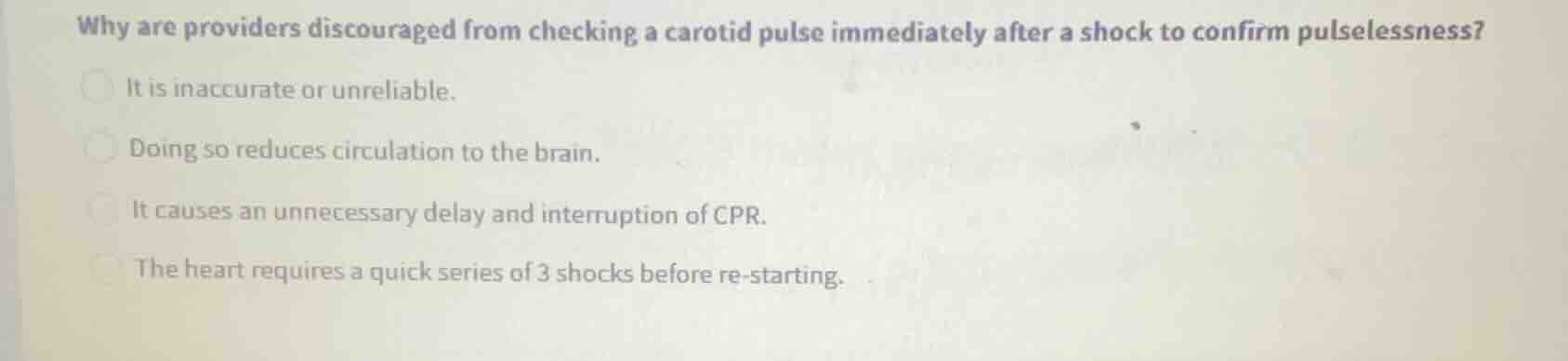
why are providers discouraged from checking a carotid pulse immediately after a shock to confirm pulselessness?
it is inaccurate or unreliable.
doing so reduces circulation to the brain.
it causes an unnecessary delay and interruption of cpr.
the heart requires a quick series of 3 shocks before re-starting.
<pre_analysis>
{
"quality": "clear",
"question_count": 1,
"skills_matched": [
"direct_cot",
"multiple_choice_formatter",
"explain_then_answer",
"tutor",
"mastery_adaptive_brevity"
],
"needs_drawing": false,
"concepts_used": [
"AHA Guidelines"
],
"new_concepts": [
"Post-Defibrillation Protocols",
"CPR Interruption Minimization"
],
"current_concepts": [
"AHA Guidelines",
"Post-Defibrillation Protocols",
"CPR Interruption Minimization"
]
}
</pre_analysis>
<reasoning>
Analyze post-shock protocols
Using the AHA Guidelines knowledge point
According to standard resuscitation guidelines, immediately following a shock delivered by an AED or manual defibrillator, providers must immediately resume high-quality chest compressions without pausing to check for a pulse or rhythm.
Identify the consequence of checking a pulse
Checking for a carotid pulse immediately after a shock is discouraged because it leads to an unnecessary delay in resuming chest compressions. Minimizing interruptions in CPR is critical to maintaining coronary and cerebral perfusion pressures. Resuming chest compressions immediately is vital because even if the shock successfully terminates the lethal arrhythmia, the heart does not immediately generate effective perfusion.
Evaluate the given options
- Option 1: "It is inaccurate or unreliable." While pulse checks can be difficult, this is not the primary clinical reason they are actively discouraged immediately post-shock.
- Option 2: "Doing so reduces circulation to the brain." While true as a consequence of stopping CPR, the direct action of checking the pulse itself does not mechanically reduce circulation; rather, the pause in CPR does.
- Option 3: "It causes an unnecessary delay and interruption of CPR." This directly aligns with guidelines emphasizing the minimization of hands-off time.
- Option 4: "The heart requires a quick series of 3 shocks before re-starting." This reflects outdated protocols (stacked shocks); current guidelines recommend a single shock followed immediately by 2 minutes of CPR.
</reasoning>
<answer>
<mcq-option>It is inaccurate or unreliable.</mcq-option>
<mcq-option>Doing so reduces circulation to the brain.</mcq-option>
<mcq-correct>It causes an unnecessary delay and interruption of CPR.</mcq-correct>
<mcq-option>The heart requires a quick series of 3 shocks before re-starting.</mcq-option>
</answer>
<post_analysis>
{
"subject": "Natural Science",
"question_type": "Multiple Choice",
"knowledge_point": [
"Natural Science",
"Medicine",
"AHA Guidelines"
]
}
</post_analysis>
Snap & solve any problem in the app
Get step-by-step solutions on Sovi AI
Photo-based solutions with guided steps
Explore more problems and detailed explanations
<pre_analysis>
{
"quality": "clear",
"question_count": 1,
"skills_matched": [
"direct_cot",
"multiple_choice_formatter",
"explain_then_answer",
"tutor",
"mastery_adaptive_brevity"
],
"needs_drawing": false,
"concepts_used": [
"AHA Guidelines"
],
"new_concepts": [
"Post-Defibrillation Protocols",
"CPR Interruption Minimization"
],
"current_concepts": [
"AHA Guidelines",
"Post-Defibrillation Protocols",
"CPR Interruption Minimization"
]
}
</pre_analysis>
<reasoning>
Analyze post-shock protocols
Using the AHA Guidelines knowledge point
According to standard resuscitation guidelines, immediately following a shock delivered by an AED or manual defibrillator, providers must immediately resume high-quality chest compressions without pausing to check for a pulse or rhythm.
Identify the consequence of checking a pulse
Checking for a carotid pulse immediately after a shock is discouraged because it leads to an unnecessary delay in resuming chest compressions. Minimizing interruptions in CPR is critical to maintaining coronary and cerebral perfusion pressures. Resuming chest compressions immediately is vital because even if the shock successfully terminates the lethal arrhythmia, the heart does not immediately generate effective perfusion.
Evaluate the given options
- Option 1: "It is inaccurate or unreliable." While pulse checks can be difficult, this is not the primary clinical reason they are actively discouraged immediately post-shock.
- Option 2: "Doing so reduces circulation to the brain." While true as a consequence of stopping CPR, the direct action of checking the pulse itself does not mechanically reduce circulation; rather, the pause in CPR does.
- Option 3: "It causes an unnecessary delay and interruption of CPR." This directly aligns with guidelines emphasizing the minimization of hands-off time.
- Option 4: "The heart requires a quick series of 3 shocks before re-starting." This reflects outdated protocols (stacked shocks); current guidelines recommend a single shock followed immediately by 2 minutes of CPR.
</reasoning>
<answer>
<mcq-option>It is inaccurate or unreliable.</mcq-option>
<mcq-option>Doing so reduces circulation to the brain.</mcq-option>
<mcq-correct>It causes an unnecessary delay and interruption of CPR.</mcq-correct>
<mcq-option>The heart requires a quick series of 3 shocks before re-starting.</mcq-option>
</answer>
<post_analysis>
{
"subject": "Natural Science",
"question_type": "Multiple Choice",
"knowledge_point": [
"Natural Science",
"Medicine",
"AHA Guidelines"
]
}
</post_analysis>