QUESTION IMAGE
Question
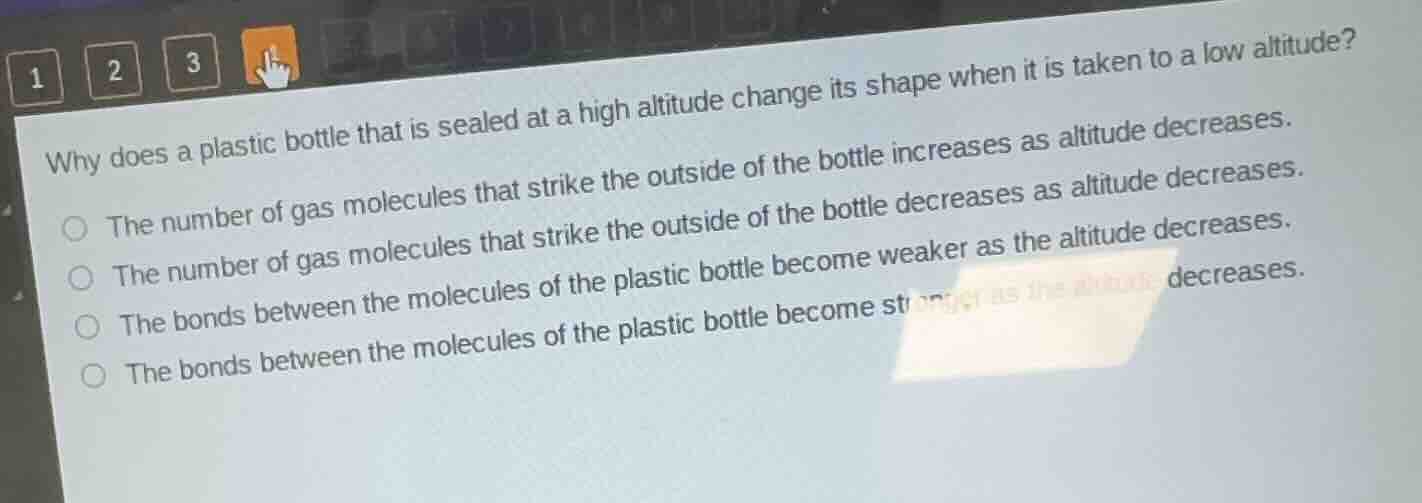
why does a plastic bottle that is sealed at a high altitude change its shape when it is taken to a low altitude?
- the number of gas molecules that strike the outside of the bottle increases as altitude decreases.
- the number of gas molecules that strike the outside of the bottle decreases as altitude decreases.
- the bonds between the molecules of the plastic bottle become weaker as the altitude decreases.
- the bonds between the molecules of the plastic bottle become stronger as the altitude decreases.
<pre_analysis>
{
"quality": "clear",
"question_count": 1,
"skills_matched": [
"direct_cot",
"multiple_choice_formatter",
"explain_then_answer",
"quick"
],
"needs_drawing": false,
"concepts_used": [],
"new_concepts": [
"Atmospheric Pressure",
"Altitude Effects",
"Gas Behavior"
],
"current_concepts": [
"Atmospheric Pressure",
"Altitude Effects",
"Gas Behavior"
]
}
</pre_analysis>
<reasoning>
Analyze atmospheric pressure changes with altitude
\[
P_{\text{external}} \propto \text{Density of air}
\]
As altitude decreases (moving closer to sea level), the density of the surrounding air increases, which means there are more gas molecules per unit volume.
Relate molecular collisions to pressure
\[
F_{\text{collision}} \propto \text{Number of molecular impacts per unit area}
\]
An increase in air density at lower altitudes results in a higher frequency of external gas molecules striking the outside surface of the bottle, increasing the external pressure relative to the sealed internal pressure.
Evaluate the given options
- Option 1 correctly states that the number of gas molecules striking the outside increases as altitude decreases.
- Option 2 is incorrect because the number of striking molecules increases, not decreases.
- Options 3 and 4 are incorrect because the physical bonds between the plastic molecules of the bottle do not change strength due to altitude changes.
</reasoning>
<answer>
<mcq-correct>(A) The number of gas molecules that strike the outside of the bottle increases as altitude decreases.</mcq-correct>
<mcq-option>(B) The number of gas molecules that strike the outside of the bottle decreases as altitude decreases.</mcq-option>
<mcq-option>(C) The bonds between the molecules of the plastic bottle become weaker as the altitude decreases.</mcq-option>
<mcq-option>(D) The bonds between the molecules of the plastic bottle become stronger as the altitude decreases.</mcq-option>
</answer>
<post_analysis>
{
"subject": "Natural Science",
"question_type": "Multiple Choice",
"knowledge_point": [
"Natural Science",
"Physics",
"Atmospheric Pressure"
]
}
</post_analysis>
Snap & solve any problem in the app
Get step-by-step solutions on Sovi AI
Photo-based solutions with guided steps
Explore more problems and detailed explanations
<pre_analysis>
{
"quality": "clear",
"question_count": 1,
"skills_matched": [
"direct_cot",
"multiple_choice_formatter",
"explain_then_answer",
"quick"
],
"needs_drawing": false,
"concepts_used": [],
"new_concepts": [
"Atmospheric Pressure",
"Altitude Effects",
"Gas Behavior"
],
"current_concepts": [
"Atmospheric Pressure",
"Altitude Effects",
"Gas Behavior"
]
}
</pre_analysis>
<reasoning>
Analyze atmospheric pressure changes with altitude
\[
P_{\text{external}} \propto \text{Density of air}
\]
As altitude decreases (moving closer to sea level), the density of the surrounding air increases, which means there are more gas molecules per unit volume.
Relate molecular collisions to pressure
\[
F_{\text{collision}} \propto \text{Number of molecular impacts per unit area}
\]
An increase in air density at lower altitudes results in a higher frequency of external gas molecules striking the outside surface of the bottle, increasing the external pressure relative to the sealed internal pressure.
Evaluate the given options
- Option 1 correctly states that the number of gas molecules striking the outside increases as altitude decreases.
- Option 2 is incorrect because the number of striking molecules increases, not decreases.
- Options 3 and 4 are incorrect because the physical bonds between the plastic molecules of the bottle do not change strength due to altitude changes.
</reasoning>
<answer>
<mcq-correct>(A) The number of gas molecules that strike the outside of the bottle increases as altitude decreases.</mcq-correct>
<mcq-option>(B) The number of gas molecules that strike the outside of the bottle decreases as altitude decreases.</mcq-option>
<mcq-option>(C) The bonds between the molecules of the plastic bottle become weaker as the altitude decreases.</mcq-option>
<mcq-option>(D) The bonds between the molecules of the plastic bottle become stronger as the altitude decreases.</mcq-option>
</answer>
<post_analysis>
{
"subject": "Natural Science",
"question_type": "Multiple Choice",
"knowledge_point": [
"Natural Science",
"Physics",
"Atmospheric Pressure"
]
}
</post_analysis>