QUESTION IMAGE
Question
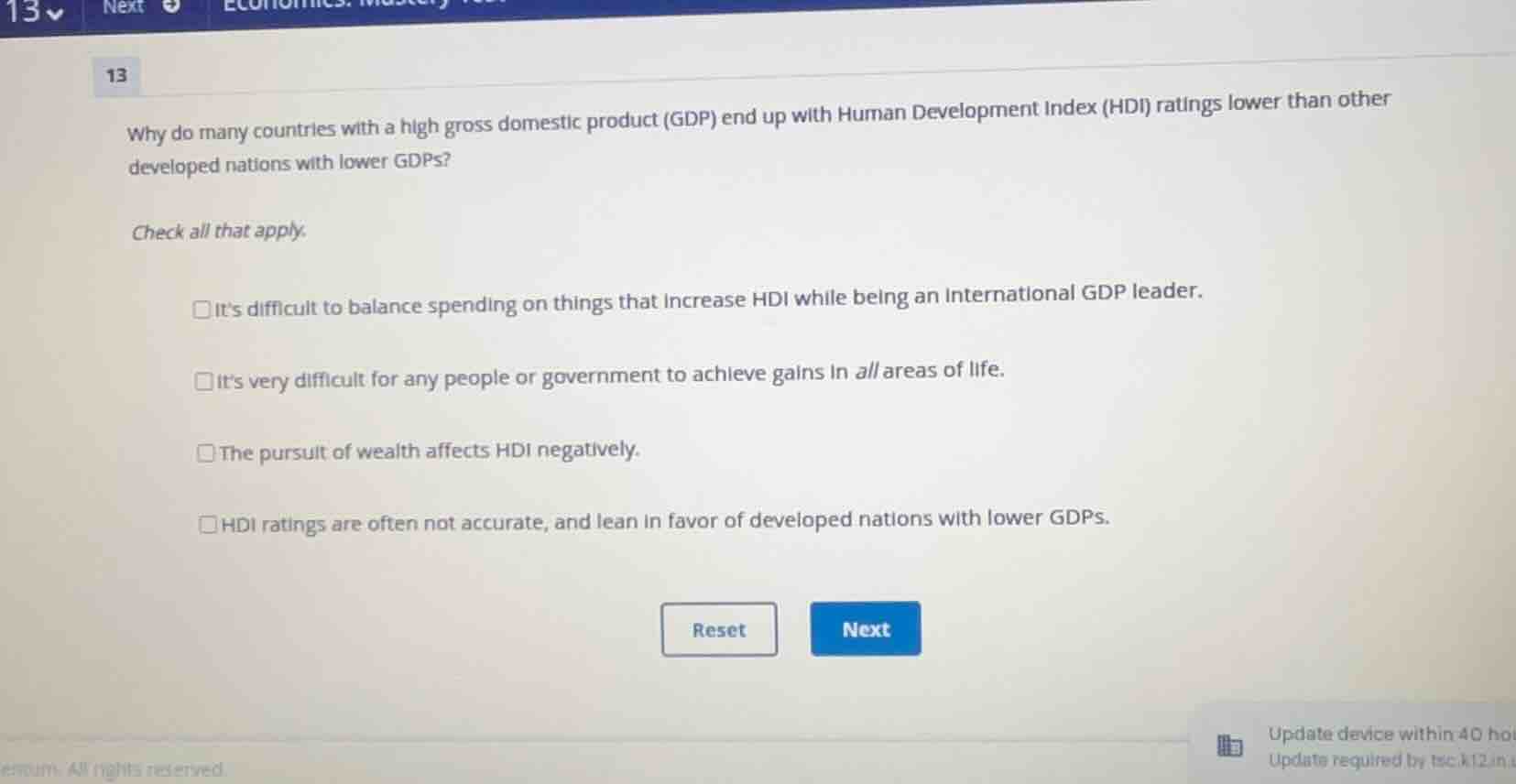
why do many countries with a high gross domestic product (gdp) end up with human development index (hdi) ratings lower than other developed nations with lower gdps?
check all that apply.
its difficult to balance spending on things that increase hdi while being an international gdp leader.
its very difficult for any people or government to achieve gains in all areas of life.
the pursuit of wealth affects hdi negatively.
hdi ratings are often not accurate, and lean in favor of developed nations with lower gdps.
<pre_analysis>
{
"quality": "clear",
"question_count": 1,
"skills_matched": [
"direct_cot",
"multiple_choice_formatter",
"explain_then_answer",
"quick"
],
"needs_drawing": false,
"concepts_used": [
"Gross Domestic Product",
"Human Development Index",
"HDI Components"
],
"new_concepts": [],
"current_concepts": [
"Gross Domestic Product",
"Human Development Index",
"HDI Components",
"Socioeconomic Development"
]
}
</pre_analysis>
<reasoning>
Analyze the relationship between GDP and HDI
GDP measures economic output, while HDI measures overall well-being (life expectancy, education, and per capita income). A high GDP does not automatically translate to high human development if wealth is concentrated or not invested in public services.
Evaluate the options
- Option 1: "It's difficult to balance spending on things that increase HDI while being an international GDP leader." This is a recognized challenge, as prioritizing pure economic growth can divert resources away from social infrastructure like healthcare and education.
- Option 2: "It's very difficult for any people or government to achieve gains in all areas of life." This is a general, realistic constraint on development, explaining why high economic performance (GDP) doesn't automatically guarantee high achievements in health and education (HDI).
- Option 3: "The pursuit of wealth affects HDI negatively." This is incorrect; the pursuit of wealth itself does not inherently harm human development, and higher income is actually a component of HDI.
- Option 4: "HDI ratings are often not accurate, and lean in favor of developed nations with lower GDPs." This is incorrect; HDI is a standardized, widely accepted metric and does not have a systematic bias favoring lower-GDP developed nations.
</reasoning>
<answer>
<mcq-correct>It's difficult to balance spending on things that increase HDI while being an international GDP leader.</mcq-correct>
<mcq-correct>It's very difficult for any people or government to achieve gains in all areas of life.</mcq-correct>
<mcq-option>The pursuit of wealth affects HDI negatively.</mcq-option>
<mcq-option>HDI ratings are often not accurate, and lean in favor of developed nations with lower GDPs.</mcq-option>
</answer>
<post_analysis>
{
"subject": "Social Science",
"question_type": "Multiple Choice",
"knowledge_point": [
"Social Science",
"Geography",
"Socioeconomic Development"
]
}
</post_analysis>
Snap & solve any problem in the app
Get step-by-step solutions on Sovi AI
Photo-based solutions with guided steps
Explore more problems and detailed explanations
<pre_analysis>
{
"quality": "clear",
"question_count": 1,
"skills_matched": [
"direct_cot",
"multiple_choice_formatter",
"explain_then_answer",
"quick"
],
"needs_drawing": false,
"concepts_used": [
"Gross Domestic Product",
"Human Development Index",
"HDI Components"
],
"new_concepts": [],
"current_concepts": [
"Gross Domestic Product",
"Human Development Index",
"HDI Components",
"Socioeconomic Development"
]
}
</pre_analysis>
<reasoning>
Analyze the relationship between GDP and HDI
GDP measures economic output, while HDI measures overall well-being (life expectancy, education, and per capita income). A high GDP does not automatically translate to high human development if wealth is concentrated or not invested in public services.
Evaluate the options
- Option 1: "It's difficult to balance spending on things that increase HDI while being an international GDP leader." This is a recognized challenge, as prioritizing pure economic growth can divert resources away from social infrastructure like healthcare and education.
- Option 2: "It's very difficult for any people or government to achieve gains in all areas of life." This is a general, realistic constraint on development, explaining why high economic performance (GDP) doesn't automatically guarantee high achievements in health and education (HDI).
- Option 3: "The pursuit of wealth affects HDI negatively." This is incorrect; the pursuit of wealth itself does not inherently harm human development, and higher income is actually a component of HDI.
- Option 4: "HDI ratings are often not accurate, and lean in favor of developed nations with lower GDPs." This is incorrect; HDI is a standardized, widely accepted metric and does not have a systematic bias favoring lower-GDP developed nations.
</reasoning>
<answer>
<mcq-correct>It's difficult to balance spending on things that increase HDI while being an international GDP leader.</mcq-correct>
<mcq-correct>It's very difficult for any people or government to achieve gains in all areas of life.</mcq-correct>
<mcq-option>The pursuit of wealth affects HDI negatively.</mcq-option>
<mcq-option>HDI ratings are often not accurate, and lean in favor of developed nations with lower GDPs.</mcq-option>
</answer>
<post_analysis>
{
"subject": "Social Science",
"question_type": "Multiple Choice",
"knowledge_point": [
"Social Science",
"Geography",
"Socioeconomic Development"
]
}
</post_analysis>