QUESTION IMAGE
Question
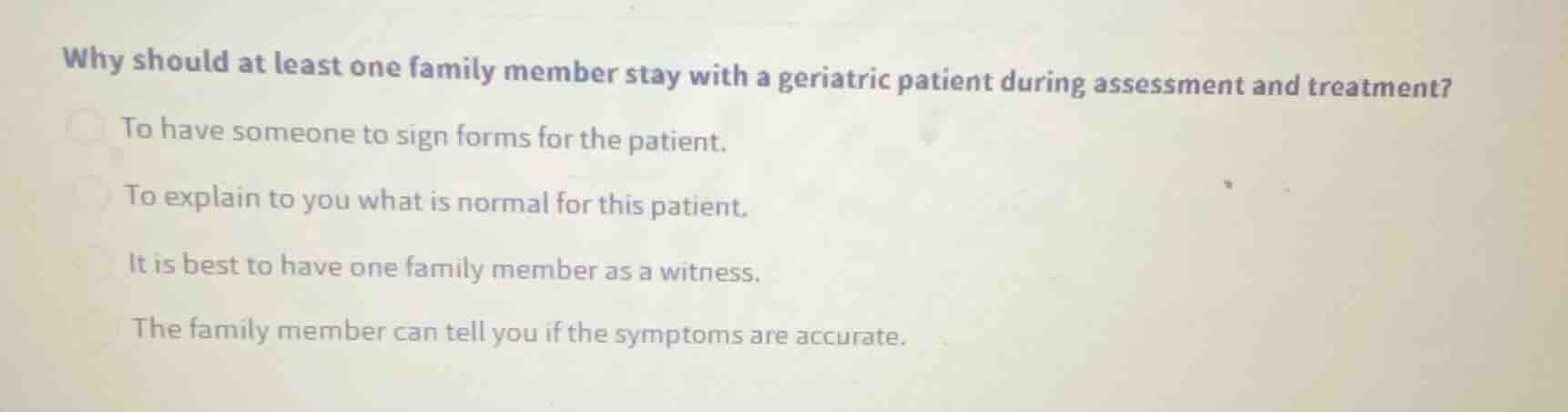
why should at least one family member stay with a geriatric patient during assessment and treatment?
to have someone to sign forms for the patient.
to explain to you what is normal for this patient.
it is best to have one family member as a witness.
the family member can tell you if the symptoms are accurate.
<pre_analysis>
{
"quality": "clear",
"question_count": 1,
"skills_matched": [
"direct_cot",
"multiple_choice_formatter",
"explain_then_answer",
"tutor"
],
"needs_drawing": false,
"concepts_used": [
"Medical History Taking"
],
"new_concepts": [
"Geriatric Assessment",
"Baseline Mental Status"
],
"current_concepts": [
"Medical History Taking",
"Geriatric Assessment",
"Baseline Mental Status"
]
}
</pre_analysis>
<reasoning>
Analyze the clinical challenge in geriatric assessment
Geriatric patients often present with complex medical histories, chronic conditions, and baseline cognitive or physical impairments. When assessing a geriatric patient, establishing their baseline status (what is "normal" for them) is critical to identifying acute changes.
Evaluate the role of family members
Using the Medical History Taking knowledge point, family members or long-term caregivers are invaluable sources of collateral history. They can immediately clarify whether a patient's current behavior, confusion, or physical limitation is a chronic baseline state or a sudden, acute deviation requiring urgent intervention.
Assess the given options
- To have someone to sign forms for the patient: While administrative consent is important, it is not the primary clinical reason for a family member to remain during active assessment and treatment.
- To explain to you what is normal for this patient: This is the primary clinical benefit, as it allows the provider to differentiate acute pathology from chronic baseline conditions.
- It is best to have one family member as a witness: While having a witness can be helpful, it is not the primary clinical reason for their presence during assessment.
- The family member can tell you if the symptoms are accurate: Symptoms are subjective experiences reported by the patient; a family member cannot validate the subjective accuracy of a symptom, but they can identify changes in objective signs and baseline behaviors.
</reasoning>
<answer>
<mcq-option>(A) To have someone to sign forms for the patient.</mcq-option>
<mcq-correct>(B) To explain to you what is normal for this patient.</mcq-correct>
<mcq-option>(C) It is best to have one family member as a witness.</mcq-option>
<mcq-option>(D) The family member can tell you if the symptoms are accurate.</mcq-option>
</answer>
<post_analysis>
{
"subject": "Natural Science",
"question_type": "Multiple Choice",
"knowledge_point": [
"Natural Science",
"Medicine",
"Geriatric Assessment"
]
}
</post_analysis>
Snap & solve any problem in the app
Get step-by-step solutions on Sovi AI
Photo-based solutions with guided steps
Explore more problems and detailed explanations
<pre_analysis>
{
"quality": "clear",
"question_count": 1,
"skills_matched": [
"direct_cot",
"multiple_choice_formatter",
"explain_then_answer",
"tutor"
],
"needs_drawing": false,
"concepts_used": [
"Medical History Taking"
],
"new_concepts": [
"Geriatric Assessment",
"Baseline Mental Status"
],
"current_concepts": [
"Medical History Taking",
"Geriatric Assessment",
"Baseline Mental Status"
]
}
</pre_analysis>
<reasoning>
Analyze the clinical challenge in geriatric assessment
Geriatric patients often present with complex medical histories, chronic conditions, and baseline cognitive or physical impairments. When assessing a geriatric patient, establishing their baseline status (what is "normal" for them) is critical to identifying acute changes.
Evaluate the role of family members
Using the Medical History Taking knowledge point, family members or long-term caregivers are invaluable sources of collateral history. They can immediately clarify whether a patient's current behavior, confusion, or physical limitation is a chronic baseline state or a sudden, acute deviation requiring urgent intervention.
Assess the given options
- To have someone to sign forms for the patient: While administrative consent is important, it is not the primary clinical reason for a family member to remain during active assessment and treatment.
- To explain to you what is normal for this patient: This is the primary clinical benefit, as it allows the provider to differentiate acute pathology from chronic baseline conditions.
- It is best to have one family member as a witness: While having a witness can be helpful, it is not the primary clinical reason for their presence during assessment.
- The family member can tell you if the symptoms are accurate: Symptoms are subjective experiences reported by the patient; a family member cannot validate the subjective accuracy of a symptom, but they can identify changes in objective signs and baseline behaviors.
</reasoning>
<answer>
<mcq-option>(A) To have someone to sign forms for the patient.</mcq-option>
<mcq-correct>(B) To explain to you what is normal for this patient.</mcq-correct>
<mcq-option>(C) It is best to have one family member as a witness.</mcq-option>
<mcq-option>(D) The family member can tell you if the symptoms are accurate.</mcq-option>
</answer>
<post_analysis>
{
"subject": "Natural Science",
"question_type": "Multiple Choice",
"knowledge_point": [
"Natural Science",
"Medicine",
"Geriatric Assessment"
]
}
</post_analysis>