QUESTION IMAGE
Question
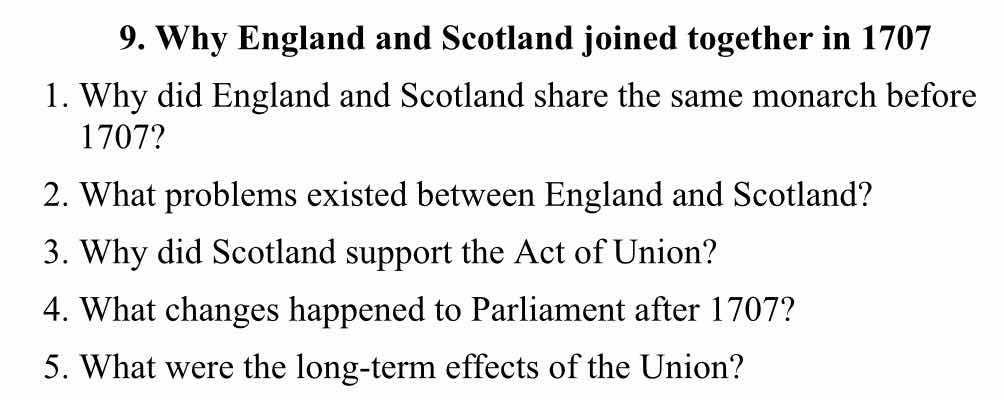
- why england and scotland joined together in 1707
- why did england and scotland share the same monarch before 1707?
- what problems existed between england and scotland?
- why did scotland support the act of union?
- what changes happened to parliament after 1707?
- what were the long-term effects of the union?
Union of the Crowns
The shared monarchy before 1707 stems from the Stuart Monarchy. In 1603, Queen Elizabeth I of England died without heirs. King James VI of Scotland, her cousin, inherited the English throne as James I, uniting both crowns under one ruler.
Anglo-Scottish Tensions
Despite sharing a monarch, they remained separate states with distinct parliaments, religions, and trade policies. Friction arose over trade barriers, religious differences, and England's foreign wars, which dragged Scotland in without Scottish consent.
Scottish Economic Crisis
Scotland faced severe financial ruin after the failure of the Darien Scheme, an ambitious attempt to establish a colony in Panama. Facing bankruptcy, Scotland supported the Act of Union in exchange for financial compensation (the "Equivalent") and access to England's global trade network.
Parliamentary Unification
The Act of Union dissolved both the English and Scottish Parliaments. They were replaced by a single, unified Parliament of Great Britain based at Westminster, which established Parliamentary Sovereignty over the newly created Kingdom of Great Britain.
Long-Term Consequences
The Union created a massive free-trade zone, fueling the Scottish Enlightenment and industrial growth. However, it also led to political centralization in London, the suppression of Highland culture, and persistent Jacobite rebellions seeking to restore the Stuart line.

Snap & solve any problem in the app
Get step-by-step solutions on Sovi AI
Photo-based solutions with guided steps
Explore more problems and detailed explanations
Question 1
England and Scotland shared a monarch before 1707 because of the Union of the Crowns in 1603, when King James VI of Scotland inherited the English throne as James I after the death of Queen Elizabeth I.
Question 2
The main problems included economic competition, trade barriers, religious differences, and political friction caused by England dragging Scotland into foreign conflicts without the consent of the Scottish Parliament.
Question 3
Scotland supported the Act of Union primarily due to severe economic distress following the failure of the Darien Scheme, which left the nation near bankruptcy. The Union offered financial compensation and access to England's lucrative colonial trade markets.
Question 4
After 1707, both the independent Scottish and English Parliaments were dissolved and replaced by a single, unified Parliament of Great Britain based at Westminster in London.
Question 5
The long-term effects included the creation of the Kingdom of Great Britain, rapid economic growth and industrialization in Scotland, the flourishing of the Scottish Enlightenment, and political centralization that sparked Jacobite uprisings.