QUESTION IMAGE
Question
why was brown v. board of education a significant case?
correct answer(s)
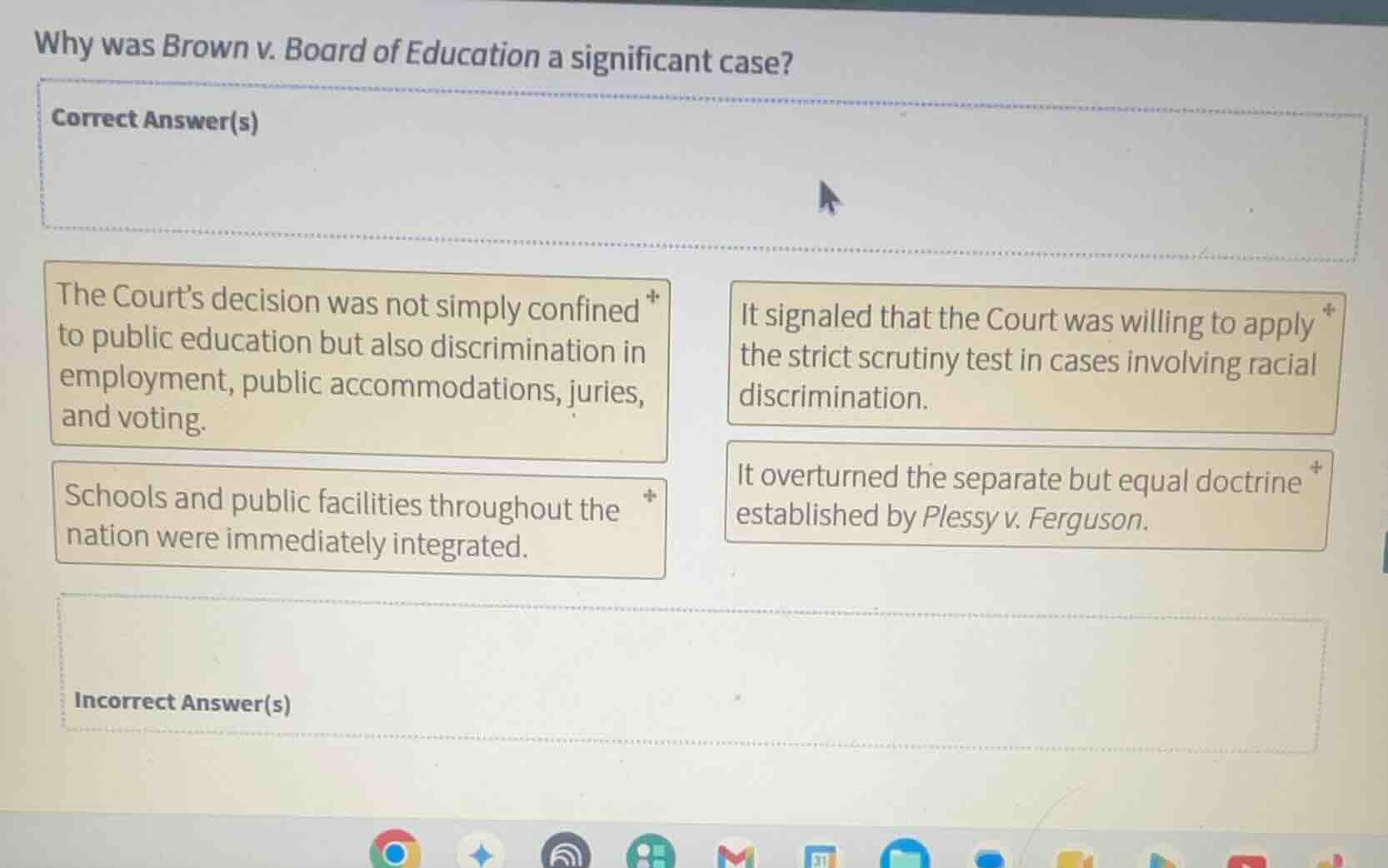
the courts decision was not simply confined to public education but also discrimination in employment, public accommodations, juries, and voting.
schools and public facilities throughout the nation were immediately integrated.
it signaled that the court was willing to apply the strict scrutiny test in cases involving racial discrimination.
it overturned the separate but equal doctrine established by plessy v. ferguson.
incorrect answer(s)
Analyze the historical impact of Brown v. Board of Education
The case of Brown v. Board of Education (1954) is a landmark Supreme Court decision that ruled racial segregation in public schools unconstitutional.
Evaluate each statement for historical accuracy
- "The Court's decision was not simply confined to public education but also discrimination in employment, public accommodations, juries, and voting."
Correct. The legal precedent established by Brown struck down the constitutional basis for state-sanctioned segregation across all public spheres, paving the way for civil rights challenges in employment, accommodations, juries, and voting.
- "It signaled that the Court was willing to apply the strict scrutiny test in cases involving racial discrimination."
Correct. Brown reinforced the application of strict scrutiny to state-sponsored racial classifications, requiring the government to prove a compelling interest for any such distinction.
- "It overturned the separate but equal doctrine established by Plessy v. Ferguson."
Correct. The ruling explicitly held that "separate educational facilities are inherently unequal," directly overturning the "separate but equal" doctrine of Plessy v. Ferguson (1896).
- "Schools and public facilities throughout the nation were immediately integrated."
Incorrect. Integration was not immediate. The Court's subsequent ruling in Brown II (1955) ordered integration with "all deliberate speed," which led to decades of resistance, delay, and gradual desegregation.
Categorize into Correct and Incorrect Answers
- Correct Answer(s):
- The Court's decision was not simply confined to public education but also discrimination in employment, public accommodations, juries, and voting.
- It signaled that the Court was willing to apply the strict scrutiny test in cases involving racial discrimination.
- It overturned the separate but equal doctrine established by Plessy v. Ferguson.
- Incorrect Answer(s):
- Schools and public facilities throughout the nation were immediately integrated.

Snap & solve any problem in the app
Get step-by-step solutions on Sovi AI
Photo-based solutions with guided steps
Explore more problems and detailed explanations
- Correct: The Court's decision was not simply confined to public education but also discrimination in employment, public accommodations, juries, and voting. (Correct answer)
- Correct: It signaled that the Court was willing to apply the strict scrutiny test in cases involving racial discrimination. (Correct answer)
- Correct: It overturned the separate but equal doctrine established by Plessy v. Ferguson. (Correct answer)
- Incorrect: Schools and public facilities throughout the nation were immediately integrated.