QUESTION IMAGE
Question
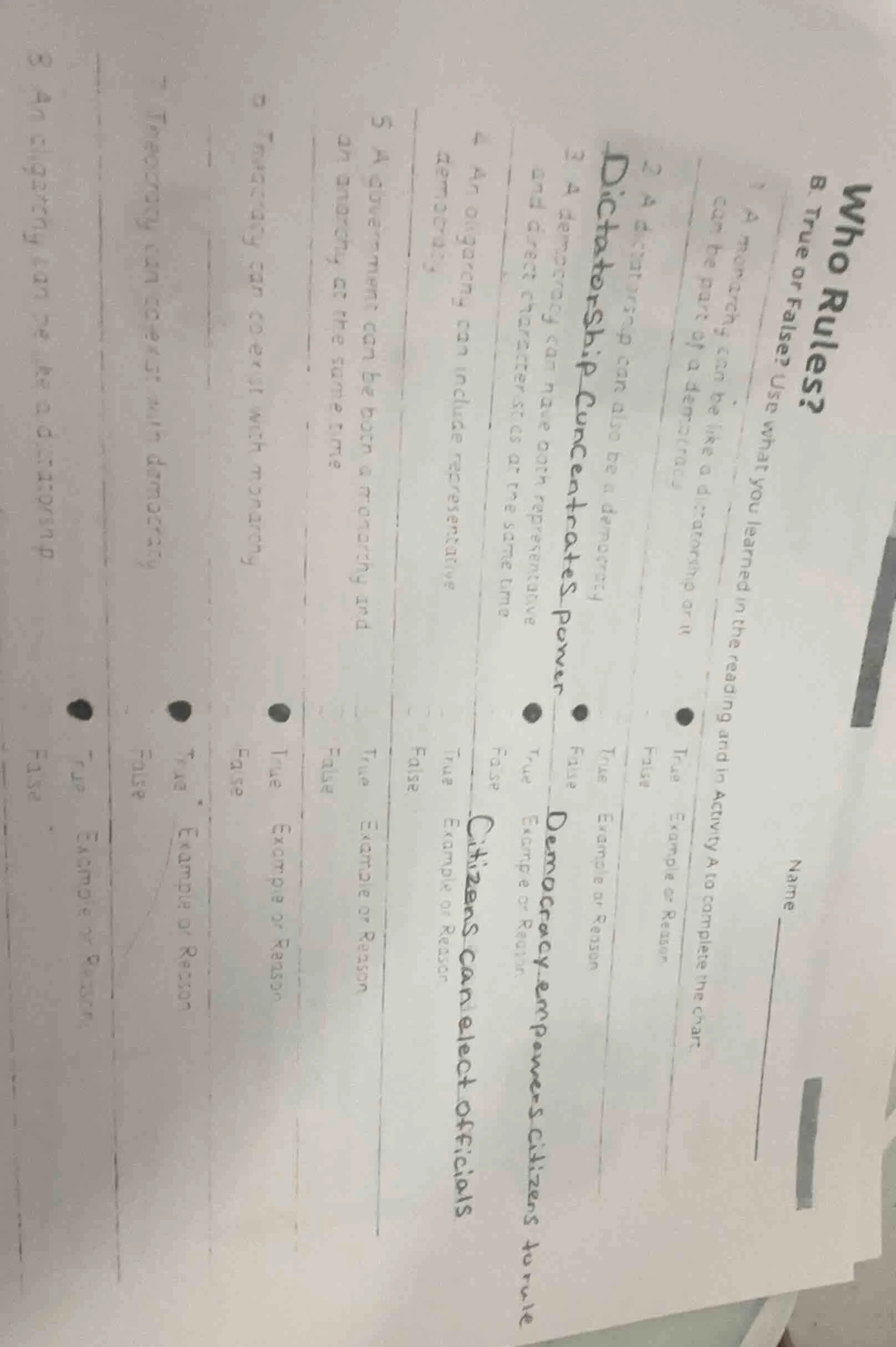
b. who rules?
1 a monarchy can be like a dictatorship or it can be part of a democracy
true false
example or reason
2 a dictatorship can also be a democracy
true false
example or reason
3 a democracy can have both representative and direct characteristics at the same time
true false
example or reason
democracy empowers citizens to rule
4 an oligarchy can include representative democracy?
true false
example or reason
citizens can elect officials
5 a government can be both a monarchy and an anarchy at the same time
true false
example or reason
6 a monarchy can coexist with monarchy
true false
example or reason
7 theocracy can coexist with democracy?
true false
example or reason
8 an oligarchy can be a dictatorship
true false
example or reason
To solve these true - false questions about different forms of government, we analyze each one based on the definitions and characteristics of monarchies, dictatorships, democracies, and oligarchies:
Question 1
- Explanation: A monarchy is a form of government where a single person (the monarch) rules, and it can be absolute (dictatorial, with the monarch having unrestricted power) or constitutional (where the monarch's power is limited and there can be democratic elements like a parliament). So the statement "A monarchy can be like a dictatorship or it can be part of a democracy" is true.
Question 2
- Explanation: A dictatorship is a system where power is concentrated in the hands of one person (the dictator) who has absolute control, and there are no democratic processes like free elections or citizen participation in decision - making. So the statement "A dictatorship can also be a democracy" is false.
Question 3
- Explanation: In a democracy, citizens have the right to vote for representatives (representative democracy) or directly participate in decision - making (direct democracy). So a democracy can have both representative and direct characteristics at the same time. The statement "A democracy can have both representative and direct characteristics at the same time" is true.
Question 4
- Explanation: An oligarchy is a form of government where a small group of people (like a few wealthy families, a political clique, etc.) holds power. This group can act as representatives of their own interests, and there is no broad - based citizen participation in the way a democracy has. So the statement "An oligarchy can include representative democracy" is false.
Question 5
- Explanation: An autocracy is a system where one person has absolute power (like a dictatorship), and an oligarchy is a system where a small group has power. These are distinct forms of non - democratic government, and a government can't be both an autocracy (one - person rule) and an oligarchy (rule by a group) at the same time. So the statement "A government can be both a monarchy and an oligarchy at the same time" (assuming a mis - type and it should be autocracy and oligarchy) is false. But if we take the statement as is, a monarchy (rule by one family, essentially a form of autocracy) and an oligarchy (rule by a group) are different, and a government can't be both in the sense of power structure (one person vs a group). So the statement is false.
Question 6
- Explanation: An oligarchy is rule by a small group, and a monarchy is rule by a single family or person. These are different power structures, and an oligarchy can't co - exist with a monarchy in terms of the core power - holding mechanism (a group vs an individual). So the statement "An oligarchy can co - exist with a monarchy" is false.
Question 7
- Explanation: A theocracy is a system where religious leaders hold power and make decisions based on religious law. A democracy is based on citizen participation and secular or broad - based decision - making. These are fundamentally different, and a theocracy can't co - exist with a democracy as the power in a theocracy is not based on democratic principles of citizen choice. So the statement "A theocracy can co - exist with democracy" is false.
Question 8
- Explanation: A democracy is based on the principle of citizen participation (either directly or through representatives) in governance. An oligarchy is rule by a small group, and these two systems are incompatible as the power - holding and de…

Snap & solve any problem in the app
Get step-by-step solutions on Sovi AI
Photo-based solutions with guided steps
Explore more problems and detailed explanations
s:
- True
- False
- True
- False
- False
- False
- False
- False