Sovi.AI - AI Math Tutor

Scan to solve math questions

QUESTION IMAGE

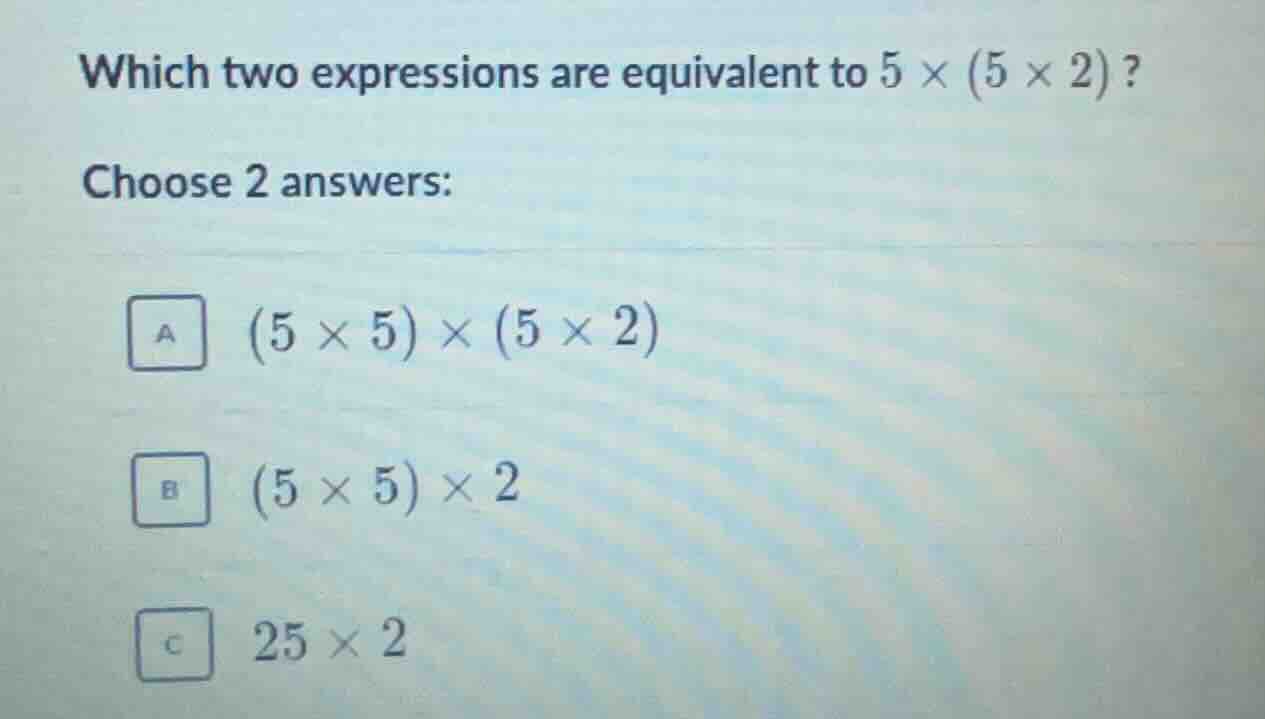
which two expressions are equivalent to (5 \\times (5 \\times 2))? choo…

Question

which two expressions are equivalent to (5 \times (5 \times 2))?

choose 2 answers:

a ((5 \times 5) \times (5 \times 2))

b ((5 \times 5) \times 2)

c (25 \times 2)

Explanation:

Response

<pre_analysis>
{
"quality": "clear",
"question_count": 1,
"skills_matched": [
"step_cot",
"multiple_choice_formatter",
"explain_then_answer",
"tutor"
],
"needs_drawing": false,
"concepts_used": [
"Basic Multiplication",
"Associative Property"
],
"new_concepts": [
"Equivalent Expressions"
],
"current_concepts": [
"Basic Multiplication",
"Associative Property",
"Equivalent Expressions"
]
}
</pre_analysis>

<reasoning>

Evaluate the original expression

We calculate the value of the given expression:
\[
5 \times (5 \times 2)
\]
Using Basic Multiplication:
\[
5 \times 2 = 10
\]
Then:
\[
5 \times 10 = 50
\]

Apply the associative property

Using the Associative Property of multiplication, we can regroup the factors:
\[
5 \times (5 \times 2) = (5 \times 5) \times 2
\]
This matches option (B).

Simplify the regrouped expression

We simplify the grouped terms:
\[
(5 \times 5) \times 2 = 25 \times 2
\]
This matches option (C).

Verify the remaining option

We evaluate option (A):
\[
(5 \times 5) \times (5 \times 2) = 25 \times 10 = 250
\]
Since \(250
eq 50\), option (A) is incorrect.
</reasoning>

<answer>
<mcq-option>(A) \((5 \times 5) \times (5 \times 2)\)</mcq-option>
<mcq-correct>(B) \((5 \times 5) \times 2\)</mcq-correct>
<mcq-correct>(C) \(25 \times 2\)</mcq-correct>
</answer>

<post_analysis>
{
"subject": "Mathematics",
"question_type": "Multiple Choice",
"knowledge_point": [
"Mathematics",
"Algebra",
"Associative Property"
]
}
</post_analysis>

Answer:

<pre_analysis>
{
"quality": "clear",
"question_count": 1,
"skills_matched": [
"step_cot",
"multiple_choice_formatter",
"explain_then_answer",
"tutor"
],
"needs_drawing": false,
"concepts_used": [
"Basic Multiplication",
"Associative Property"
],
"new_concepts": [
"Equivalent Expressions"
],
"current_concepts": [
"Basic Multiplication",
"Associative Property",
"Equivalent Expressions"
]
}
</pre_analysis>

<reasoning>

Evaluate the original expression

We calculate the value of the given expression:
\[
5 \times (5 \times 2)
\]
Using Basic Multiplication:
\[
5 \times 2 = 10
\]
Then:
\[
5 \times 10 = 50
\]

Apply the associative property

Using the Associative Property of multiplication, we can regroup the factors:
\[
5 \times (5 \times 2) = (5 \times 5) \times 2
\]
This matches option (B).

Simplify the regrouped expression

We simplify the grouped terms:
\[
(5 \times 5) \times 2 = 25 \times 2
\]
This matches option (C).

Verify the remaining option

We evaluate option (A):
\[
(5 \times 5) \times (5 \times 2) = 25 \times 10 = 250
\]
Since \(250
eq 50\), option (A) is incorrect.
</reasoning>

<answer>
<mcq-option>(A) \((5 \times 5) \times (5 \times 2)\)</mcq-option>
<mcq-correct>(B) \((5 \times 5) \times 2\)</mcq-correct>
<mcq-correct>(C) \(25 \times 2\)</mcq-correct>
</answer>

<post_analysis>
{
"subject": "Mathematics",
"question_type": "Multiple Choice",
"knowledge_point": [
"Mathematics",
"Algebra",
"Associative Property"
]
}
</post_analysis>