QUESTION IMAGE
Question
which of these was a result of the exchange shown in the map above?
a. europeans became infected with diseases such as smallpox.
b. native americans became addicted to tobacco.
c. europeans became dependent on american crops.
d. native americans rejected european horses and livestock.
<pre_analysis>
{
"quality": "clear",
"question_count": 1,
"skills_matched": [
"direct_cot",
"multiple_choice_formatter",
"explain_then_answer",
"tutor"
],
"needs_drawing": false,
"concepts_used": [
"Historical Evidence"
],
"new_concepts": [
"Columbian Exchange",
"Old World and New World"
],
"current_concepts": [
"Historical Evidence",
"Columbian Exchange",
"Old World and New World"
]
}
</pre_analysis>
<reasoning>
Analyze the map and question
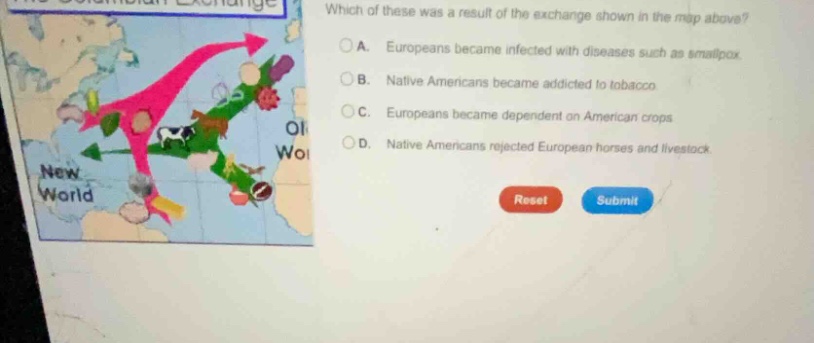
The map illustrates "The Columbian Exchange" between the New World (the Americas) and the Old World (Europe, Africa, and Asia). The pink arrow shows goods, crops, and other items moving from the New World to the Old World, while the green arrow shows items moving from the Old World to the New World. The question asks for a result of this exchange based on the options provided.
Evaluate Option A
Option A states: "Europeans became infected with diseases such as smallpox."
- Smallpox was native to the Old World and was brought to the New World by European explorers, devastating Native American populations. It did not originate in the New World to infect Europeans. Thus, this statement is historically incorrect.
Evaluate Option B
Option B states: "Native Americans became addicted to tobacco."
- Tobacco is native to the Americas (New World) and was used by Native Americans long before the arrival of Europeans. It was exported to Europe, where it became highly popular. Thus, this statement is incorrect.
Evaluate Option C
Option C states: "Europeans became dependent on American crops."
- The New World introduced highly nutritious and easily cultivated crops such as potatoes, maize (corn), cassava, and sweet potatoes to the Old World. These crops became staple foods in Europe, significantly boosting population growth and agricultural productivity, leading to a strong reliance on them. This is a historically accurate result of the exchange.
Evaluate Option D
Option D states: "Native Americans rejected European horses and livestock."
- Native Americans did not reject European livestock. On the contrary, many indigenous groups, particularly Great Plains tribes, rapidly integrated horses into their culture, transportation, and hunting practices. Thus, this statement is incorrect.
Synthesize historical evidence
Using Historical Evidence, we confirm that the introduction of highly productive American crops like potatoes and maize revolutionized European agriculture and diets, making European populations highly dependent on these New World crops.
</reasoning>
<answer>
<mcq-option>(A) Europeans became infected with diseases such as smallpox.</mcq-option>
<mcq-option>(B) Native Americans became addicted to tobacco.</mcq-option>
<mcq-correct>(C) Europeans became dependent on American crops.</mcq-correct>
<mcq-option>(D) Native Americans rejected European horses and livestock.</mcq-option>
</answer>
<post_analysis>
{
"subject": "Social Science",
"question_type": "Multiple Choice",
"knowledge_point": [
"Social Science",
"History",
"Columbian Exchange"
]
}
</post_analysis>
Snap & solve any problem in the app
Get step-by-step solutions on Sovi AI
Photo-based solutions with guided steps
Explore more problems and detailed explanations
<pre_analysis>
{
"quality": "clear",
"question_count": 1,
"skills_matched": [
"direct_cot",
"multiple_choice_formatter",
"explain_then_answer",
"tutor"
],
"needs_drawing": false,
"concepts_used": [
"Historical Evidence"
],
"new_concepts": [
"Columbian Exchange",
"Old World and New World"
],
"current_concepts": [
"Historical Evidence",
"Columbian Exchange",
"Old World and New World"
]
}
</pre_analysis>
<reasoning>
Analyze the map and question
The map illustrates "The Columbian Exchange" between the New World (the Americas) and the Old World (Europe, Africa, and Asia). The pink arrow shows goods, crops, and other items moving from the New World to the Old World, while the green arrow shows items moving from the Old World to the New World. The question asks for a result of this exchange based on the options provided.
Evaluate Option A
Option A states: "Europeans became infected with diseases such as smallpox."
- Smallpox was native to the Old World and was brought to the New World by European explorers, devastating Native American populations. It did not originate in the New World to infect Europeans. Thus, this statement is historically incorrect.
Evaluate Option B
Option B states: "Native Americans became addicted to tobacco."
- Tobacco is native to the Americas (New World) and was used by Native Americans long before the arrival of Europeans. It was exported to Europe, where it became highly popular. Thus, this statement is incorrect.
Evaluate Option C
Option C states: "Europeans became dependent on American crops."
- The New World introduced highly nutritious and easily cultivated crops such as potatoes, maize (corn), cassava, and sweet potatoes to the Old World. These crops became staple foods in Europe, significantly boosting population growth and agricultural productivity, leading to a strong reliance on them. This is a historically accurate result of the exchange.
Evaluate Option D
Option D states: "Native Americans rejected European horses and livestock."
- Native Americans did not reject European livestock. On the contrary, many indigenous groups, particularly Great Plains tribes, rapidly integrated horses into their culture, transportation, and hunting practices. Thus, this statement is incorrect.
Synthesize historical evidence
Using Historical Evidence, we confirm that the introduction of highly productive American crops like potatoes and maize revolutionized European agriculture and diets, making European populations highly dependent on these New World crops.
</reasoning>
<answer>
<mcq-option>(A) Europeans became infected with diseases such as smallpox.</mcq-option>
<mcq-option>(B) Native Americans became addicted to tobacco.</mcq-option>
<mcq-correct>(C) Europeans became dependent on American crops.</mcq-correct>
<mcq-option>(D) Native Americans rejected European horses and livestock.</mcq-option>
</answer>
<post_analysis>
{
"subject": "Social Science",
"question_type": "Multiple Choice",
"knowledge_point": [
"Social Science",
"History",
"Columbian Exchange"
]
}
</post_analysis>