Sovi.AI - AI Math Tutor

Scan to solve math questions

QUESTION IMAGE

which of these covers the epiphyses of long bones? multiple choice medu…

Question

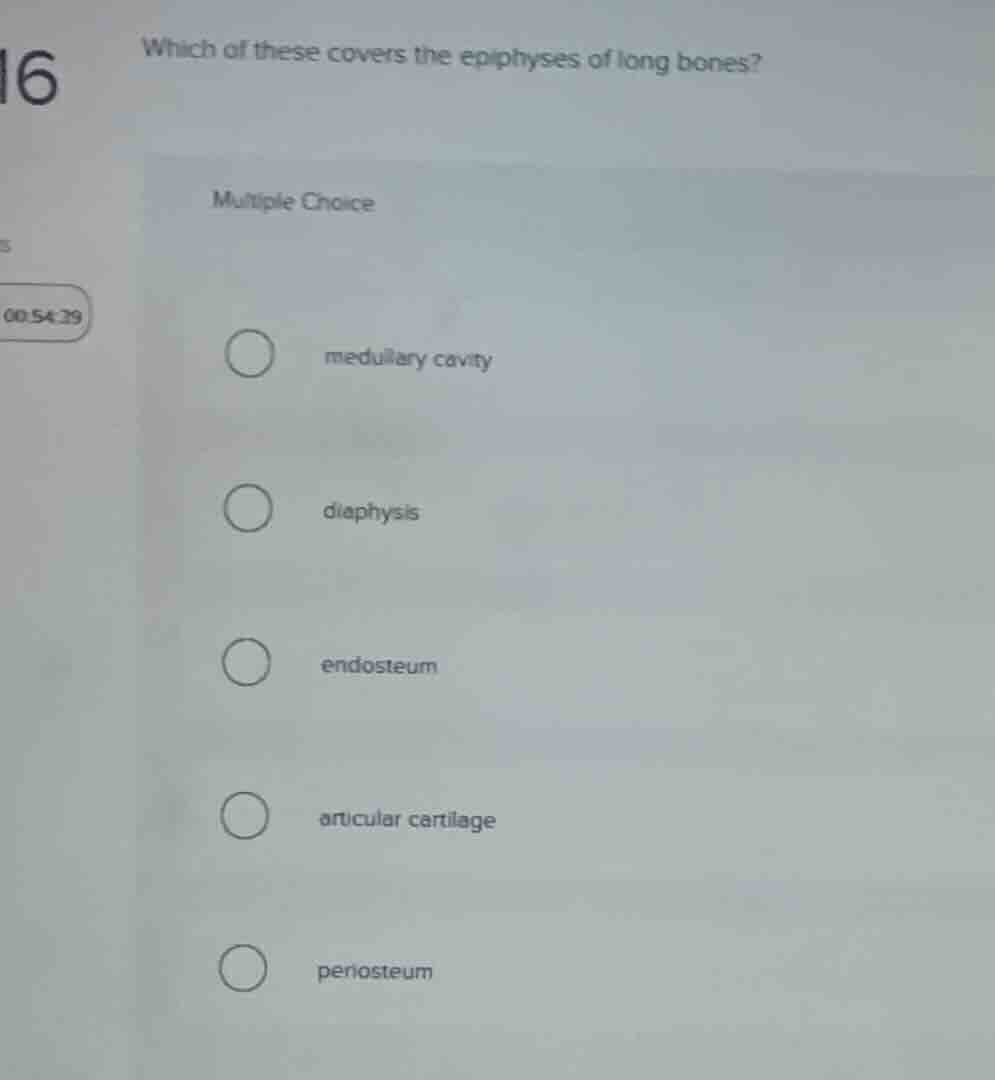
which of these covers the epiphyses of long bones?

multiple choice

medullary cavity

diaphysis

endosteum

articular cartilage

periosteum

Explanation:

Response

<pre_analysis>
{
"quality": "clear",
"question_count": 1,
"skills_matched": [
"direct_cot",
"multiple_choice_formatter",
"explain_then_answer",
"tutor",
"mastery_adaptive_brevity"
],
"needs_drawing": false,
"concepts_used": [
"Long Bone Anatomy",
"Epiphysis"
],
"new_concepts": [
"Articular Cartilage"
],
"current_concepts": [
"Long Bone Anatomy",
"Epiphysis",
"Articular Cartilage"
]
}
</pre_analysis>

<reasoning>

Identify the target anatomical structure

Using the Long Bone Anatomy and Epiphysis knowledge points

  • The question asks what covers the epiphyses (the expanded ends) of long bones.
  • The epiphyses are the proximal and distal ends of a long bone that articulate with other bones to form joints.

Evaluate the anatomical options

  • medullary cavity: The hollow chamber within the diaphysis containing yellow marrow.
  • diaphysis: The shaft or central main portion of a long bone.
  • endosteum: The thin vascular membrane lining the inner medullary cavity.
  • articular cartilage: A thin layer of hyaline cartilage covering the epiphysis where the bone forms a joint.
  • periosteum: A dense fibrous membrane covering the outer surface of the diaphysis, but it does not cover the articular surfaces of the epiphyses.

Select the correct covering

  • The outer surface of the epiphysis at a joint is covered by hyaline cartilage, specifically called articular cartilage, to reduce friction and absorb shock.

</reasoning>

<answer>
<mcq-option>medullary cavity</mcq-option>
<mcq-option>diaphysis</mcq-option>
<mcq-option>endosteum</mcq-option>
<mcq-correct>articular cartilage</mcq-correct>
<mcq-option>periosteum</mcq-option>
</answer>

<post_analysis>
{
"subject": "Natural Science",
"question_type": "Multiple Choice",
"knowledge_point": [
"Natural Science",
"Anatomy",
"Long Bone Anatomy"
]
}
</post_analysis>

Answer:

<pre_analysis>
{
"quality": "clear",
"question_count": 1,
"skills_matched": [
"direct_cot",
"multiple_choice_formatter",
"explain_then_answer",
"tutor",
"mastery_adaptive_brevity"
],
"needs_drawing": false,
"concepts_used": [
"Long Bone Anatomy",
"Epiphysis"
],
"new_concepts": [
"Articular Cartilage"
],
"current_concepts": [
"Long Bone Anatomy",
"Epiphysis",
"Articular Cartilage"
]
}
</pre_analysis>

<reasoning>

Identify the target anatomical structure

Using the Long Bone Anatomy and Epiphysis knowledge points

  • The question asks what covers the epiphyses (the expanded ends) of long bones.
  • The epiphyses are the proximal and distal ends of a long bone that articulate with other bones to form joints.

Evaluate the anatomical options

  • medullary cavity: The hollow chamber within the diaphysis containing yellow marrow.
  • diaphysis: The shaft or central main portion of a long bone.
  • endosteum: The thin vascular membrane lining the inner medullary cavity.
  • articular cartilage: A thin layer of hyaline cartilage covering the epiphysis where the bone forms a joint.
  • periosteum: A dense fibrous membrane covering the outer surface of the diaphysis, but it does not cover the articular surfaces of the epiphyses.

Select the correct covering

  • The outer surface of the epiphysis at a joint is covered by hyaline cartilage, specifically called articular cartilage, to reduce friction and absorb shock.

</reasoning>

<answer>
<mcq-option>medullary cavity</mcq-option>
<mcq-option>diaphysis</mcq-option>
<mcq-option>endosteum</mcq-option>
<mcq-correct>articular cartilage</mcq-correct>
<mcq-option>periosteum</mcq-option>
</answer>

<post_analysis>
{
"subject": "Natural Science",
"question_type": "Multiple Choice",
"knowledge_point": [
"Natural Science",
"Anatomy",
"Long Bone Anatomy"
]
}
</post_analysis>