QUESTION IMAGE
Question
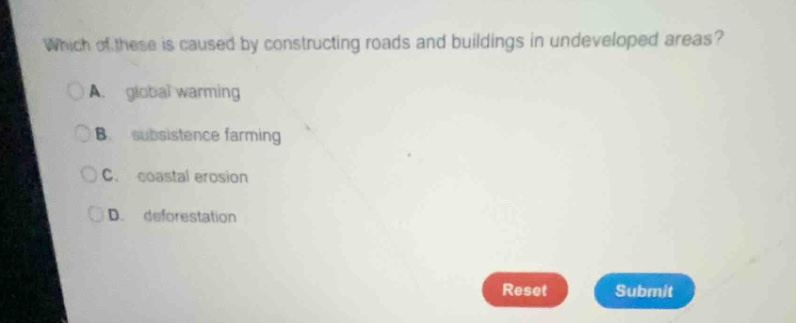
which of these is caused by constructing roads and buildings in undeveloped areas?
a. global warming
b. subsistence farming
c. coastal erosion
d. deforestation
<pre_analysis>
{
"quality": "clear",
"question_count": 1,
"skills_matched": [
"direct_cot",
"multiple_choice_formatter",
"explain_then_answer",
"tutor",
"mastery_adaptive_brevity"
],
"needs_drawing": false,
"concepts_used": [
"Human Impact on Ecosystems",
"Urbanization Effects"
],
"new_concepts": [],
"current_concepts": [
"Human Impact on Ecosystems",
"Urbanization Effects",
"Deforestation"
]
}
</pre_analysis>
<reasoning>
Analyze the impact of construction
Using the Human Impact on Ecosystems and Urbanization Effects knowledge points
- Constructing roads and buildings in undeveloped areas (such as forests or grasslands) requires clearing the existing natural vegetation and trees.
- This direct removal of forest cover to repurpose the land for human infrastructure is defined as deforestation.
Evaluate the given options
- A. global warming: While deforestation contributes to global warming over time by reducing carbon sinks, constructing roads and buildings is not the direct, immediate definition of global warming itself.
- B. subsistence farming: This is a form of agriculture where farmers grow food to feed themselves, not a consequence of urban construction.
- C. coastal erosion: This is the loss of coastal land due to wave action and currents, which is not directly caused by general inland construction.
- D. deforestation: This is the direct and immediate result of clearing forested or undeveloped land to make way for roads and buildings.
</reasoning>
<answer>
<mcq-option>(A) global warming</mcq-option>
<mcq-option>(B) subsistence farming</mcq-option>
<mcq-option>(C) coastal erosion</mcq-option>
<mcq-correct>(D) deforestation</mcq-correct>
</answer>
<post_analysis>
{
"subject": "Natural Science",
"question_type": "Multiple Choice",
"knowledge_point": [
"Natural Science",
"Environmental Science",
"Human Impact on Ecosystems"
]
}
</post_analysis>
Snap & solve any problem in the app
Get step-by-step solutions on Sovi AI
Photo-based solutions with guided steps
Explore more problems and detailed explanations
<pre_analysis>
{
"quality": "clear",
"question_count": 1,
"skills_matched": [
"direct_cot",
"multiple_choice_formatter",
"explain_then_answer",
"tutor",
"mastery_adaptive_brevity"
],
"needs_drawing": false,
"concepts_used": [
"Human Impact on Ecosystems",
"Urbanization Effects"
],
"new_concepts": [],
"current_concepts": [
"Human Impact on Ecosystems",
"Urbanization Effects",
"Deforestation"
]
}
</pre_analysis>
<reasoning>
Analyze the impact of construction
Using the Human Impact on Ecosystems and Urbanization Effects knowledge points
- Constructing roads and buildings in undeveloped areas (such as forests or grasslands) requires clearing the existing natural vegetation and trees.
- This direct removal of forest cover to repurpose the land for human infrastructure is defined as deforestation.
Evaluate the given options
- A. global warming: While deforestation contributes to global warming over time by reducing carbon sinks, constructing roads and buildings is not the direct, immediate definition of global warming itself.
- B. subsistence farming: This is a form of agriculture where farmers grow food to feed themselves, not a consequence of urban construction.
- C. coastal erosion: This is the loss of coastal land due to wave action and currents, which is not directly caused by general inland construction.
- D. deforestation: This is the direct and immediate result of clearing forested or undeveloped land to make way for roads and buildings.
</reasoning>
<answer>
<mcq-option>(A) global warming</mcq-option>
<mcq-option>(B) subsistence farming</mcq-option>
<mcq-option>(C) coastal erosion</mcq-option>
<mcq-correct>(D) deforestation</mcq-correct>
</answer>
<post_analysis>
{
"subject": "Natural Science",
"question_type": "Multiple Choice",
"knowledge_point": [
"Natural Science",
"Environmental Science",
"Human Impact on Ecosystems"
]
}
</post_analysis>