QUESTION IMAGE
Question
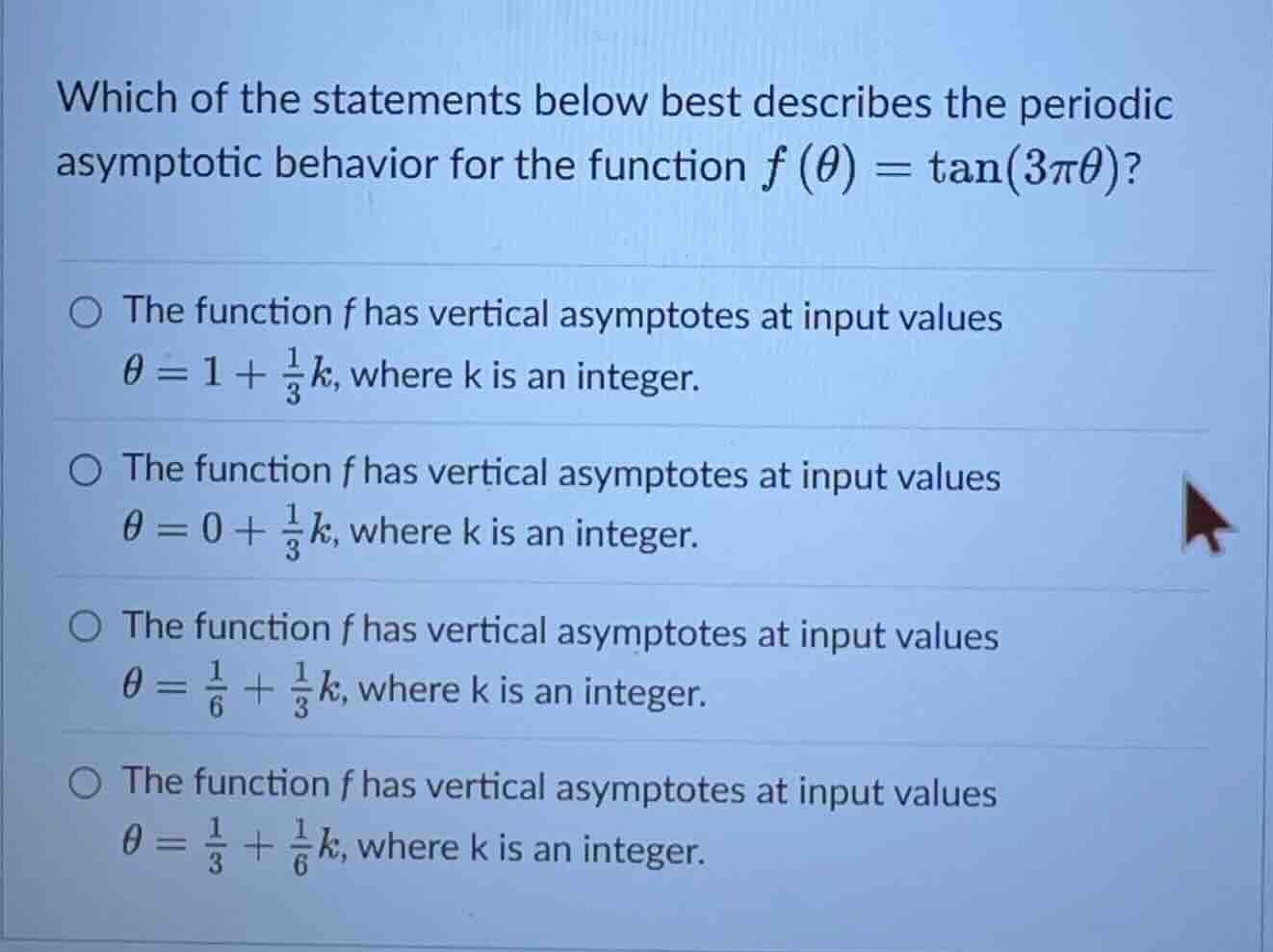
which of the statements below best describes the periodic asymptotic behavior for the function (f(\theta) = \tan(3pi\theta))?
- the function (f) has vertical asymptotes at input values (\theta = 1 + \frac{1}{3}k), where (k) is an integer.
- the function (f) has vertical asymptotes at input values (\theta = 0 + \frac{1}{3}k), where (k) is an integer.
- the function (f) has vertical asymptotes at input values (\theta = \frac{1}{6} + \frac{1}{3}k), where (k) is an integer.
- the function (f) has vertical asymptotes at input values (\theta = \frac{1}{3} + \frac{1}{6}k), where (k) is an integer.
Identify the asymptote condition for the tangent function
Using the Tangent Function Period knowledge point
$$
LATEXBLOCK0
$$
Solve for the input variable
Using the Tangent Function Period knowledge point
$$
LATEXBLOCK1
$$
Match with the given multiple-choice options
Using the Tangent Function Period knowledge point
$$
LATEXBLOCK2
$$

Snap & solve any problem in the app
Get step-by-step solutions on Sovi AI
Photo-based solutions with guided steps
Explore more problems and detailed explanations
- The function f has vertical asymptotes at input values \(\theta = 1 + \frac{1}{3}k\), where k is an integer.
- The function f has vertical asymptotes at input values \(\theta = 0 + \frac{1}{3}k\), where k is an integer.
- The function f has vertical asymptotes at input values \(\theta = \frac{1}{6} + \frac{1}{3}k\), where k is an integer. (Correct answer)
- The function f has vertical asymptotes at input values \(\theta = \frac{1}{3} + \frac{1}{6}k\), where k is an integer.