QUESTION IMAGE
Question
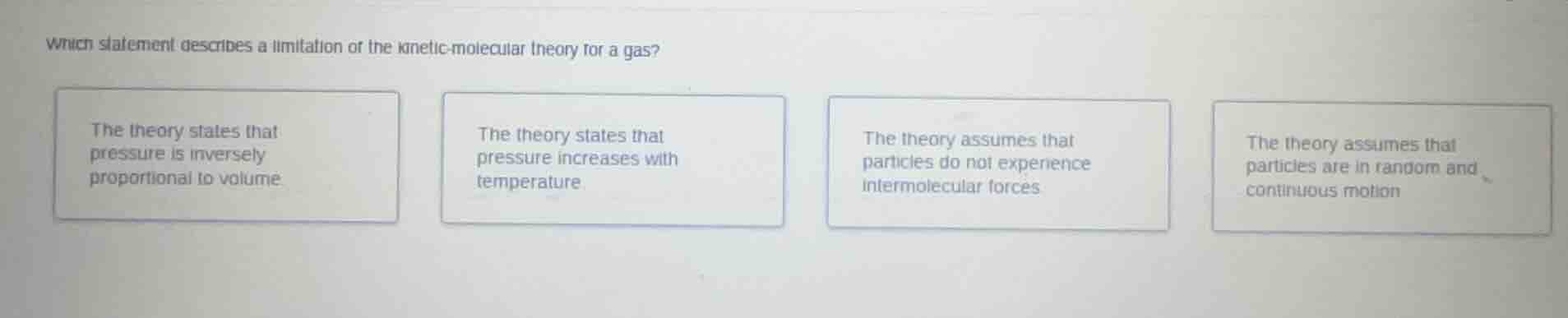
which statement describes a limitation of the kinetic-molecular theory for a gas?
- the theory states that pressure is inversely proportional to volume
- the theory states that pressure increases with temperature
- the theory assumes that particles do not experience intermolecular forces
- the theory assumes that particles are in random and continuous motion
Identify the core assumptions of kinetic-molecular theory
The kinetic-molecular theory (KMT) describes the behavior of an ideal gas based on several postulates, including:
- Gas particles are in constant, random, straight-line motion.
- The actual volume of gas particles is negligible compared to the total volume of the container.
- There are no attractive or repulsive intermolecular forces between gas particles.
- Collisions between particles are perfectly elastic.
Determine the limitation of the theory
Real gases deviate from ideal behavior because real gas particles do have finite volumes and do experience intermolecular attractions, especially under high pressure and low temperature. Therefore, assuming that particles do not experience intermolecular forces is a major simplification and a key limitation of KMT when applied to real gases.
Evaluate the given options
- Option 1: "The theory states that pressure is inversely proportional to volume" — This is Boyle's law, which is a consequence of KMT, not a limitation.
- Option 2: "The theory states that pressure increases with temperature" — This is Gay-Lussac's law, also a consequence of KMT, not a limitation.
- Option 3: "The theory assumes that particles do not experience intermolecular forces" — This is an assumption of KMT that fails for real gases, representing a major limitation.
- Option 4: "The theory assumes that particles are in random and continuous motion" — This is a standard postulate of KMT, not a limitation.

Snap & solve any problem in the app
Get step-by-step solutions on Sovi AI
Photo-based solutions with guided steps
Explore more problems and detailed explanations
- The theory states that pressure is inversely proportional to volume
- The theory states that pressure increases with temperature
- The theory assumes that particles do not experience intermolecular forces (Correct answer)
- The theory assumes that particles are in random and continuous motion