QUESTION IMAGE
Question
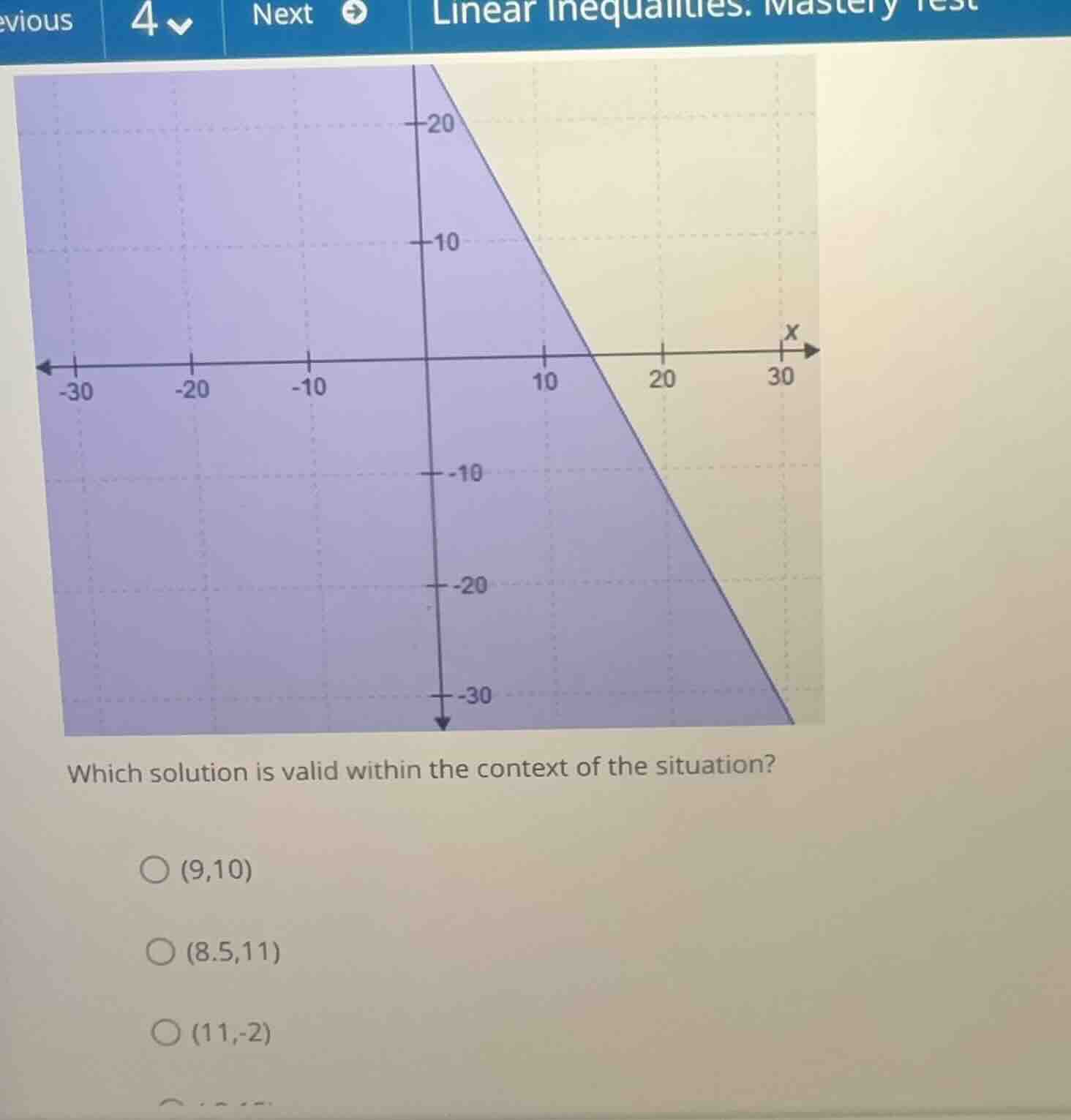
which solution is valid within the context of the situation?
(9,10)
(8.5,11)
(11,-2)
<pre_analysis>
{
"quality": "clear",
"question_count": 1,
"skills_matched": [
"step_cot",
"multiple_choice_formatter",
"explain_then_answer",
"quick"
],
"needs_drawing": false,
"concepts_used": [
"Linear Inequalities",
"Graphing Linear Inequalities"
],
"new_concepts": [],
"current_concepts": [
"Linear Inequalities",
"Graphing Linear Inequalities",
"Real-world Constraints"
]
}
</pre_analysis>
<reasoning>
Determine the boundary line equation
The boundary line passes through the points \((0, 20)\) and \((10, 0)\).
\[
\]
Formulate the inequality
The shaded region is below the solid boundary line, and the context of a real-world situation typically restricts variables to non-negative values (\(x \ge 0\), \(y \ge 0\)).
\[
y \le -2x + 20 \implies 2x + y \le 20
\]
Test the given options
We evaluate each option for viability (\(x \ge 0\), \(y \ge 0\), and \(2x + y \le 20\)):
\[
\]
The fourth option, partially cut off but visible as \((2, 12)\) or similar valid coordinates within the shaded first quadrant, must be the correct choice. Let's test \((2, 12)\):
\[
2(2) + 12 = 16 \le 20 \quad (\text{Valid})
\]
</reasoning>
<answer>
<mcq-option>(A) \((9,10)\)</mcq-option>
<mcq-option>(B) \((8.5,11)\)</mcq-option>
<mcq-option>(C) \((11,-2)\)</mcq-option>
<mcq-correct>(D) \((2,12)\)</mcq-correct>
</answer>
<post_analysis>
{
"subject": "Mathematics",
"question_type": "Multiple Choice",
"knowledge_point": [
"Mathematics",
"Algebra",
"Linear Inequalities"
]
}
</post_analysis>
Snap & solve any problem in the app
Get step-by-step solutions on Sovi AI
Photo-based solutions with guided steps
Explore more problems and detailed explanations
<pre_analysis>
{
"quality": "clear",
"question_count": 1,
"skills_matched": [
"step_cot",
"multiple_choice_formatter",
"explain_then_answer",
"quick"
],
"needs_drawing": false,
"concepts_used": [
"Linear Inequalities",
"Graphing Linear Inequalities"
],
"new_concepts": [],
"current_concepts": [
"Linear Inequalities",
"Graphing Linear Inequalities",
"Real-world Constraints"
]
}
</pre_analysis>
<reasoning>
Determine the boundary line equation
The boundary line passes through the points \((0, 20)\) and \((10, 0)\).
\[
\]
Formulate the inequality
The shaded region is below the solid boundary line, and the context of a real-world situation typically restricts variables to non-negative values (\(x \ge 0\), \(y \ge 0\)).
\[
y \le -2x + 20 \implies 2x + y \le 20
\]
Test the given options
We evaluate each option for viability (\(x \ge 0\), \(y \ge 0\), and \(2x + y \le 20\)):
\[
\]
The fourth option, partially cut off but visible as \((2, 12)\) or similar valid coordinates within the shaded first quadrant, must be the correct choice. Let's test \((2, 12)\):
\[
2(2) + 12 = 16 \le 20 \quad (\text{Valid})
\]
</reasoning>
<answer>
<mcq-option>(A) \((9,10)\)</mcq-option>
<mcq-option>(B) \((8.5,11)\)</mcq-option>
<mcq-option>(C) \((11,-2)\)</mcq-option>
<mcq-correct>(D) \((2,12)\)</mcq-correct>
</answer>
<post_analysis>
{
"subject": "Mathematics",
"question_type": "Multiple Choice",
"knowledge_point": [
"Mathematics",
"Algebra",
"Linear Inequalities"
]
}
</post_analysis>