QUESTION IMAGE
Question
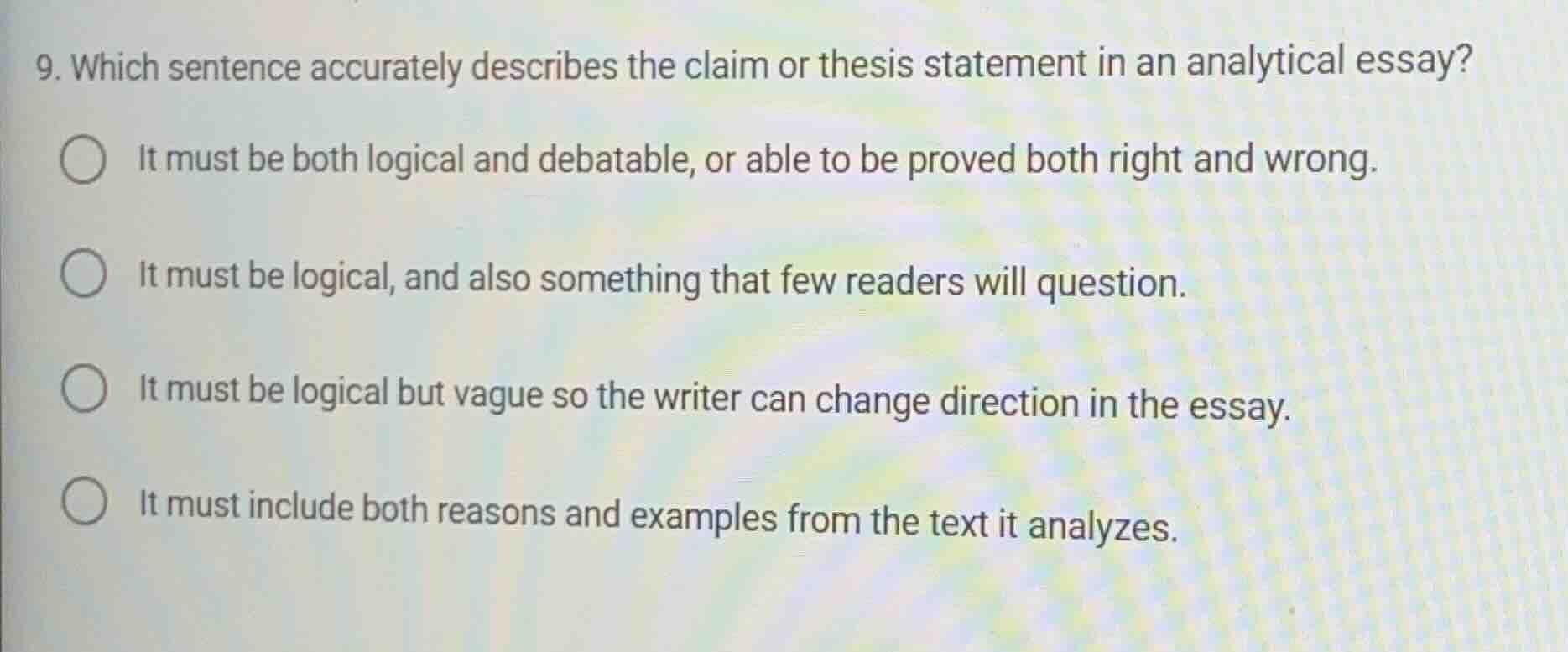
- which sentence accurately describes the claim or thesis statement in an analytical essay?
it must be both logical and debatable, or able to be proved both right and wrong.
it must be logical, and also something that few readers will question.
it must be logical but vague so the writer can change direction in the essay.
it must include both reasons and examples from the text it analyzes.
Define analytical thesis
An analytical thesis statement must present a clear, logical claim that is debatable. A strong thesis is not a simple statement of fact; it must be an argument that requires evidence to prove, meaning reasonable people could disagree with it (debatable).
Evaluate first option
The first option states: "It must be both logical and debatable, or able to be proved both right and wrong." This aligns with the academic definition of a thesis statement, which must be logical (supported by reasoning) and debatable (not a consensus fact).
Evaluate second option
The second option states: "It must be logical, and also something that few readers will question." If few readers question it, the statement is likely a factual summary rather than an argumentative claim, making it a weak thesis.
Evaluate third option
The third option states: "It must be logical but vague so the writer can change direction in the essay." A thesis statement must be specific and focused, not vague, to provide a clear roadmap for the essay.
Evaluate fourth option
The fourth option states: "It must include both reasons and examples from the text it analyzes." While a thesis includes main reasons, specific textual examples belong in the body paragraphs rather than the thesis statement itself.

Snap & solve any problem in the app
Get step-by-step solutions on Sovi AI
Photo-based solutions with guided steps
Explore more problems and detailed explanations
- (A) It must be both logical and debatable, or able to be proved both right and wrong. (Correct answer)
- (B) It must be logical, and also something that few readers will question.
- (C) It must be logical but vague so the writer can change direction in the essay.
- (D) It must include both reasons and examples from the text it analyzes.