QUESTION IMAGE
Question
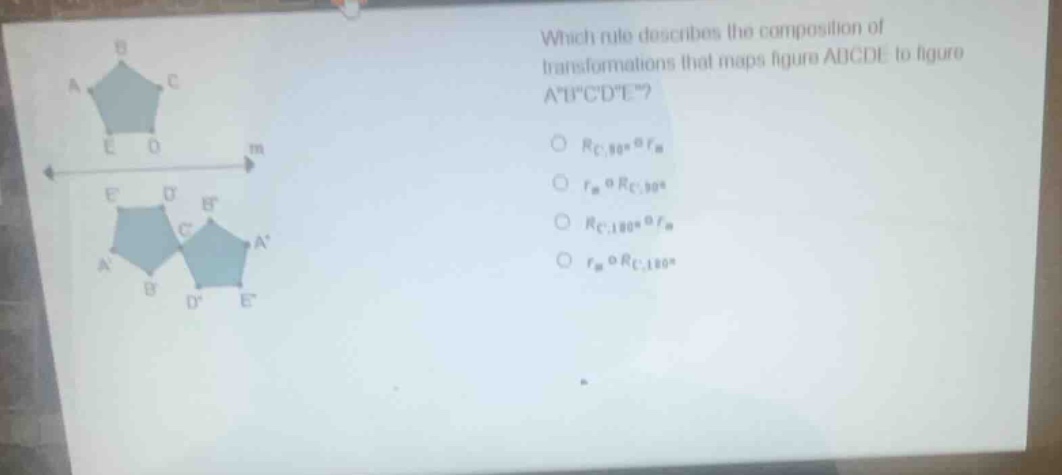
which rule describes the composition of transformations that maps figure abcde to figure a\b\c\d\e\?
\\( r_{c, 90^{\circ}} \circ r_m \\)
\\( r_m \circ r_{c, 90^{\circ}} \\)
\\( r_{c, 180^{\circ}} \circ r_m \\)
\\( r_m \circ r_{c, 180^{\circ}} \\)
Analyze the first transformation mapping ABCDE to A'B'C'D'E'
$$
\text{Figure } ABCDE \xrightarrow{r_m} A'B'C'D'E'
$$
$$
\text{This is a reflection across line } m.
$$
Analyze the second transformation mapping A'B'C'D'E' to A''B''C''D''E''
$$
A'B'C'D'E' \xrightarrow{R_{C', 180^\circ}} A''B''C''D''E''
$$
$$
\text{This is a rotation of } 180^\circ \text{ about point } C'.
$$
Write the composition of transformations
$$
(R_{C', 180^\circ} \circ r_m)(ABCDE) = A''B''C''D''E''
$$

Snap & solve any problem in the app
Get step-by-step solutions on Sovi AI
Photo-based solutions with guided steps
Explore more problems and detailed explanations
- (A) \(R_{C', 90^\circ} \circ r_m\)
- (B) \(r_m \circ R_{C', 90^\circ}\)
- (C) \(R_{C', 180^\circ} \circ r_m\) (Correct answer)
- (D) \(r_m \circ R_{C', 180^\circ}\)