QUESTION IMAGE
Question
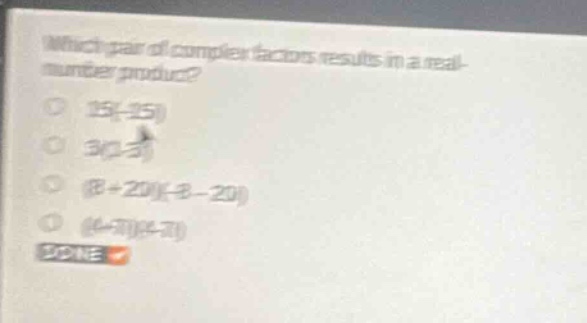
which pair of complex factors results in a real-number product?
\\(15(-15i)\\)
\\(3i(3i)\\)
\\((8 + 2i)(-8 - 2i)\\)
\\((4 - 7i)(4 - 7i)\\)
🆕 New Concept Discovered: Complex Conjugates
Multiplying a complex number by its conjugate always results in a real number.
Step 1: Understand the rule for a real-number product
When we multiply two complex numbers, the result is generally another complex number. However, if we multiply a complex number \(a + bi\) by its complex conjugate \(a - bi\), the imaginary parts cancel out:
Since \(i^2 = -1\):
Because \(a\) and \(b\) are real numbers, \(a^2 + b^2\) is always a real number. Therefore, we need to find the pair of factors that are complex conjugates of each other (same real parts, opposite imaginary parts).
Step 2: Analyze the given options
Let's test the options to see which one represents a pair of complex conjugates:
- Option 1: \(15(-15)\)
These are real numbers, not a pair of complex factors with imaginary parts.
- Option 2: \(3(3i)\)
Multiplying these gives:
This is an imaginary number, not a real number.
- Option 3: \((8 + 2i)(-8 - 2i)\)
Let's multiply them:
This contains an imaginary term (\(-32i\)), so it is not a real number.
- Option 4: \((4 - 7i)(4 + 7i)\)
These are complex conjugates because they have the same real part (\(4\)) and opposite imaginary parts (\(-7i\) and \(+7i\)). Let's multiply them:
Since \(65\) is a real number, this pair results in a real-number product.

Snap & solve any problem in the app
Get step-by-step solutions on Sovi AI
Photo-based solutions with guided steps
Explore more problems and detailed explanations
The correct option is the fourth one:
\((4 - 7i)(4 + 7i)\)