QUESTION IMAGE
Question
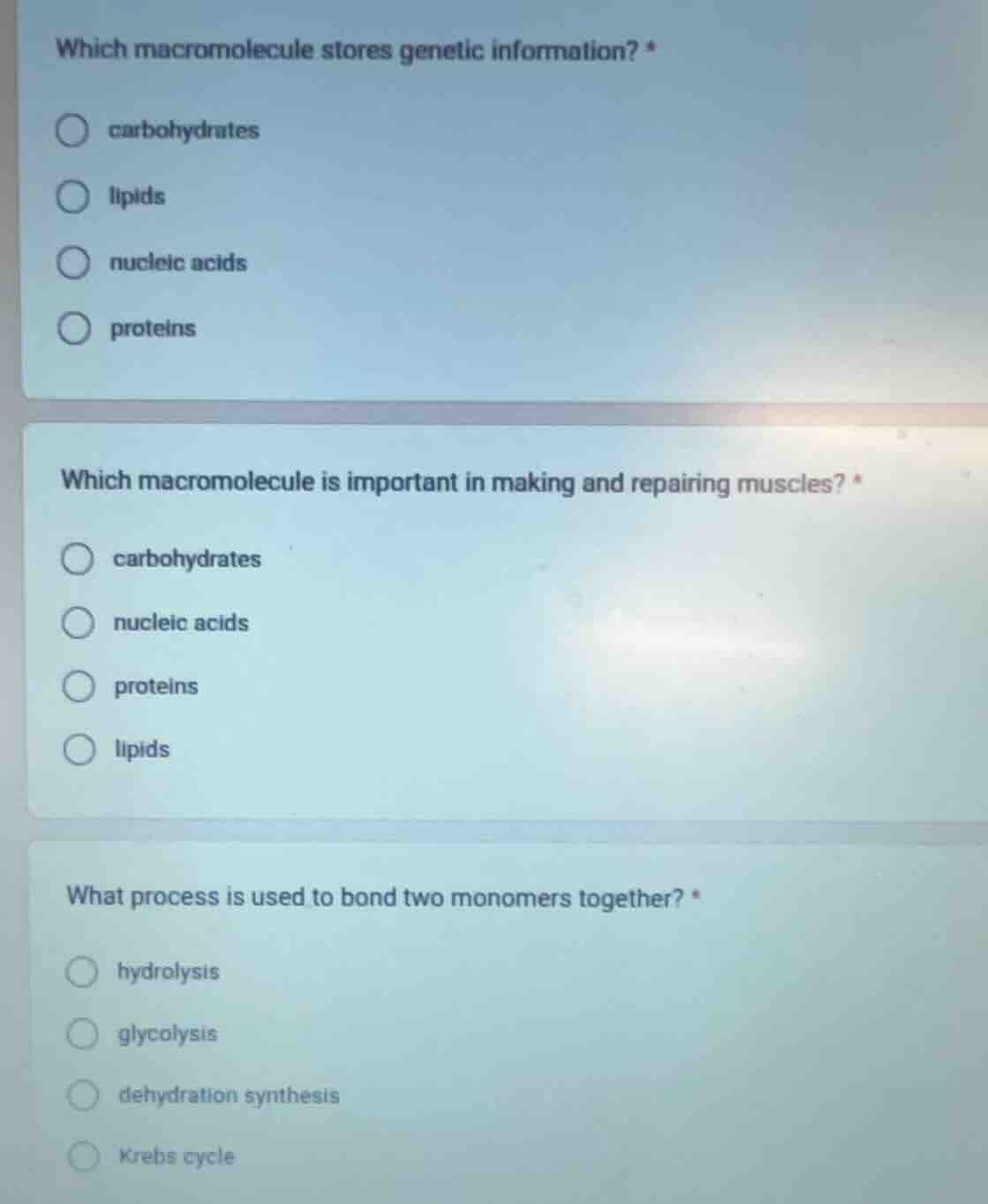
which macromolecule stores genetic information? *
carbohydrates
lipids
nucleic acids
proteins
which macromolecule is important in making and repairing muscles? *
carbohydrates
nucleic acids
proteins
lipids
what process is used to bond two monomers together? *
hydrolysis
glycolysis
dehydration synthesis
krebs cycle
<pre_analysis>
{
"quality": "clear",
"question_count": 3,
"skills_matched": [
"direct_cot",
"multiple_choice_formatter",
"explain_then_answer",
"tutor",
"mastery_adaptive_brevity"
],
"needs_drawing": false,
"concepts_used": [
"Macromolecule Classification",
"Dehydration Synthesis"
],
"new_concepts": [
"Nucleic Acid Function",
"Protein Function"
],
"current_concepts": [
"Macromolecule Classification",
"Dehydration Synthesis",
"Nucleic Acid Function",
"Protein Function"
]
}
</pre_analysis>
<reasoning>
Identify genetic information storage
Using the Macromolecule Classification knowledge point
- Nucleic acids (DNA and RNA) store and transmit genetic information.
- Carbohydrates provide energy, lipids store energy/form membranes, and proteins perform cellular work.
Identify muscle building and repair macromolecule
Using the Macromolecule Classification knowledge point
- Proteins are the primary structural components of muscle tissues (actin and myosin).
- They are essential for building, maintaining, and repairing body tissues.
Identify the monomer bonding process
Using the Dehydration Synthesis knowledge point
- Bonding monomers together requires removing a water molecule to form a covalent bond.
- This process is dehydration synthesis.
- Hydrolysis breaks bonds using water, while glycolysis and the Krebs cycle are metabolic pathways for energy production.
</reasoning>
<answer>
Question 1
<mcq-option>carbohydrates</mcq-option>
<mcq-option>lipids</mcq-option>
<mcq-correct>nucleic acids</mcq-correct>
<mcq-option>proteins</mcq-option>
Question 2
<mcq-option>carbohydrates</mcq-option>
<mcq-option>nucleic acids</mcq-correct>
<mcq-correct>proteins</mcq-correct>
<mcq-option>lipids</mcq-option>
Question 3
<mcq-option>hydrolysis</mcq-option>
<mcq-option>glycolysis</mcq-option>
<mcq-correct>dehydration synthesis</mcq-correct>
<mcq-option>Krebs cycle</mcq-option>
</answer>
<post_analysis>
{
"subject": "Natural Science",
"question_type": "Multiple Choice",
"knowledge_point": [
"Natural Science",
"Biology",
"Macromolecules"
]
}
</post_analysis>
Snap & solve any problem in the app
Get step-by-step solutions on Sovi AI
Photo-based solutions with guided steps
Explore more problems and detailed explanations
<pre_analysis>
{
"quality": "clear",
"question_count": 3,
"skills_matched": [
"direct_cot",
"multiple_choice_formatter",
"explain_then_answer",
"tutor",
"mastery_adaptive_brevity"
],
"needs_drawing": false,
"concepts_used": [
"Macromolecule Classification",
"Dehydration Synthesis"
],
"new_concepts": [
"Nucleic Acid Function",
"Protein Function"
],
"current_concepts": [
"Macromolecule Classification",
"Dehydration Synthesis",
"Nucleic Acid Function",
"Protein Function"
]
}
</pre_analysis>
<reasoning>
Identify genetic information storage
Using the Macromolecule Classification knowledge point
- Nucleic acids (DNA and RNA) store and transmit genetic information.
- Carbohydrates provide energy, lipids store energy/form membranes, and proteins perform cellular work.
Identify muscle building and repair macromolecule
Using the Macromolecule Classification knowledge point
- Proteins are the primary structural components of muscle tissues (actin and myosin).
- They are essential for building, maintaining, and repairing body tissues.
Identify the monomer bonding process
Using the Dehydration Synthesis knowledge point
- Bonding monomers together requires removing a water molecule to form a covalent bond.
- This process is dehydration synthesis.
- Hydrolysis breaks bonds using water, while glycolysis and the Krebs cycle are metabolic pathways for energy production.
</reasoning>
<answer>
Question 1
<mcq-option>carbohydrates</mcq-option>
<mcq-option>lipids</mcq-option>
<mcq-correct>nucleic acids</mcq-correct>
<mcq-option>proteins</mcq-option>
Question 2
<mcq-option>carbohydrates</mcq-option>
<mcq-option>nucleic acids</mcq-correct>
<mcq-correct>proteins</mcq-correct>
<mcq-option>lipids</mcq-option>
Question 3
<mcq-option>hydrolysis</mcq-option>
<mcq-option>glycolysis</mcq-option>
<mcq-correct>dehydration synthesis</mcq-correct>
<mcq-option>Krebs cycle</mcq-option>
</answer>
<post_analysis>
{
"subject": "Natural Science",
"question_type": "Multiple Choice",
"knowledge_point": [
"Natural Science",
"Biology",
"Macromolecules"
]
}
</post_analysis>