Sovi.AI - AI Math Tutor

Scan to solve math questions

QUESTION IMAGE

which hearing aid verification method is considered the gold standard f…

Question

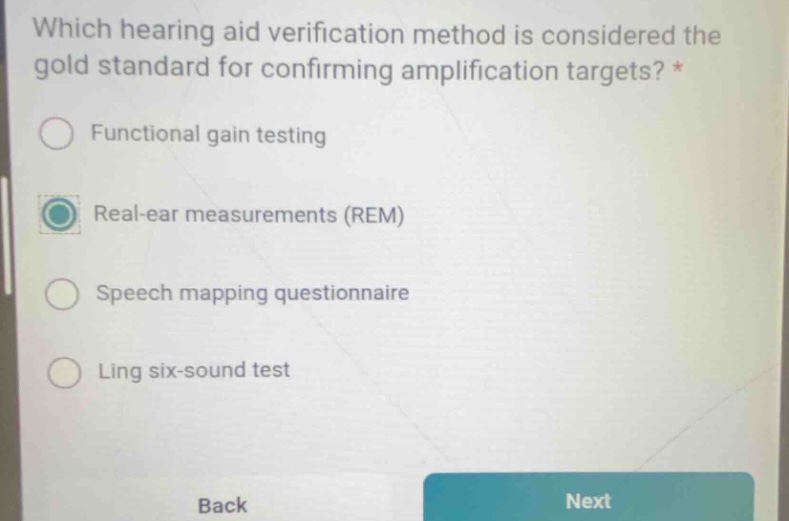
which hearing aid verification method is considered the gold standard for confirming amplification targets? *

functional gain testing
real-ear measurements (rem)
speech mapping questionnaire
ling six-sound test

Explanation:

Response

<pre_analysis>
{
"quality": "clear",
"question_count": 1,
"skills_matched": [
"direct_cot",
"multiple_choice_formatter",
"explain_then_answer",
"tutor"
],
"needs_drawing": false,
"concepts_used": [
"Evidence-Based Practice"
],
"new_concepts": [
"Hearing Aid Verification",
"Real-Ear Measurements"
],
"current_concepts": [
"Evidence-Based Practice",
"Hearing Aid Verification",
"Real-Ear Measurements"
]
}
</pre_analysis>

<reasoning>

Identify the core clinical question

The question asks for the "gold standard" hearing aid verification method used to confirm that amplification targets are being met in the patient's ear.

Evaluate the options based on audiological standards

  • Functional gain testing: This is a behavioral, soundfield-based measurement comparing aided and unaided thresholds. It is highly subjective, prone to error, and does not provide a continuous measurement of output across frequencies or input levels.
  • Real-ear measurements (REM): This is an objective probe-microphone measurement that directly measures the sound pressure level (SPL) near the tympanic membrane with the hearing aid in place. It is widely recognized as the gold standard for verifying that a hearing aid matches prescriptive targets (such as NAL-NL2 or DSL v5).
  • Speech mapping questionnaire: Questionnaires are subjective validation tools rather than objective verification methods.
  • Ling six-sound test: This is a quick behavioral check used primarily in pediatric audiology to verify detection/identification of speech sounds, not a quantitative method to confirm prescriptive amplification targets.

Connect to clinical evidence-based practice

Using Evidence-Based Practice guidelines, objective verification via probe-tube microphone measurements (REM) is established as the gold standard because it accounts for individual ear canal acoustics and provides precise, repeatable physical verification of the hearing aid's performance.
</reasoning>

<answer>
<mcq-option>Functional gain testing</mcq-option>
<mcq-correct>Real-ear measurements (REM)</mcq-correct>
<mcq-option>Speech mapping questionnaire</mcq-option>
<mcq-option>Ling six-sound test</mcq-option>
</answer>

<post_analysis>
{
"subject": "Natural Science",
"question_type": "Multiple Choice",
"knowledge_point": [
"Natural Science",
"Audiology",
"Hearing Aid Verification"
]
}
</post_analysis>

Answer:

<pre_analysis>
{
"quality": "clear",
"question_count": 1,
"skills_matched": [
"direct_cot",
"multiple_choice_formatter",
"explain_then_answer",
"tutor"
],
"needs_drawing": false,
"concepts_used": [
"Evidence-Based Practice"
],
"new_concepts": [
"Hearing Aid Verification",
"Real-Ear Measurements"
],
"current_concepts": [
"Evidence-Based Practice",
"Hearing Aid Verification",
"Real-Ear Measurements"
]
}
</pre_analysis>

<reasoning>

Identify the core clinical question

The question asks for the "gold standard" hearing aid verification method used to confirm that amplification targets are being met in the patient's ear.

Evaluate the options based on audiological standards

  • Functional gain testing: This is a behavioral, soundfield-based measurement comparing aided and unaided thresholds. It is highly subjective, prone to error, and does not provide a continuous measurement of output across frequencies or input levels.
  • Real-ear measurements (REM): This is an objective probe-microphone measurement that directly measures the sound pressure level (SPL) near the tympanic membrane with the hearing aid in place. It is widely recognized as the gold standard for verifying that a hearing aid matches prescriptive targets (such as NAL-NL2 or DSL v5).
  • Speech mapping questionnaire: Questionnaires are subjective validation tools rather than objective verification methods.
  • Ling six-sound test: This is a quick behavioral check used primarily in pediatric audiology to verify detection/identification of speech sounds, not a quantitative method to confirm prescriptive amplification targets.

Connect to clinical evidence-based practice

Using Evidence-Based Practice guidelines, objective verification via probe-tube microphone measurements (REM) is established as the gold standard because it accounts for individual ear canal acoustics and provides precise, repeatable physical verification of the hearing aid's performance.
</reasoning>

<answer>
<mcq-option>Functional gain testing</mcq-option>
<mcq-correct>Real-ear measurements (REM)</mcq-correct>
<mcq-option>Speech mapping questionnaire</mcq-option>
<mcq-option>Ling six-sound test</mcq-option>
</answer>

<post_analysis>
{
"subject": "Natural Science",
"question_type": "Multiple Choice",
"knowledge_point": [
"Natural Science",
"Audiology",
"Hearing Aid Verification"
]
}
</post_analysis>