QUESTION IMAGE
Question
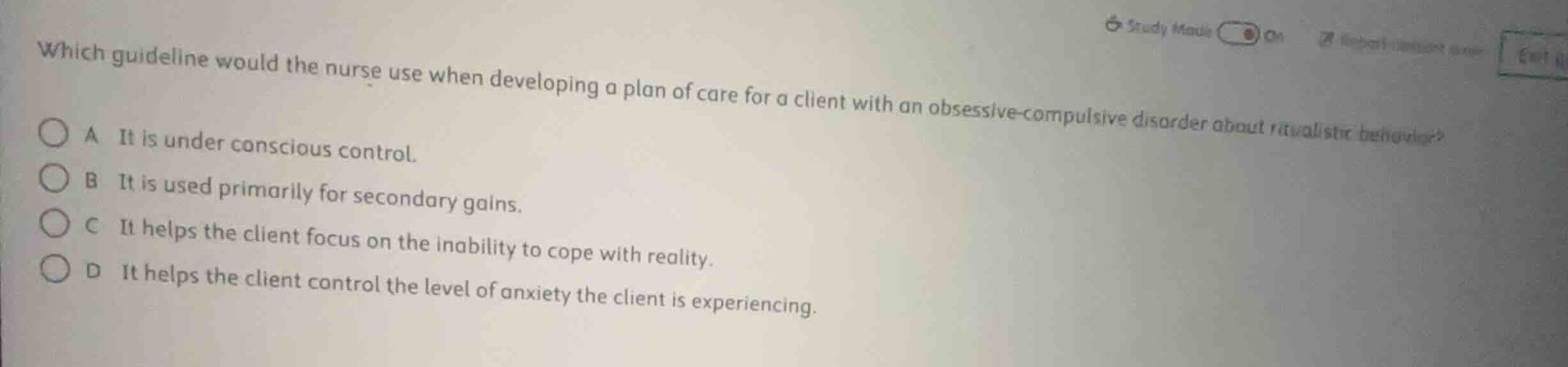
which guideline would the nurse use when developing a plan of care for a client with an obsessive-compulsive disorder about ritualistic behavior?
a it is under conscious control.
b it is used primarily for secondary gains.
c it helps the client focus on the inability to cope with reality.
d it helps the client control the level of anxiety the client is experiencing.
Analyze the purpose of ritualistic behavior in OCD
In Obsessive-Compulsive Disorder (OCD), ritualistic behaviors (compulsions) are repetitive actions performed in response to an obsession. The primary purpose of these rituals is to reduce or control the intense anxiety and distress caused by the obsessive thoughts.
Evaluate the given options
- Option A ("It is under conscious control"): Incorrect. Ritualistic behaviors are driven by an overwhelming, uncontrollable urge, and clients often feel unable to stop them despite knowing they are irrational.
- Option B ("It is used primarily for secondary gains"): Incorrect. Secondary gains refer to external benefits (such as attention or avoiding responsibilities). Rituals are performed for primary internal relief from anxiety.
- Option C ("It helps the client focus on the inability to cope with reality"): Incorrect. Rituals serve as a maladaptive coping mechanism to escape or manage anxiety, not to focus on an inability to cope.
- Option D ("It helps the client control the level of anxiety the client is experiencing"): Correct. Performing the ritual temporarily decreases the client's severe anxiety.
Formulate the clinical rationale
When planning care, the nurse must understand that the ritual is a defense mechanism used to manage anxiety. Stopping the ritual abruptly without alternative coping strategies will cause the client's anxiety to escalate dramatically. Therefore, the plan of care should allow time for rituals initially while gradually introducing healthier anxiety-reduction techniques.

Snap & solve any problem in the app
Get step-by-step solutions on Sovi AI
Photo-based solutions with guided steps
Explore more problems and detailed explanations
- A It is under conscious control.
- B It is used primarily for secondary gains.
- C It helps the client focus on the inability to cope with reality.
- D It helps the client control the level of anxiety the client is experiencing. (Correct answer)