Sovi.AI - AI Math Tutor

Scan to solve math questions

QUESTION IMAGE

which functions represent exponential growth? \\(y = f(x)\\) \\(y = h(x…

Question

which functions represent exponential growth?
\\(y = f(x)\\)
\\(y = h(x)\\)
\\(y = g(x)\\)
\\(y = k(x)\\)

which functions have a horizontal asymptote?
\\(y = f(x)\\)
\\(y = h(x)\\)
\\(y = g(x)\\)
\\(y = k(x)\\)

Explanation:

Response

<pre_analysis>
{
"quality": "clear",
"question_count": 1,
"skills_matched": [
"direct_cot",
"multiple_choice_formatter",
"explain_then_answer",
"tutor",
"mastery_adaptive_brevity"
],
"needs_drawing": false,
"concepts_used": [
"Exponential Growth and Decay Behavior",
"Horizontal Asymptotes"
],
"new_concepts": [],
"current_concepts": [
"Exponential Growth and Decay Behavior",
"Horizontal Asymptotes",
"Exponential Function Graphs"
]
}
</pre_analysis>

<reasoning>

Identify exponential growth functions

Using the Exponential Growth and Decay Behavior knowledge point

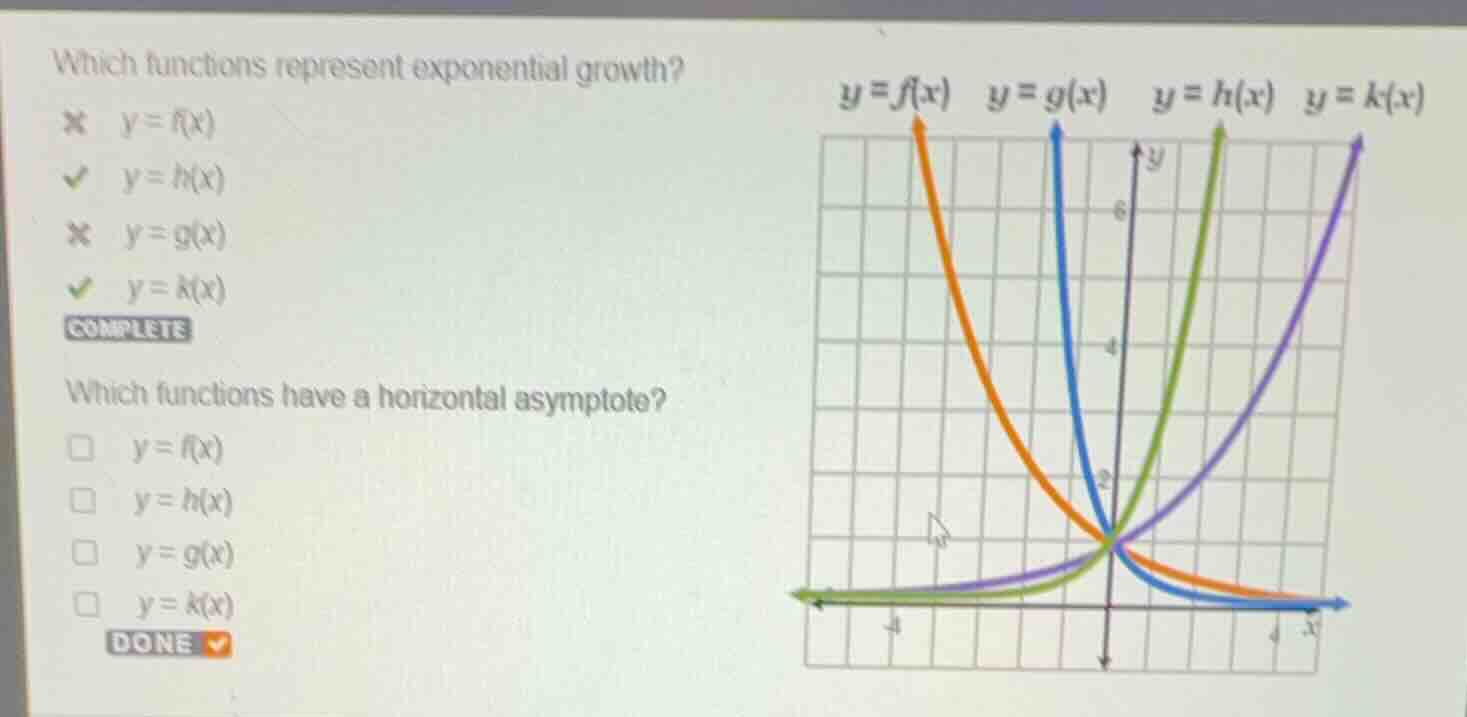
  • The functions \(y = h(x)\) (green curve) and \(y = k(x)\) (purple curve) increase from left to right, approaching \(0\) as \(x \to -\infty\) and growing rapidly as \(x \to \infty\). Thus, \(y = h(x)\) and \(y = k(x)\) represent exponential growth.

Identify horizontal asymptotes

Using the Horizontal Asymptotes knowledge point

  • An exponential function of the form \(y = ab^x\) (where \(a > 0, b > 0\)) has a horizontal asymptote at \(y = 0\) (the x-axis).
  • Looking at the graph, all four curves—\(y = f(x)\) (orange), \(y = g(x)\) (blue), \(y = h(x)\) (green), and \(y = k(x)\) (purple)—flatten out and approach the x-axis (\(y = 0\)) on one side.
  • Specifically, \(y = f(x)\) and \(y = g(x)\) approach \(y = 0\) as \(x \to \infty\).
  • Meanwhile, \(y = h(x)\) and \(y = k(x)\) approach \(y = 0\) as \(x \to -\infty\).
  • Therefore, all four functions have a horizontal asymptote.

</reasoning>

<answer>
<mcq-correct>[x] \(y = f(x)\)</mcq-correct>
<mcq-correct>[x] \(y = h(x)\)</mcq-correct>
<mcq-correct>[x] \(y = g(x)\)</mcq-correct>
<mcq-correct>[x] \(y = k(x)\)</mcq-correct>
</answer>

<post_analysis>
{
"subject": "Mathematics",
"question_type": "Multiple Choice",
"knowledge_point": [
"Mathematics",
"Algebra",
"Exponential Function Graphs"
]
}
</post_analysis>

Answer:

<pre_analysis>
{
"quality": "clear",
"question_count": 1,
"skills_matched": [
"direct_cot",
"multiple_choice_formatter",
"explain_then_answer",
"tutor",
"mastery_adaptive_brevity"
],
"needs_drawing": false,
"concepts_used": [
"Exponential Growth and Decay Behavior",
"Horizontal Asymptotes"
],
"new_concepts": [],
"current_concepts": [
"Exponential Growth and Decay Behavior",
"Horizontal Asymptotes",
"Exponential Function Graphs"
]
}
</pre_analysis>

<reasoning>

Identify exponential growth functions

Using the Exponential Growth and Decay Behavior knowledge point

  • The functions \(y = h(x)\) (green curve) and \(y = k(x)\) (purple curve) increase from left to right, approaching \(0\) as \(x \to -\infty\) and growing rapidly as \(x \to \infty\). Thus, \(y = h(x)\) and \(y = k(x)\) represent exponential growth.

Identify horizontal asymptotes

Using the Horizontal Asymptotes knowledge point

  • An exponential function of the form \(y = ab^x\) (where \(a > 0, b > 0\)) has a horizontal asymptote at \(y = 0\) (the x-axis).
  • Looking at the graph, all four curves—\(y = f(x)\) (orange), \(y = g(x)\) (blue), \(y = h(x)\) (green), and \(y = k(x)\) (purple)—flatten out and approach the x-axis (\(y = 0\)) on one side.
  • Specifically, \(y = f(x)\) and \(y = g(x)\) approach \(y = 0\) as \(x \to \infty\).
  • Meanwhile, \(y = h(x)\) and \(y = k(x)\) approach \(y = 0\) as \(x \to -\infty\).
  • Therefore, all four functions have a horizontal asymptote.

</reasoning>

<answer>
<mcq-correct>[x] \(y = f(x)\)</mcq-correct>
<mcq-correct>[x] \(y = h(x)\)</mcq-correct>
<mcq-correct>[x] \(y = g(x)\)</mcq-correct>
<mcq-correct>[x] \(y = k(x)\)</mcq-correct>
</answer>

<post_analysis>
{
"subject": "Mathematics",
"question_type": "Multiple Choice",
"knowledge_point": [
"Mathematics",
"Algebra",
"Exponential Function Graphs"
]
}
</post_analysis>