QUESTION IMAGE
Question
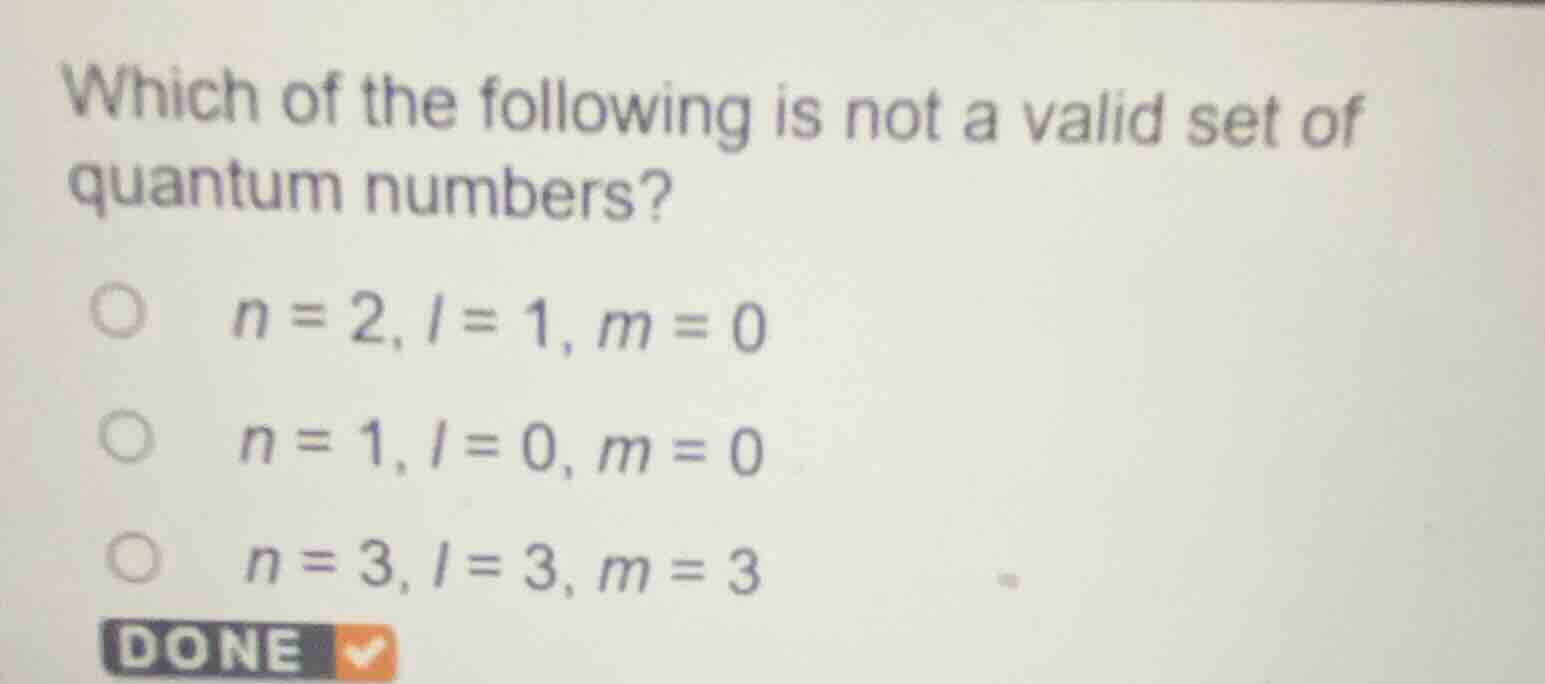
which of the following is not a valid set of quantum numbers?
\\(n = 2, l = 1, m = 0\\)
\\(n = 1, l = 0, m = 0\\)
\\(n = 3, l = 3, m = 3\\)
State the rules for quantum numbers
Quantum numbers describe atomic orbitals.
The principal quantum number \(n\) must be a positive integer:
The angular momentum quantum number \(l\) depends on \(n\):
The magnetic quantum number \(m\) (or \(m_l\)) depends on \(l\):
Analyze the first option
Evaluate \(n = 2\), \(l = 1\), \(m = 0\).
Since \(n = 2\), \(l\) can be \(0\) or \(1\). Here, \(l = 1\), which is valid.
Since \(l = 1\), \(m\) can be \(-1, 0, 1\). Here, \(m = 0\), which is valid.
Analyze the second option
Evaluate \(n = 1\), \(l = 0\), \(m = 0\).
Since \(n = 1\), \(l\) can only be \(0\). Here, \(l = 0\), which is valid.
Since \(l = 0\), \(m\) can only be \(0\). Here, \(m = 0\), which is valid.
Analyze the third option
Evaluate \(n = 3\), \(l = 3\), \(m = 3\).
Since \(n = 3\), the allowed values for \(l\) are \(0, 1, 2\).
The value \(l = 3\) is invalid because \(l\) must be strictly less than \(n\).
Consequently, \(m = 3\) is also invalid because \(m\) cannot exceed \(l\).

Snap & solve any problem in the app
Get step-by-step solutions on Sovi AI
Photo-based solutions with guided steps
Explore more problems and detailed explanations
- \(n = 2, l = 1, m = 0\)
- \(n = 1, l = 0, m = 0\)
- \(n = 3, l = 3, m = 3\) (Correct answer)