QUESTION IMAGE
Question
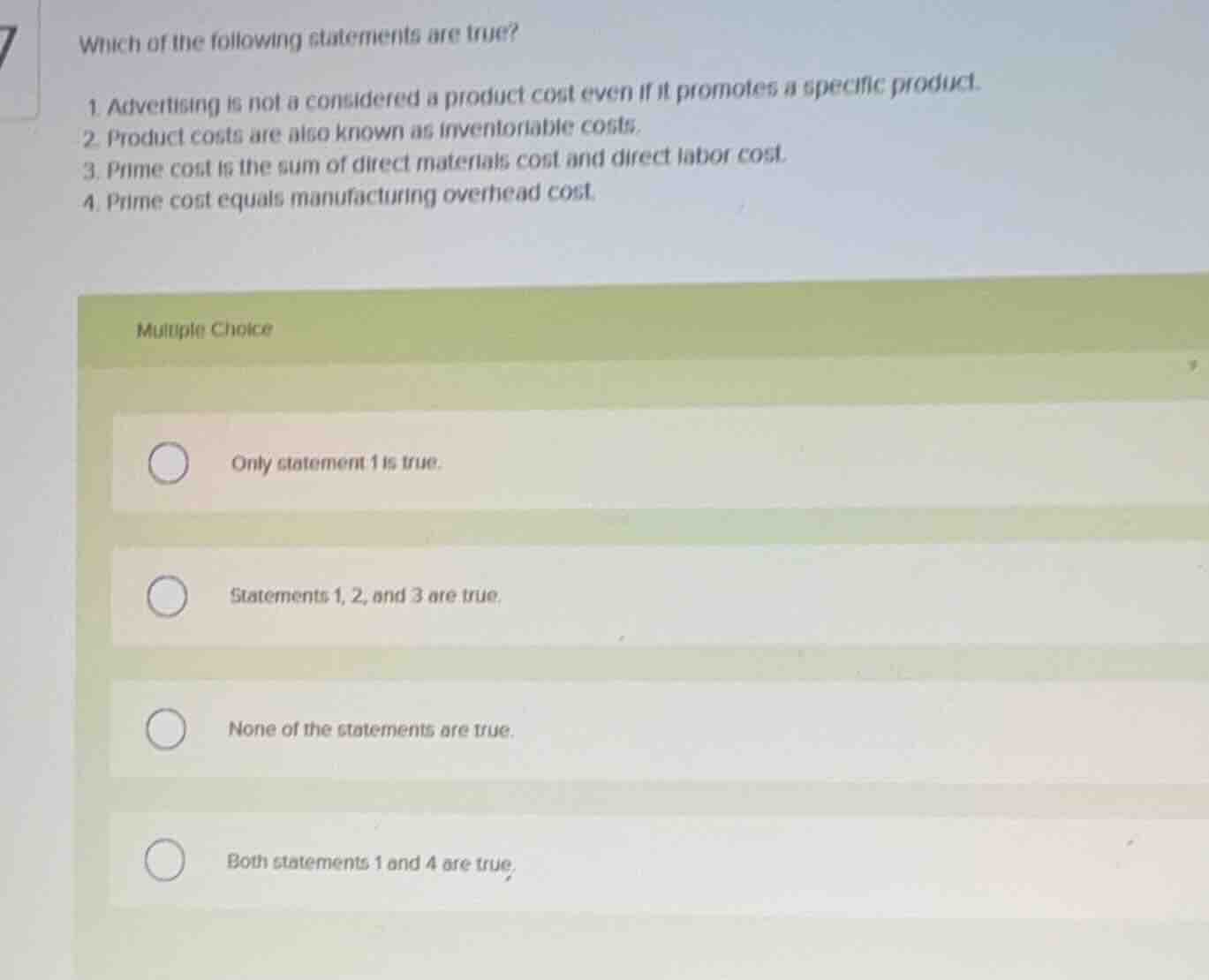
which of the following statements are true?
- advertising is not considered a product cost even if it promotes a specific product.
- product costs are also known as inventoriable costs.
- prime cost is the sum of direct materials cost and direct labor cost.
- prime cost equals manufacturing overhead cost.
multiple choice
- only statement 1 is true.
- statements 1, 2, and 3 are true.
- none of the statements are true.
- both statements 1 and 4 are true.
Analyze Statement 1
Statement 1 states: "Advertising is not considered a product cost even if it promotes a specific product."
- Advertising is a selling and administrative expense, which is classified as a period cost.
- Period costs are expensed in the period incurred and are never treated as product costs, regardless of whether they promote a specific product.
- Therefore, Statement 1 is true.
Analyze Statement 2
Statement 2 states: "Product costs are also known as inventoriable costs."
- Product costs (direct materials, direct labor, and manufacturing overhead) are attached to units of product as they are produced and go into inventory.
- They only become expenses (cost of goods sold) when the inventory is sold.
- Therefore, product costs are indeed called inventoriable costs, making Statement 2 is true.
Analyze Statement 3
Statement 3 states: "Prime cost is the sum of direct materials cost and direct labor cost."
- Using the Prime Cost Calculation knowledge point, prime costs are defined as the direct manufacturing costs.
- The formula is:
$$
\text{Prime Cost} = \text{Direct Materials} + \text{Direct Labor}
$$
- Therefore, Statement 3 is true.
Analyze Statement 4
Statement 4 states: "Prime cost equals manufacturing overhead cost."
- Prime cost consists of direct materials and direct labor, whereas manufacturing overhead consists of indirect manufacturing costs.
- These are distinct categories of manufacturing costs and are not equal.
- Therefore, Statement 4 is false.
Determine the correct option
- Since Statements 1, 2, and 3 are true, and Statement 4 is false, the correct choice is "Statements 1, 2, and 3 are true."

Snap & solve any problem in the app
Get step-by-step solutions on Sovi AI
Photo-based solutions with guided steps
Explore more problems and detailed explanations
- Only statement 1 is true.
- Statements 1, 2, and 3 are true. (Correct answer)
- None of the statements are true.
- Both statements 1 and 4 are true.