QUESTION IMAGE
Question
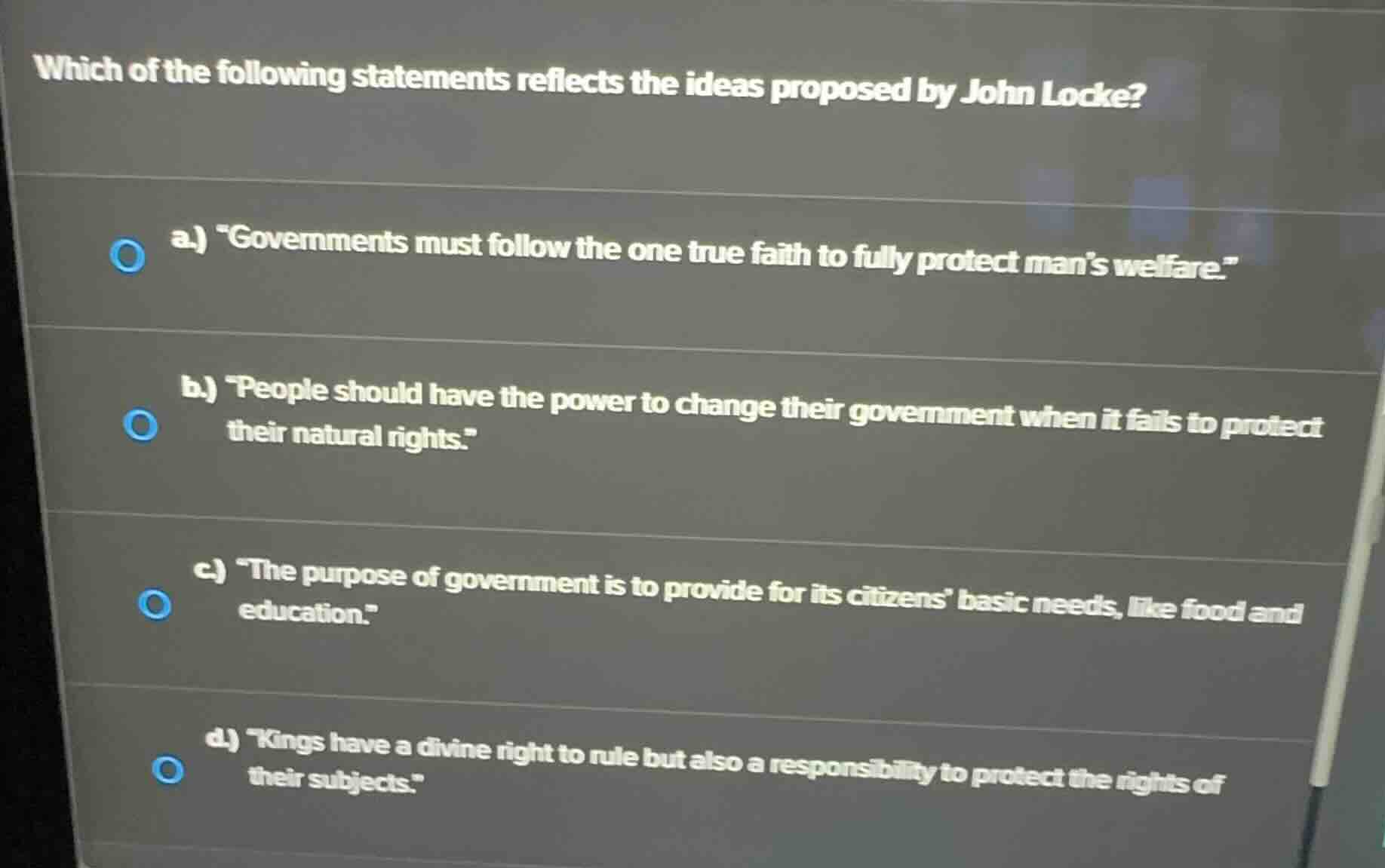
which of the following statements reflects the ideas proposed by john locke?
a.) \governments must follow the one true faith to fully protect mans welfare.\
b.) \people should have the power to change their government when it fails to protect their natural rights.\
c.) \the purpose of government is to provide for its citizens basic needs, like food and education.\
d.) \kings have a divine right to rule but also a responsibility to protect the rights of their subjects.\
Identify John Locke's core political philosophy
John Locke was an influential Enlightenment philosopher whose ideas laid the foundation for modern democratic governance. His political philosophy is centered around the concept of Natural Rights (life, liberty, and property) and the Social Contract Theory. Locke argued that governments are created by the consent of the governed solely to protect these inherent rights.
Analyze the social contract and the right to revolution
According to Locke's social contract, if a government fails to protect the natural rights of its citizens, or if it becomes tyrannical, the contract is broken. Consequently, the citizens retain the moral authority and power to alter, overthrow, or replace that government to re-establish a system that secures their liberties.
Evaluate the given multiple-choice options
- Option a: Locke strongly advocated for religious toleration (except in very specific political cases) and argued for a separation between the duties of the state and the care of the soul, rejecting the idea of a state-enforced "one true faith."
- Option b: This directly aligns with Locke's theory of the social contract and the right to revolution when natural rights are violated.
- Option c: While modern welfare states focus on basic needs like food and education, Locke's classical liberal focus was strictly on negative rights: life, liberty, and estate (property).
- Option d: Locke explicitly rejected the "divine right of kings" in his First Treatise of Government, arguing instead that political legitimacy comes from the consent of the governed.

Snap & solve any problem in the app
Get step-by-step solutions on Sovi AI
Photo-based solutions with guided steps
Explore more problems and detailed explanations
- a.) "Governments must follow the one true faith to fully protect man's welfare."
- b.) "People should have the power to change their government when it fails to protect their natural rights." (Correct answer)
- c.) "The purpose of government is to provide for its citizens' basic needs, like food and education."
- d.) "Kings have a divine right to rule but also a responsibility to protect the rights of their subjects."