QUESTION IMAGE
Question
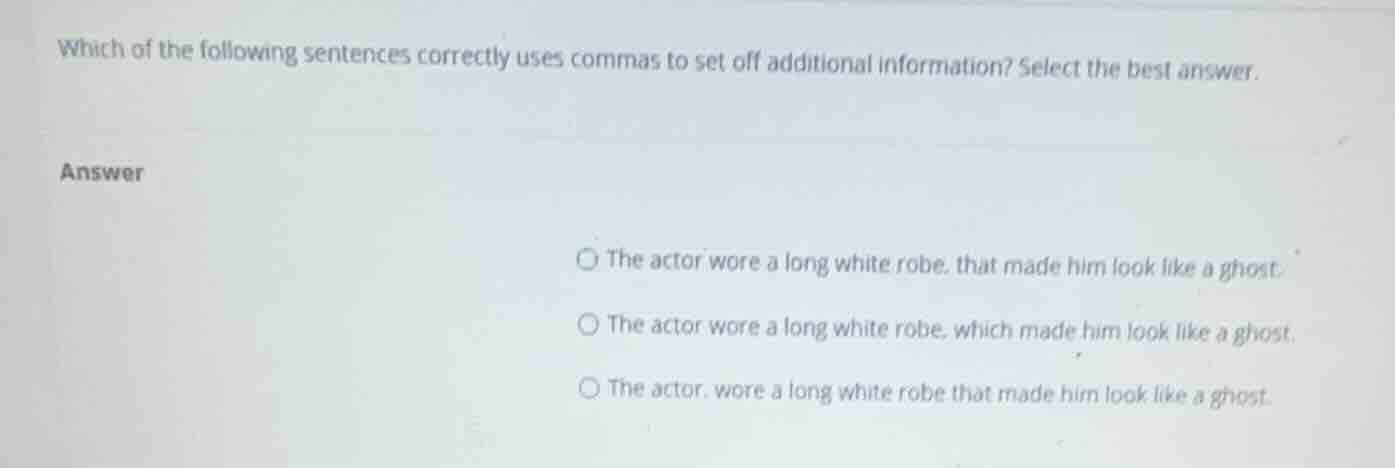
which of the following sentences correctly uses commas to set off additional information? select the best answer.
answer
- the actor wore a long white robe, that made him look like a ghost.
- the actor wore a long white robe, which made him look like a ghost.
- the actor, wore a long white robe that made him look like a ghost.
🆕 New Concept Discovered: Non-essential Relative Clauses
Using commas to set off extra information.
Step 1: Understand non-essential vs. essential information
When adding extra, non-essential information to a sentence (information that can be removed without changing the core meaning of the sentence), we set it off with commas.
- "Which" clauses are typically non-essential (non-restrictive) and require a comma before them.
- "That" clauses are essential (restrictive) to the meaning of the sentence and should not be set off by commas.
Step 2: Analyze the options
- Option 1:
"The actor wore a long white robe, that made him look like a ghost." - Incorrect: A comma should not be placed before a restrictive "that" clause.
- Option 2:
"The actor wore a long white robe, which made him look like a ghost." - Correct: The clause starting with "which" adds extra, non-essential information about the robe and is correctly preceded by a comma.
- Option 3:
"The actor, wore a long white robe that made him look like a ghost." - Incorrect: This places a single comma incorrectly between the subject ("The actor") and the verb ("wore").

Snap & solve any problem in the app
Get step-by-step solutions on Sovi AI
Photo-based solutions with guided steps
Explore more problems and detailed explanations
The actor wore a long white robe, which made him look like a ghost.