QUESTION IMAGE
Question
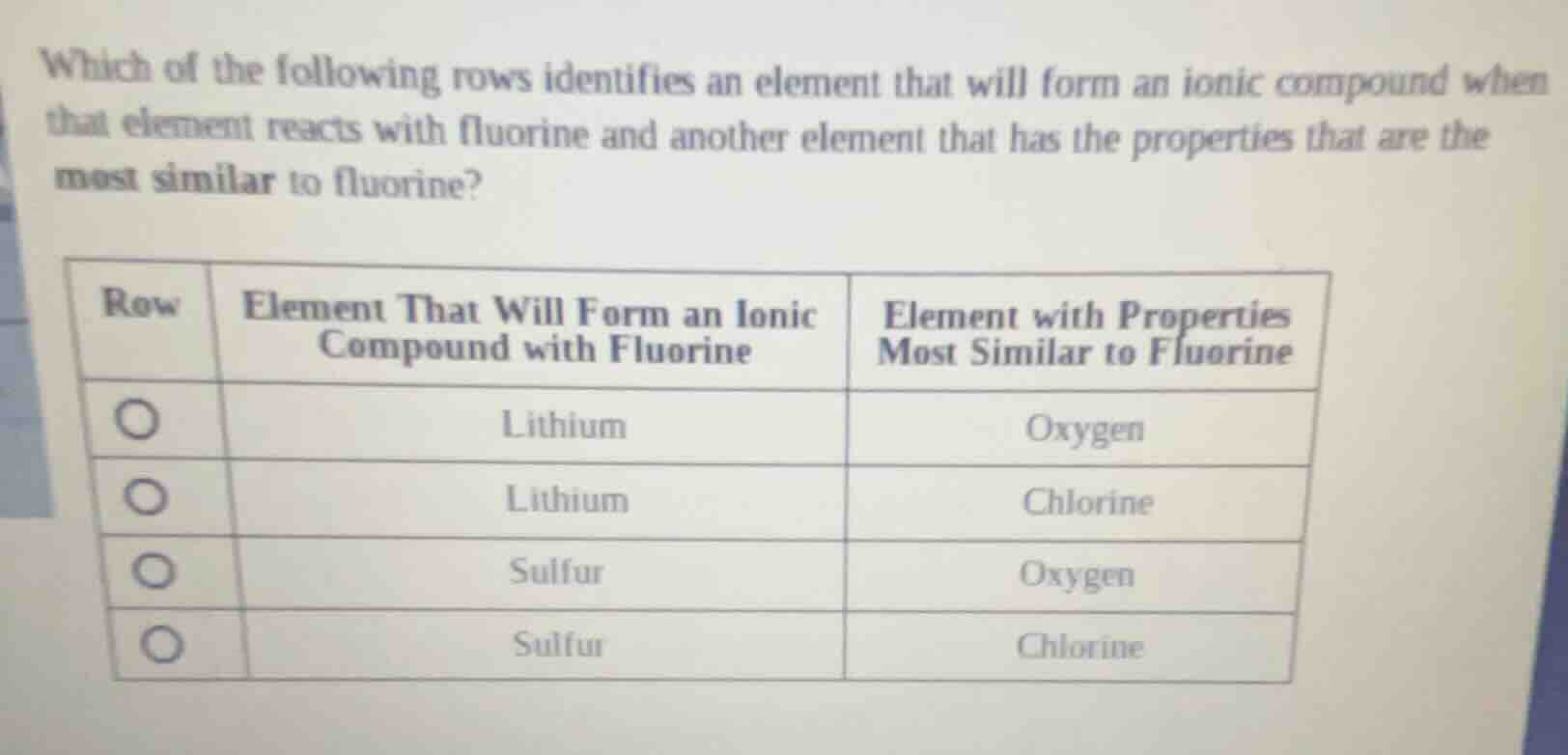
which of the following rows identifies an element that will form an ionic compound when that element reacts with fluorine and another element that has the properties that are the most similar to fluorine?
\
<pre_analysis>
{
"quality": "clear",
"question_count": 1,
"skills_matched": [
"direct_cot",
"multiple_choice_formatter",
"explain_then_answer",
"tutor"
],
"needs_drawing": false,
"concepts_used": [
"Periodic Table Organization"
],
"new_concepts": [
"Ionic Bonding",
"Chemical Families"
],
"current_concepts": [
"Periodic Table Organization",
"Ionic Bonding",
"Chemical Families"
]
}
</pre_analysis>
<reasoning>
Identify the element forming an ionic compound with fluorine
Fluorine is a highly reactive non-metal (halogen). An ionic compound is formed when a metal reacts with a non-metal. Among the choices in the second column:
- Lithium is an alkali metal.
- Sulfur is a non-metal.
Therefore, lithium will react with fluorine to form an ionic compound (\(\text{LiF}\)), while sulfur and fluorine would form a covalent compound. This narrows our choices to the first two rows.
Identify the element with properties most similar to fluorine
Elements in the same group (column) of the periodic table share similar chemical properties because they have the same number of valence electrons.
- Fluorine is in Group 17 (the halogens).
- Chlorine is also in Group 17 (the halogens), meaning it has properties most similar to fluorine.
- Oxygen is in Group 16 (the chalcogens).
Using the Periodic Table Organization knowledge point, we identify chlorine as the element most similar to fluorine.
Select the correct row
Combining both findings:
- Element forming an ionic compound with fluorine: Lithium
- Element with properties most similar to fluorine: Chlorine
This corresponds to the second row of the table.
</reasoning>
<answer>
<mcq-option>Row 1: Lithium | Oxygen</mcq-option>
<mcq-correct>Row 2: Lithium | Chlorine</mcq-correct>
<mcq-option>Row 3: Sulfur | Oxygen</mcq-option>
<mcq-option>Row 4: Sulfur | Chlorine</mcq-option>
</answer>
<post_analysis>
{
"subject": "Natural Science",
"question_type": "Multiple Choice",
"knowledge_point": [
"Natural Science",
"Chemistry",
"Periodic Table Organization"
]
}
</post_analysis>
Snap & solve any problem in the app
Get step-by-step solutions on Sovi AI
Photo-based solutions with guided steps
Explore more problems and detailed explanations
<pre_analysis>
{
"quality": "clear",
"question_count": 1,
"skills_matched": [
"direct_cot",
"multiple_choice_formatter",
"explain_then_answer",
"tutor"
],
"needs_drawing": false,
"concepts_used": [
"Periodic Table Organization"
],
"new_concepts": [
"Ionic Bonding",
"Chemical Families"
],
"current_concepts": [
"Periodic Table Organization",
"Ionic Bonding",
"Chemical Families"
]
}
</pre_analysis>
<reasoning>
Identify the element forming an ionic compound with fluorine
Fluorine is a highly reactive non-metal (halogen). An ionic compound is formed when a metal reacts with a non-metal. Among the choices in the second column:
- Lithium is an alkali metal.
- Sulfur is a non-metal.
Therefore, lithium will react with fluorine to form an ionic compound (\(\text{LiF}\)), while sulfur and fluorine would form a covalent compound. This narrows our choices to the first two rows.
Identify the element with properties most similar to fluorine
Elements in the same group (column) of the periodic table share similar chemical properties because they have the same number of valence electrons.
- Fluorine is in Group 17 (the halogens).
- Chlorine is also in Group 17 (the halogens), meaning it has properties most similar to fluorine.
- Oxygen is in Group 16 (the chalcogens).
Using the Periodic Table Organization knowledge point, we identify chlorine as the element most similar to fluorine.
Select the correct row
Combining both findings:
- Element forming an ionic compound with fluorine: Lithium
- Element with properties most similar to fluorine: Chlorine
This corresponds to the second row of the table.
</reasoning>
<answer>
<mcq-option>Row 1: Lithium | Oxygen</mcq-option>
<mcq-correct>Row 2: Lithium | Chlorine</mcq-correct>
<mcq-option>Row 3: Sulfur | Oxygen</mcq-option>
<mcq-option>Row 4: Sulfur | Chlorine</mcq-option>
</answer>
<post_analysis>
{
"subject": "Natural Science",
"question_type": "Multiple Choice",
"knowledge_point": [
"Natural Science",
"Chemistry",
"Periodic Table Organization"
]
}
</post_analysis>