QUESTION IMAGE
Question
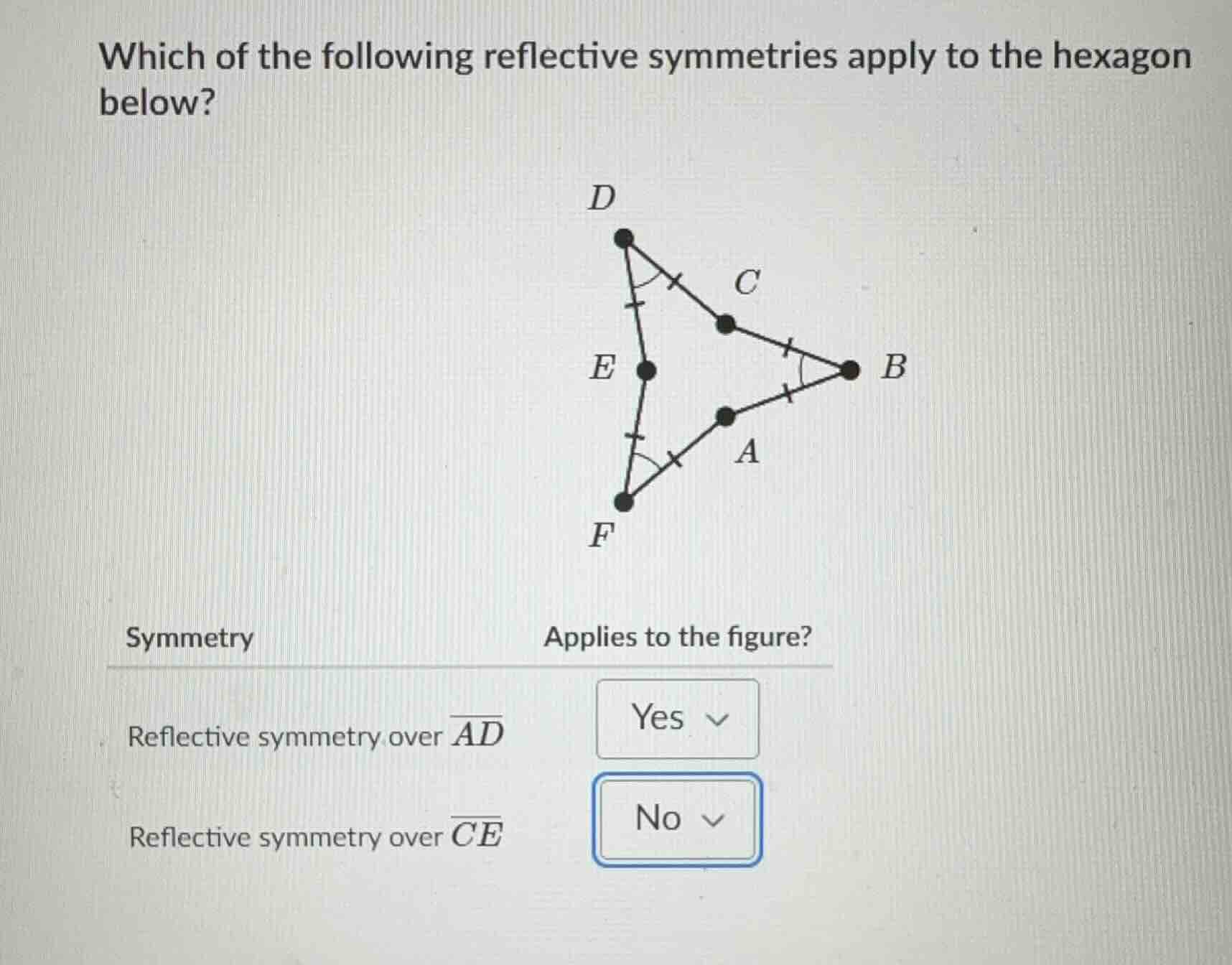
which of the following reflective symmetries apply to the hexagon below?
symmetry
applies to the figure?
reflective symmetry over \\(\overline{ad}\\)
reflective symmetry over \\(\overline{ce}\\)
Analyze the geometric properties of the hexagon
Using the Reflective Symmetry knowledge point, we observe the markings on the hexagon \(ABCDEF\):
- The side lengths have tick marks: \(DE = EF\) (indicated by single tick marks on segments \(DE\) and \(EF\)), and \(DC = CB = BA = AF\) (indicated by single tick marks on segments \(DC\), \(CB\), \(BA\), and \(AF\)).
- The interior angles at vertices \(D\), \(B\), and \(F\) are marked as congruent.
- Points \(C\), \(E\), and \(A\) are vertices where the sides meet, with \(E\) being the midpoint-like vertex on the left vertical-ish boundary, and \(C\) and \(A\) being symmetric inner vertices.
- The shape is symmetric across a horizontal line passing through \(E\) and \(B\).
Evaluate reflective symmetry over line AD
Using the Line of Reflection knowledge point
Reflecting the figure across the line \(AD\) does not map the vertices onto each other because:
- Vertex \(F\) is on one side of \(AD\), but its potential reflection target \(C\) is not positioned symmetrically across \(AD\).
- The line of symmetry for this kite-like or arrowhead-like hexagon is the horizontal line \(EB\).
- Therefore, reflective symmetry over \(\overline{AD}\) does not apply.
Evaluate reflective symmetry over line CE
Using the Line of Reflection knowledge point
Reflecting the figure across the line \(CE\) does not map the figure onto itself because:
- The line \(CE\) is tilted and does not divide the hexagon into two mirror-image halves.
- For example, vertex \(B\) does not map to any corresponding vertex on the other side of \(CE\).
- Therefore, reflective symmetry over \(\overline{CE}\) does not apply.

Snap & solve any problem in the app
Get step-by-step solutions on Sovi AI
Photo-based solutions with guided steps
Explore more problems and detailed explanations
Question 1
Reflective symmetry over \(\overline{AD}\): No
Question 2
Reflective symmetry over \(\overline{CE}\): No