QUESTION IMAGE
Question
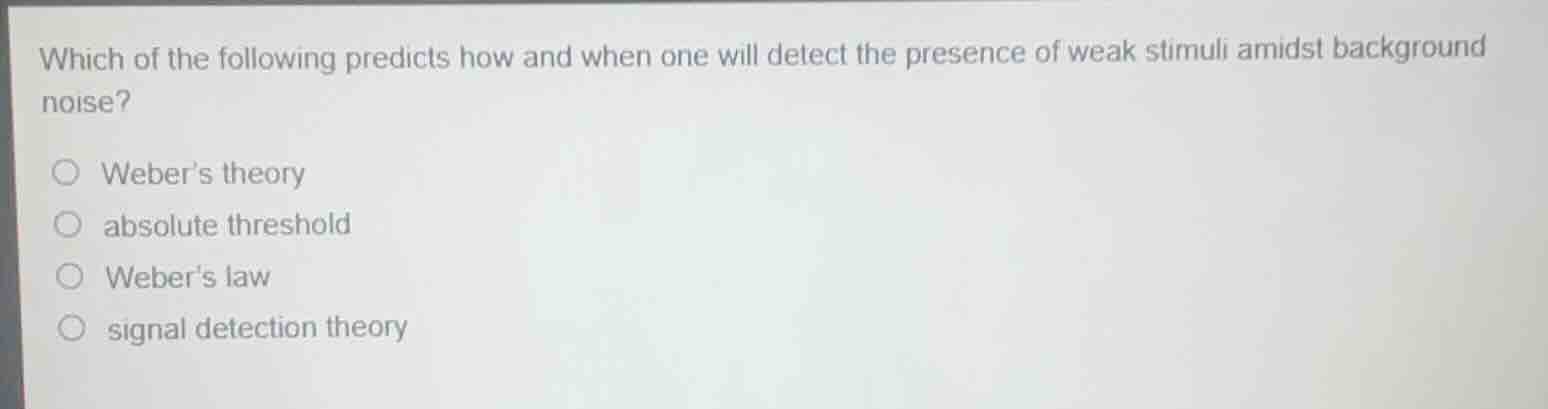
which of the following predicts how and when one will detect the presence of weak stimuli amidst background noise?
webers theory
absolute threshold
webers law
signal detection theory
Identify the core concept of detecting weak stimuli in noise
The question asks for the theory that predicts how and when we detect a faint stimulus (signal) amid background stimulation (noise).
Evaluate the given options
- Weber's theory / Weber's law: Relates to the difference threshold (just noticeable difference) and states that two stimuli must differ by a constant minimum percentage rather than a constant amount to be perceived as different.
- Absolute threshold: The minimum stimulation needed to detect a particular stimulus 50 percent of the time under ideal, noise-free conditions.
- Signal detection theory: Specifically addresses how and when we detect the presence of a faint stimulus (signal) amid background stimulation (noise), assuming there is no single absolute threshold and that detection depends partly on a person's experience, expectations, motivation, and alertness.

Snap & solve any problem in the app
Get step-by-step solutions on Sovi AI
Photo-based solutions with guided steps
Explore more problems and detailed explanations
- Weber's theory
- absolute threshold
- Weber's law
- signal detection theory (Correct answer)