QUESTION IMAGE
Question
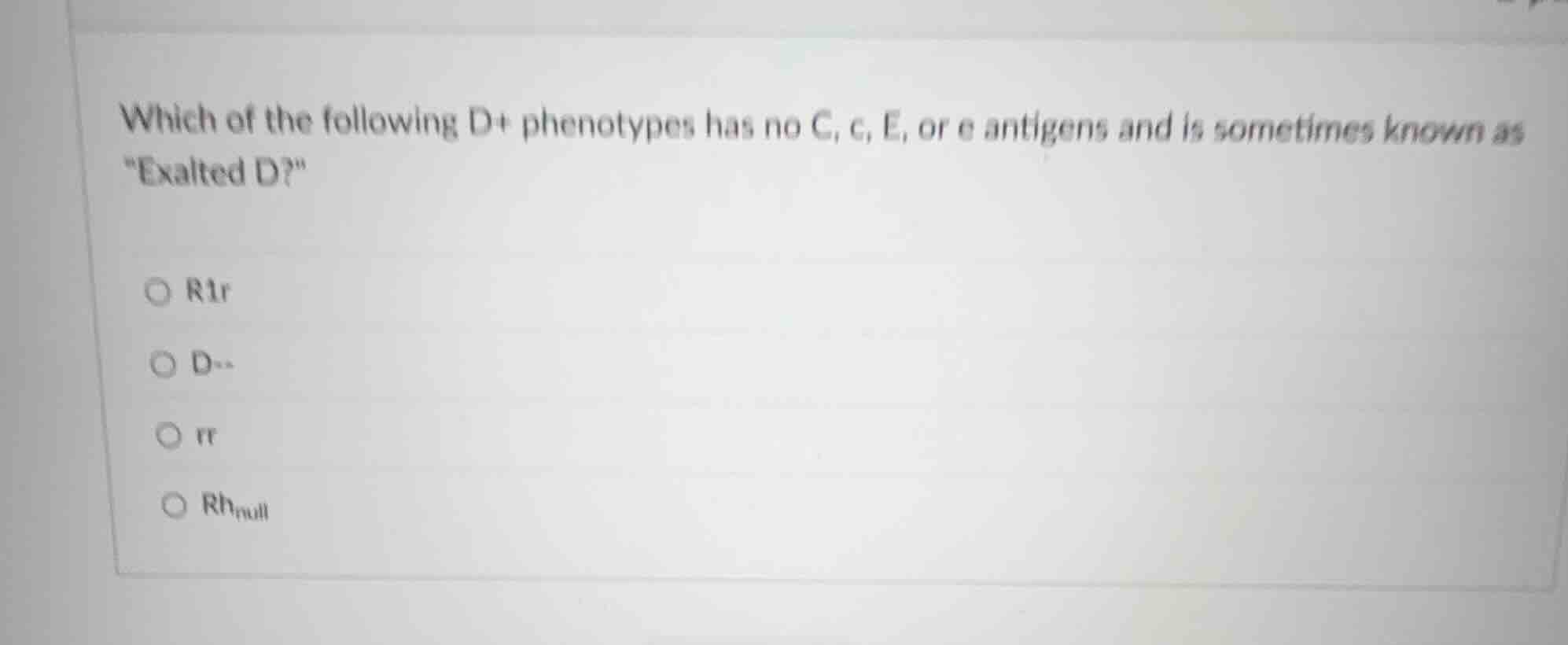
which of the following d+ phenotypes has no c, c, e, or e antigens and is sometimes known as \exalted d?\
- r1r
- d--
- rr
- rh_null
Identify the question requirements
The question asks for a \(D+\) phenotype that lacks all \(C, c, E,\) and \(e\) antigens, and is referred to as "Exalted D".
Analyze the given options
Using the Rh Blood Group System and Wiener Nomenclature knowledge points:
- \(R_1r\): Represents \(DCe/dce\), which possesses \(D, C, e, c\) antigens.
- \(D--\): Represents a deletion phenotype where \(C, c, E, e\) are completely missing, leaving only exceptionally strong \(D\) antigen expression ("Exalted D").
- \(rr\): Represents \(dce/dce\), which is \(D-\) and possesses \(c\) and \(e\) antigens.
- \(Rh_{null}\): Lacks all Rh antigens entirely, including \(D\), so it is not \(D+\).
Address the student's memory query
The student asked why option C (\(r'r'\)) is incorrect:
- \(r'\) represents \(dCe\).
- Therefore, \(r'r'\) represents \(dCe/dCe\).
- This phenotype lacks the \(D\) antigen entirely (\(D-\)) and possesses both \(C\) and \(e\) antigens, which directly violates the requirement of being \(D+\) and lacking \(C, c, E, e\).

Snap & solve any problem in the app
Get step-by-step solutions on Sovi AI
Photo-based solutions with guided steps
Explore more problems and detailed explanations
- (A) R1r
- (B) D-- (Correct answer)
- (C) rr
- (D) Rhnull