Sovi.AI - AI Math Tutor

Scan to solve math questions

QUESTION IMAGE

which of the following happens when you deposit your money in a bank sa…

Question

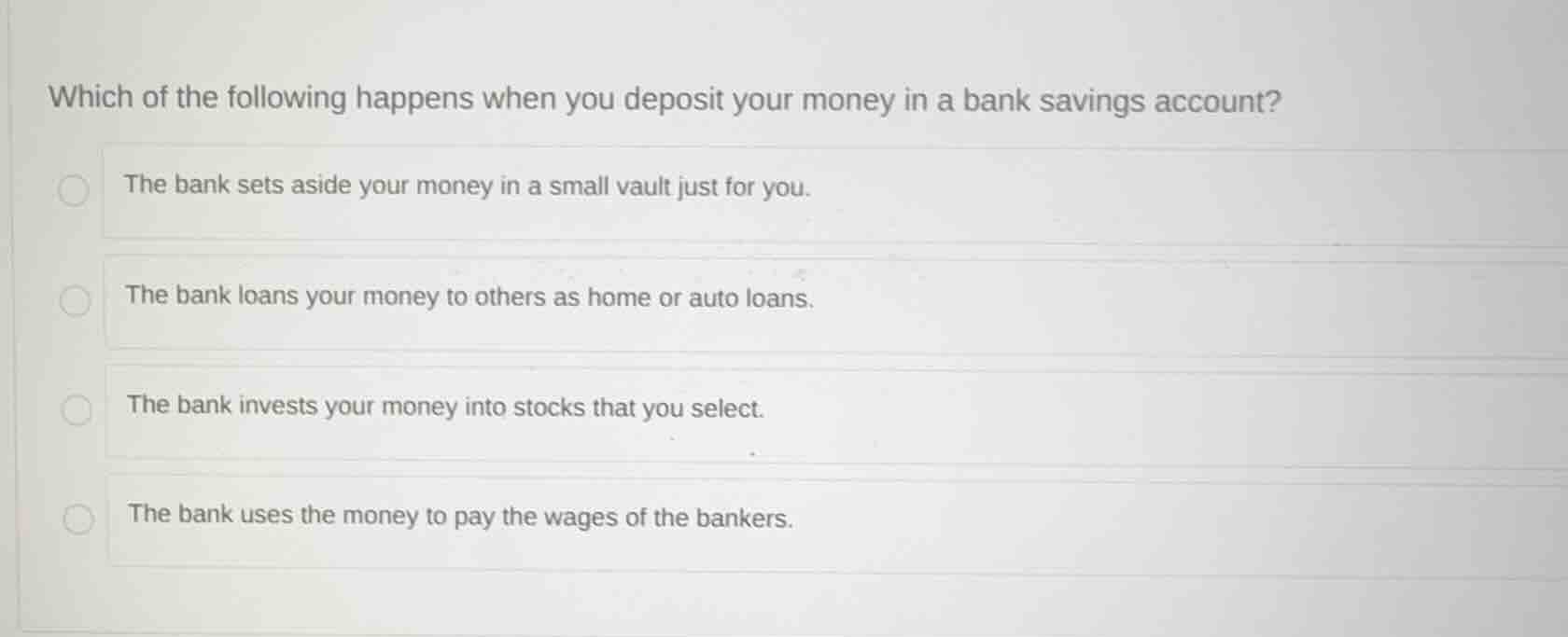
which of the following happens when you deposit your money in a bank savings account?

the bank sets aside your money in a small vault just for you.
the bank loans your money to others as home or auto loans.
the bank invests your money into stocks that you select.
the bank uses the money to pay the wages of the bankers.

Explanation:

Response

<pre_analysis>
{
"quality": "clear",
"question_count": 1,
"skills_matched": [
"direct_cot",
"multiple_choice_formatter",
"explain_then_answer",
"tutor",
"mastery_adaptive_brevity"
],
"needs_drawing": false,
"concepts_used": [
"Banking Operations",
"Financial Intermediation"
],
"new_concepts": [],
"current_concepts": [
"Banking Operations",
"Financial Intermediation"
]
}
</pre_analysis>

<reasoning>

Understand the role of banks

Using the Banking Operations and Financial Intermediation knowledge points

Banks act as financial intermediaries. When you deposit money, they do not store it in an individual vault. Instead, they pool deposits together to fund loans for other customers, such as home mortgages or auto loans, earning interest in the process.

Evaluate the given options

Using the Banking Operations and Financial Intermediation knowledge points

  • Option 1: Incorrect. Banks do not keep physical cash separated in individual vaults.
  • Option 2: Correct. This describes the core function of financial intermediation.
  • Option 3: Incorrect. Banks do not invest savings account deposits into user-selected stocks.
  • Option 4: Incorrect. Deposits are liabilities owed back to customers, not revenue used directly for payroll.

</reasoning>

<answer>
<mcq-option>The bank sets aside your money in a small vault just for you.</mcq-option>
<mcq-correct>The bank loans your money to others as home or auto loans.</mcq-correct>
<mcq-option>The bank invests your money into stocks that you select.</mcq-option>
<mcq-option>The bank uses the money to pay the wages of the bankers.</mcq-option>
</answer>

<post_analysis>
{
"subject": "Business",
"question_type": "Multiple Choice",
"knowledge_point": [
"Business",
"Banking Operations",
"Financial Intermediation"
]
}
</post_analysis>

Answer:

<pre_analysis>
{
"quality": "clear",
"question_count": 1,
"skills_matched": [
"direct_cot",
"multiple_choice_formatter",
"explain_then_answer",
"tutor",
"mastery_adaptive_brevity"
],
"needs_drawing": false,
"concepts_used": [
"Banking Operations",
"Financial Intermediation"
],
"new_concepts": [],
"current_concepts": [
"Banking Operations",
"Financial Intermediation"
]
}
</pre_analysis>

<reasoning>

Understand the role of banks

Using the Banking Operations and Financial Intermediation knowledge points

Banks act as financial intermediaries. When you deposit money, they do not store it in an individual vault. Instead, they pool deposits together to fund loans for other customers, such as home mortgages or auto loans, earning interest in the process.

Evaluate the given options

Using the Banking Operations and Financial Intermediation knowledge points

  • Option 1: Incorrect. Banks do not keep physical cash separated in individual vaults.
  • Option 2: Correct. This describes the core function of financial intermediation.
  • Option 3: Incorrect. Banks do not invest savings account deposits into user-selected stocks.
  • Option 4: Incorrect. Deposits are liabilities owed back to customers, not revenue used directly for payroll.

</reasoning>

<answer>
<mcq-option>The bank sets aside your money in a small vault just for you.</mcq-option>
<mcq-correct>The bank loans your money to others as home or auto loans.</mcq-correct>
<mcq-option>The bank invests your money into stocks that you select.</mcq-option>
<mcq-option>The bank uses the money to pay the wages of the bankers.</mcq-option>
</answer>

<post_analysis>
{
"subject": "Business",
"question_type": "Multiple Choice",
"knowledge_point": [
"Business",
"Banking Operations",
"Financial Intermediation"
]
}
</post_analysis>