QUESTION IMAGE
Question
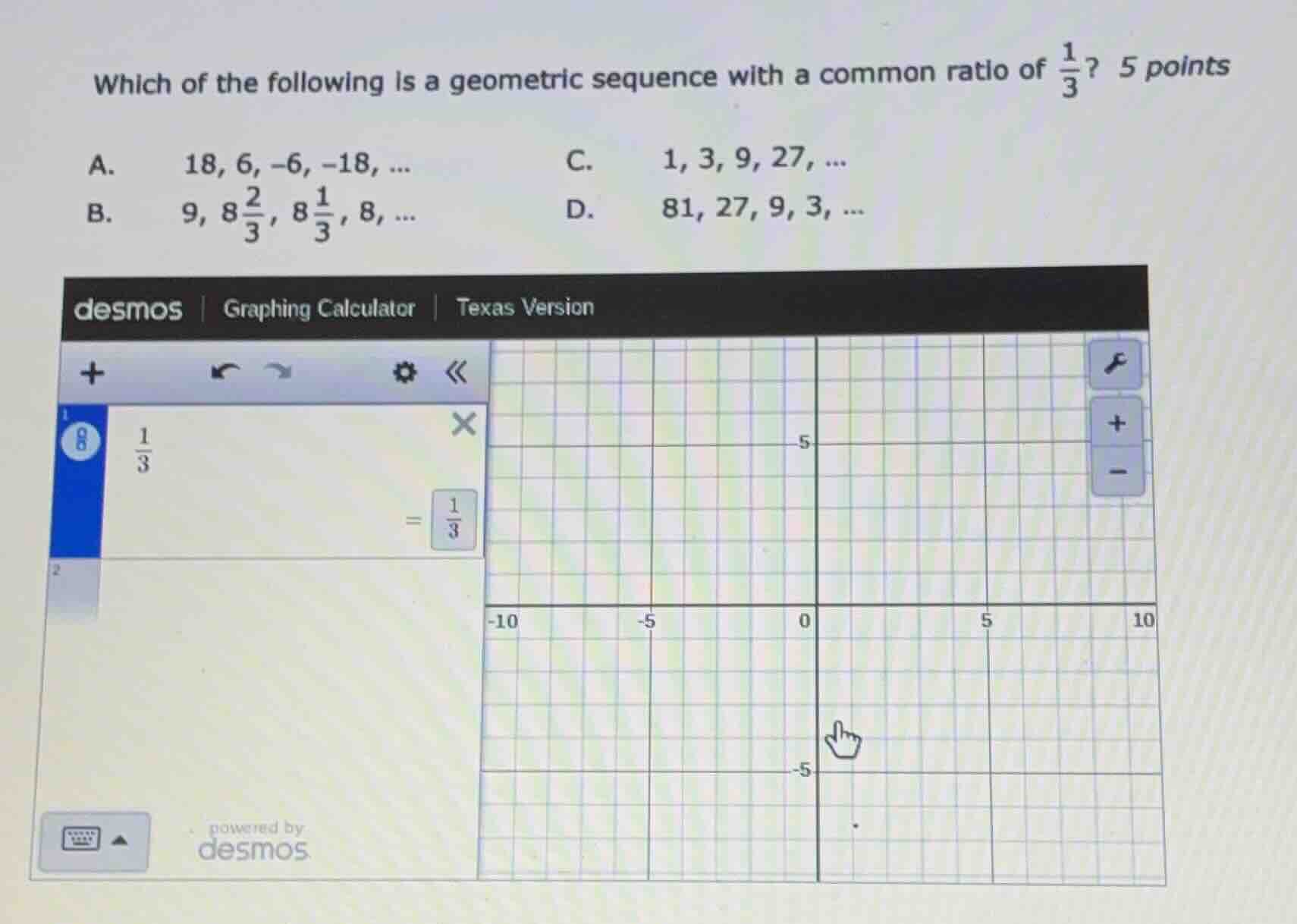
which of the following is a geometric sequence with a common ratio of \\(\frac{1}{3}\\)? 5 points
a. \\(18, 6, -6, -18, \dots\\)
b. \\(9, 8\frac{2}{3}, 8\frac{1}{3}, 8, \dots\\)
c. \\(1, 3, 9, 27, \dots\\)
d. \\(81, 27, 9, 3, \dots\\)
Define geometric sequence
A geometric sequence is a sequence where each term after the first is found by multiplying the previous term by a fixed, non-zero number called the common ratio \(r\).
State common ratio formula
To find the common ratio \(r\), we divide any term by its preceding term:
Analyze option A
The sequence is \(18, 6, -6, -18, \dots\).
Calculate successive ratios:
Since the ratios are not equal, this is not a geometric sequence.
Analyze option B
The sequence is \(9, 8\frac{2}{3}, 8\frac{1}{3}, 8, \dots\).
Calculate successive differences:
This is an arithmetic sequence with a common difference of \(-\frac{1}{3}\), not a geometric sequence.
Analyze options C and D
For option C: \(1, 3, 9, 27, \dots\)
The common ratio is \(3\).
For option D: \(81, 27, 9, 3, \dots\)
The common ratio is indeed \(\frac{1}{3}\).

Snap & solve any problem in the app
Get step-by-step solutions on Sovi AI
Photo-based solutions with guided steps
Explore more problems and detailed explanations
- (A) \(18, 6, -6, -18, \dots\)
- (B) \(9, 8\frac{2}{3}, 8\frac{1}{3}, 8, \dots\)
- (C) \(1, 3, 9, 27, \dots\)
- (D) \(81, 27, 9, 3, \dots\) (Correct answer)