QUESTION IMAGE
Question
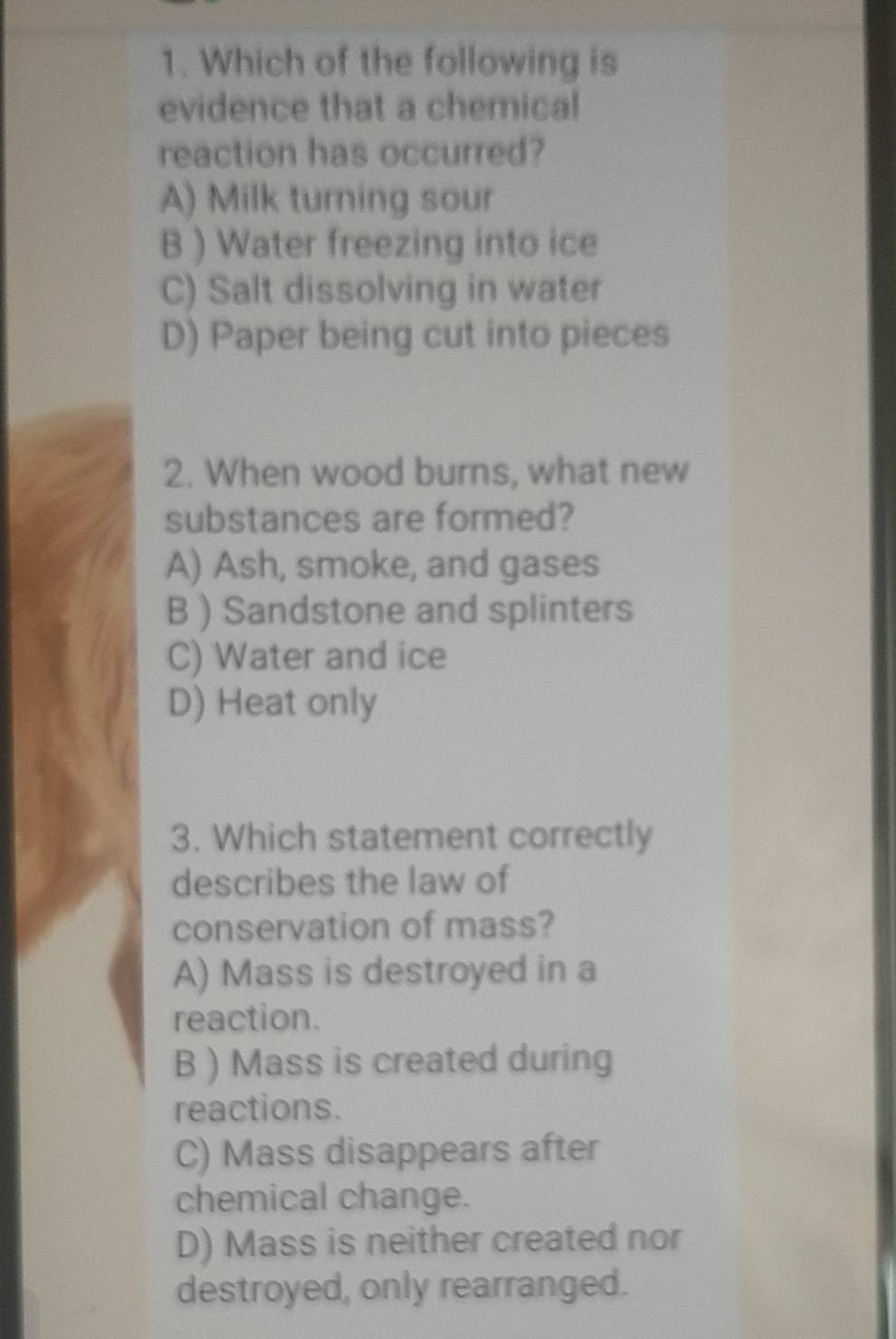
- which of the following is evidence that a chemical reaction has occurred?
a) milk turning sour
b) water freezing into ice
c) salt dissolving in water
d) paper being cut into pieces
- when wood burns, what new substances are formed?
a) ash, smoke, and gases
b) sandstone and splinters
c) water and ice
d) heat only
- which statement correctly describes the law of conservation of mass?
a) mass is destroyed in a reaction.
b) mass is created during reactions.
c) mass disappears after chemical change.
d) mass is neither created nor destroyed, only rearranged.
🆕 New Concept Discovered: Chemical vs. Physical Changes
Identifying if new substances are formed
Step 1: Analyze Question 1 (Evidence of a Chemical Reaction)
To determine if a chemical reaction has occurred, we look for the formation of entirely new substances with different chemical properties.
- A) Milk turning sour: This is a chemical change. Bacteria ferment the lactose in milk into lactic acid, changing its chemical composition, taste, and smell.
- B) Water freezing into ice: This is a physical change. It is only a change of state (liquid to solid); the substance remains \( \text{H}_2\text{O} \).
- C) Salt dissolving in water: This is a physical change. The salt and water mix but do not react to form a new chemical compound; the salt can be recovered by evaporating the water.
- D) Paper being cut into pieces: This is a physical change. Only the size and shape of the paper change, not its chemical identity.
Therefore, the correct option is A.
Step 2: Analyze Question 2 (Substances Formed When Wood Burns)
Burning (combustion) is a chemical reaction where a fuel reacts with oxygen to produce entirely new chemical substances.
- When wood burns, the carbon-based compounds in the wood react with oxygen in the air.
- This chemical reaction produces solid residue (ash), unburnt carbon particles suspended in air (smoke), and gaseous products like carbon dioxide and water vapor (gases).
- Options B, C, and D do not represent the actual chemical products of wood combustion (heat is energy, not a substance).
Therefore, the correct option is A.
Step 3: Analyze Question 3 (Law of Conservation of Mass)
The Law of Conservation of Mass is a fundamental principle in chemistry.
- It states that during any physical or chemical change, the total mass of the system remains constant.
- In other words, atoms are not created out of nothing, nor do they vanish into nothing; they are simply rearranged to form new substances.
- This matches option D: "Mass is neither created nor destroyed, only rearranged."
Therefore, the correct option is D.

Snap & solve any problem in the app
Get step-by-step solutions on Sovi AI
Photo-based solutions with guided steps
Explore more problems and detailed explanations
- A (Milk turning sour)
- A (Ash, smoke, and gases)
- D (Mass is neither created nor destroyed, only rearranged)