QUESTION IMAGE
Question
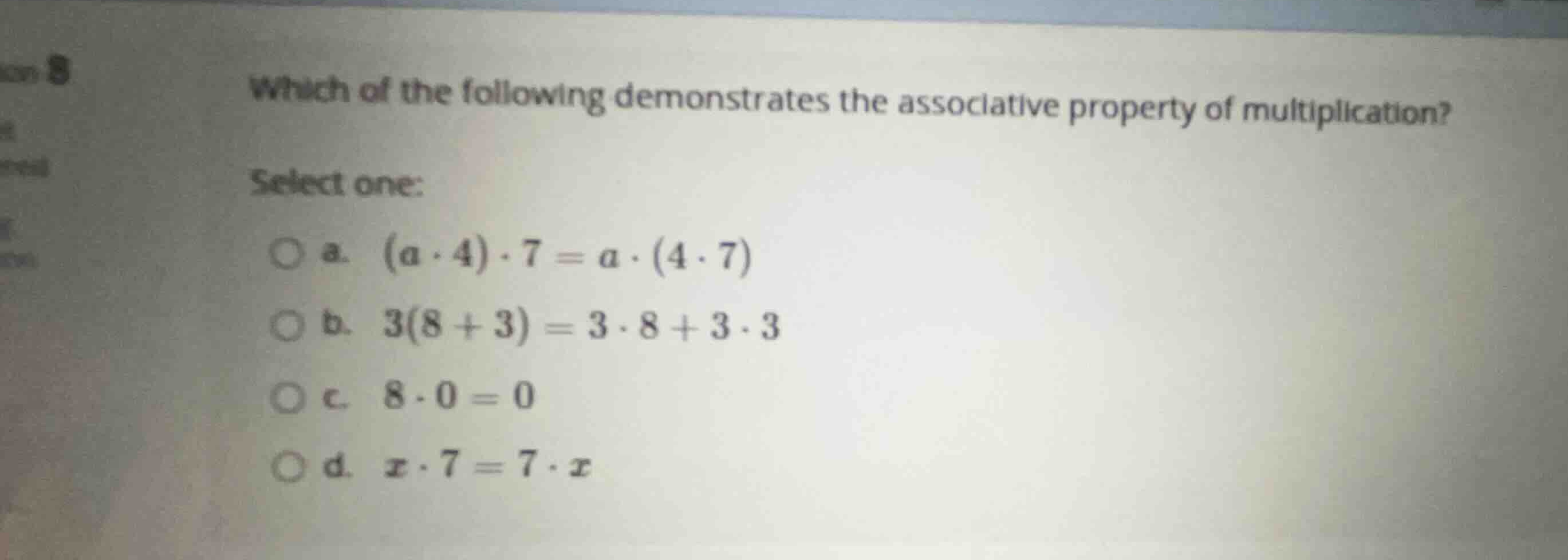
which of the following demonstrates the associative property of multiplication?
select one:
a. \\((a \cdot 4) \cdot 7 = a \cdot (4 \cdot 7)\\)
b. \\(3(8 + 3) = 3 \cdot 8 + 3 \cdot 3\\)
c. \\(8 \cdot 0 = 0\\)
d. \\(x \cdot 7 = 7 \cdot x\\)
Define the associative property
The associative property states grouping does not change the product: \((x \cdot y) \cdot z = x \cdot (y \cdot z)\).
Analyze option a
Option a shows \((a \cdot 4) \cdot 7 = a \cdot (4 \cdot 7)\). This matches the associative property.
Analyze option b
Option b shows \(3(8 + 3) = 3 \cdot 8 + 3 \cdot 3\). This is the distributive property.
Analyze option c
Option c shows \(8 \cdot 0 = 0\). This is the Zero Property of Multiplication.
Analyze option d
Option d shows \(x \cdot 7 = 7 \cdot x\). This is the commutative property.

Snap & solve any problem in the app
Get step-by-step solutions on Sovi AI
Photo-based solutions with guided steps
Explore more problems and detailed explanations
- a. \((a \cdot 4) \cdot 7 = a \cdot (4 \cdot 7)\) (Correct answer)
- b. \(3(8 + 3) = 3 \cdot 8 + 3 \cdot 3\)
- c. \(8 \cdot 0 = 0\)
- d. \(x \cdot 7 = 7 \cdot x\)