QUESTION IMAGE
Question
which of the following completes the proof?
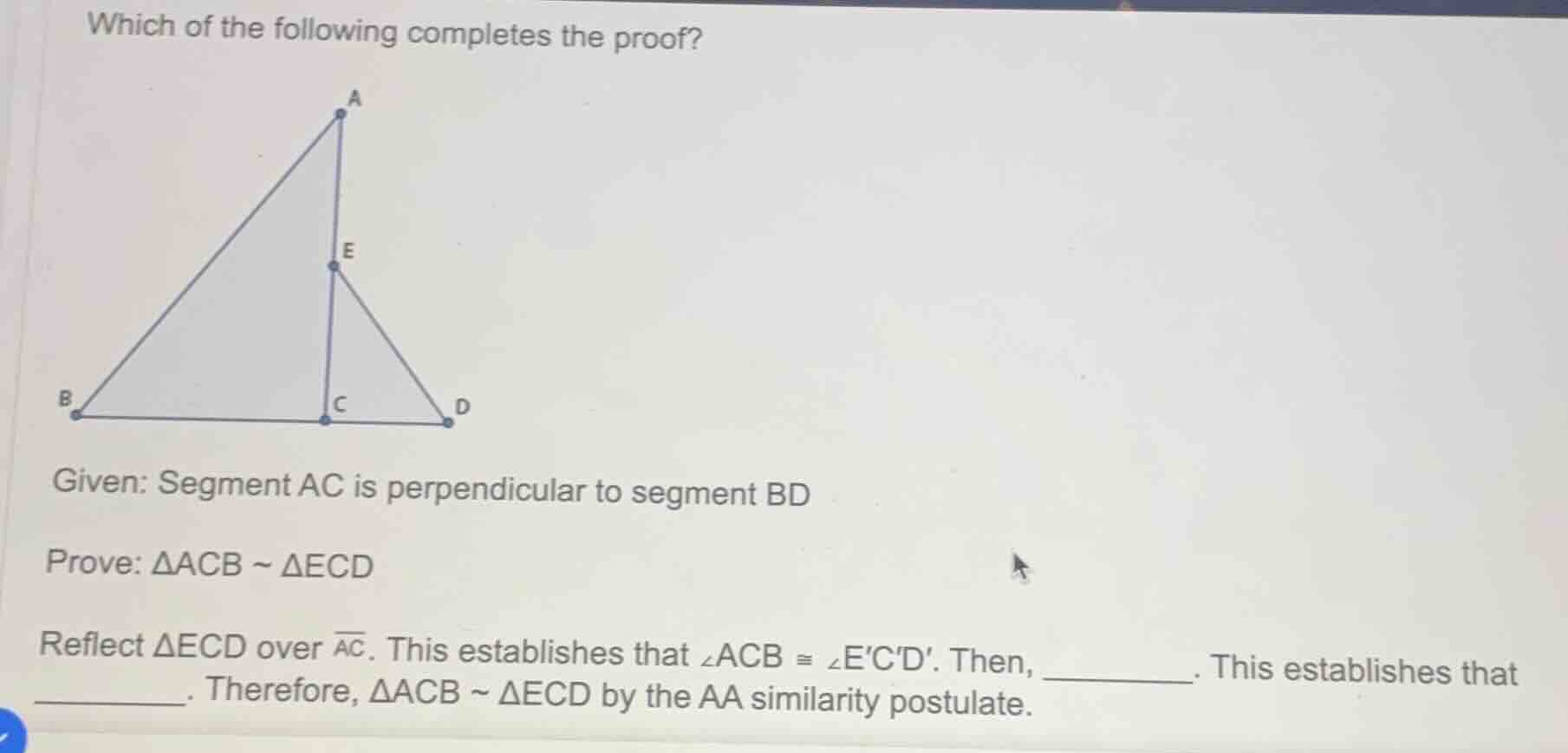
given: segment ac is perpendicular to segment bd
prove: \\(\delta acb \sim \delta ecd\\)
reflect \\(\delta ecd\\) over \\(\overline{ac}\\). this establishes that \\(\angle acb \cong \angle ecd\\). then, _____. this establishes that _____. therefore, \\(\delta acb \sim \delta ecd\\) by the aa similarity postulate.
Analyze the given proof structure
The goal is to prove \(\triangle ACB \sim \triangle ECD\) using similarity transformations and the AA Similarity Postulate.
We are given that segment \(AC\) is perpendicular to segment \(BD\). This means \(\angle ACB\) and \(\angle ECD\) are both right angles, so \(\angle ACB \cong \angle ECD\).
Trace the transformations
- Reflection: Reflect \(\triangle ECD\) over line \(AC\). This maps point \(C\) to itself (since \(C\) lies on the line of reflection) and maps the ray \(CD\) onto the ray \(CB\). Let the image of \(\triangle ECD\) be \(\triangle E'C'D'\) (where \(C' = C\)). This reflection preserves angle measures, establishing that \(\angle ACB \cong \angle E'C'D'\).
- Dilation: To map \(\triangle E'C'D'\) onto \(\triangle ACB\), we need to dilate \(\triangle E'C'D'\) centered at point \(C\) by a scale factor of \(\frac{AC}{EC}\) (or \(\frac{BC}{DC}\)).
- Establish Angle Congruence: A dilation centered at \(C\) maps ray \(CE'\) onto ray \(CA\) and ray \(CD'\) onto ray \(CB\). Since dilations preserve angle measures, the image of \(\angle C'E'D'\) (which is \(\angle CED\)) is congruent to \(\angle CAB\). This establishes that \(\angle CAB \cong \angle CED\).
- Conclusion: Since we have established two pairs of congruent angles (\(\angle ACB \cong \angle ECD\) and \(\angle CAB \cong \angle CED\)), the triangles are similar by the AA Similarity Postulate.
Fill in the blanks
- First blank: Describe the dilation. "dilate \(\triangle E'C'D'\) centered at point \(C\) by a scale factor of \(\frac{AC}{EC}\)" (or equivalent scale factor).
- Second blank: State the resulting angle congruence. "\(\angle CAB \cong \angle CED\)" (or \(\angle B \cong \angle D\)).

Snap & solve any problem in the app
Get step-by-step solutions on Sovi AI
Photo-based solutions with guided steps
Explore more problems and detailed explanations
Reflect \(\triangle ECD\) over \(\overline{AC}\). This establishes that \(\angle ACB \cong \angle E'C'D'\). Then, <blank>dilate \(\triangle E'C'D'\) about center \(C\) by a scale factor of \(\frac{AC}{EC}\)</blank>. This establishes that <blank>\(\angle CAB \cong \angle CED\)</blank>. Therefore, \(\triangle ACB \sim \triangle ECD\) by the AA similarity postulate.