QUESTION IMAGE
Question
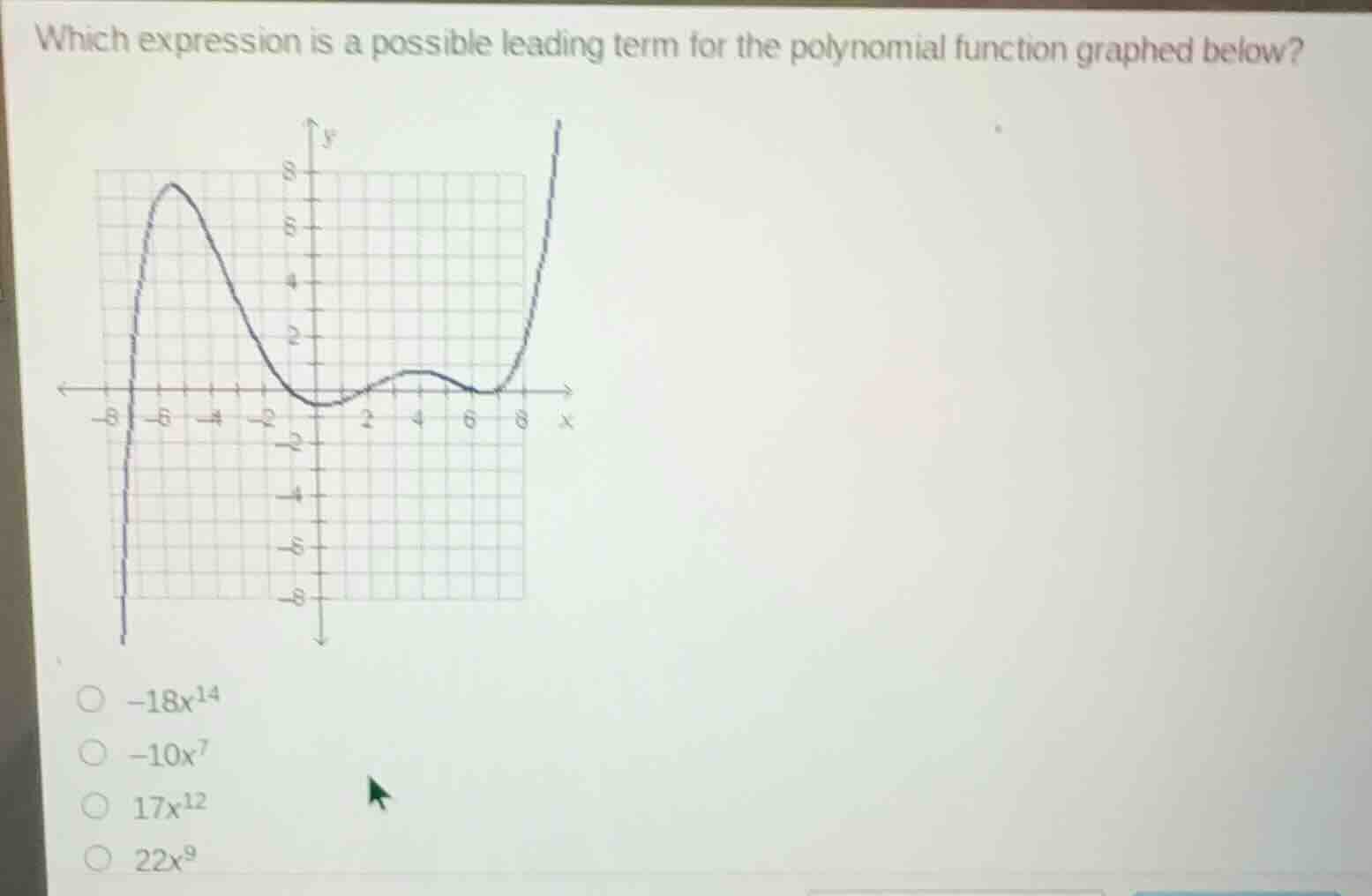
which expression is a possible leading term for the polynomial function graphed below?
\\( -18x^{14} \\)
\\( -10x^7 \\)
\\( 17x^{12} \\)
\\( 22x^9 \\)
Analyze the end behavior of the graph
The graph of the polynomial function falls to the left (\(y \to -\infty\) as \(x \to -\infty\)) and rises to the right (\(y \to \infty\) as \(x \to \infty\)). This opposite end behavior indicates that the polynomial must have an odd degree. Furthermore, because it rises to the right, the leading coefficient must be positive.
Analyze the roots and their multiplicities
Using the Roots of Polynomials concept, we identify the \(x\)-intercepts:
- At \(x = -7\), the graph crosses the \(x\)-axis, indicating a root with an odd multiplicity (minimum multiplicity of 1).
- At \(x = 1\), the graph crosses the \(x\)-axis, indicating a root with an odd multiplicity (minimum multiplicity of 1).
- At \(x = 7\), the graph is tangent to the \(x\)-axis and turns around, indicating a root with an even multiplicity (minimum multiplicity of 2).
Using the Multiplicity of Roots concept, the sum of the multiplicities of these real roots is at least \(1 + 1 + 2 = 4\). Since the overall degree of the polynomial must be odd, the minimum possible degree of the polynomial is 5 (or any odd integer greater than or equal to 5).
Determine the correct leading term
The leading term of a polynomial is of the form \(a_n x^n\). Based on our analysis:
- The degree \(n\) must be an odd integer: \(n \ge 5\).
- The leading coefficient \(a_n\) must be positive: \(a_n > 0\).
Let's evaluate the given options:
- \(-18x^{14}\): Even degree, negative coefficient (Incorrect).
- \(-10x^7\): Odd degree, negative coefficient (Incorrect).
- \(17x^{12}\): Even degree, positive coefficient (Incorrect).
- \(22x^9\): Odd degree (\(9 \ge 5\)), positive coefficient (\(22 > 0\)) (Correct).

Snap & solve any problem in the app
Get step-by-step solutions on Sovi AI
Photo-based solutions with guided steps
Explore more problems and detailed explanations
- (A) \(-18x^{14}\)
- (B) \(-10x^7\)
- (C) \(17x^{12}\)
- (D) \(22x^9\) (Correct answer)