QUESTION IMAGE
Question
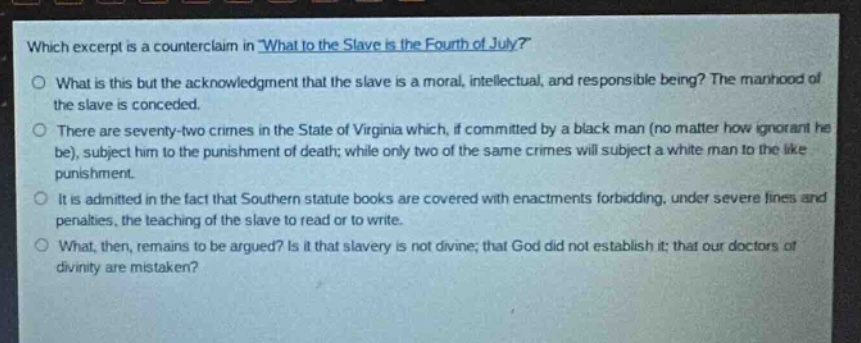
which excerpt is a counterclaim in \what to the slave is the fourth of july?\
what is this but the acknowledgment that the slave is a moral, intellectual, and responsible being? the manhood of the slave is conceded.
there are seventy-two crimes in the state of virginia which, if committed by a black man (no matter how ignorant he be), subject him to the punishment of death; while only two of the same crimes will subject a white man to the like punishment.
it is admitted in the fact that southern statute books are covered with enactments forbidding, under severe fines and penalties, the teaching of the slave to read or to write.
what, then, remains to be argued? is it that slavery is not divine; that god did not establish it; that our doctors of divinity are mistaken?
🆕 New Concept Discovered: Identifying Counterclaims
An opposing argument that challenges the author's main stance.
Step 1: Understand the concept of a counterclaim
A counterclaim is an argument, claim, or position that opposes, contradicts, or challenges the author's central argument. In Frederick Douglass's speech "What to the Slave is the Fourth of July?", his main argument is that slavery is a moral outrage, unconstitutional, and un-Christian, and that enslaved people are human beings deserving of liberty.
A counterclaim in this context is an argument used by defenders of slavery to justify the institution.
Step 2: Analyze the options
- Option 1: "What is this but the acknowledgment that the slave is a moral, intellectual, and responsible being? The manhood of the slave is conceded."
- Analysis: This is Douglass's own argument proving that society already acknowledges the humanity of enslaved people. It is not an opposing claim.
- Option 3: "It is admitted in the fact that Southern statute books are covered with enactments forbidding, under severe fines and penalties, the teaching of the slave to read or to write."
- Analysis: This is evidence Douglass uses to show that laws recognize the intelligence of enslaved people. It supports his main argument.
- Option 2: "There are seventy-two crimes in the State of Virginia which, if committed by a black man... subject him to the punishment of death; while only two of the same crimes will subject a white man to the like punishment."
- Analysis: This is factual evidence Douglass uses to show the double standards and inherent injustice of the legal system.
- Option 4: "What, then, remains to be argued? Is it that slavery is not divine; that God did not establish it; that our doctors of divinity are mistaken?"
- Analysis: Here, Douglass addresses the common pro-slavery argument (counterclaim) of his time: that slavery was divinely ordained by God and supported by religious leaders ("doctors of divinity"). By bringing up the claim that "slavery is divine" and "God established it," he is directly identifying and preparing to refute a major counterclaim used by defenders of slavery.

Snap & solve any problem in the app
Get step-by-step solutions on Sovi AI
Photo-based solutions with guided steps
Explore more problems and detailed explanations
What, then, remains to be argued? Is it that slavery is not divine; that God did not establish it; that our doctors of divinity are mistaken?