QUESTION IMAGE
Question
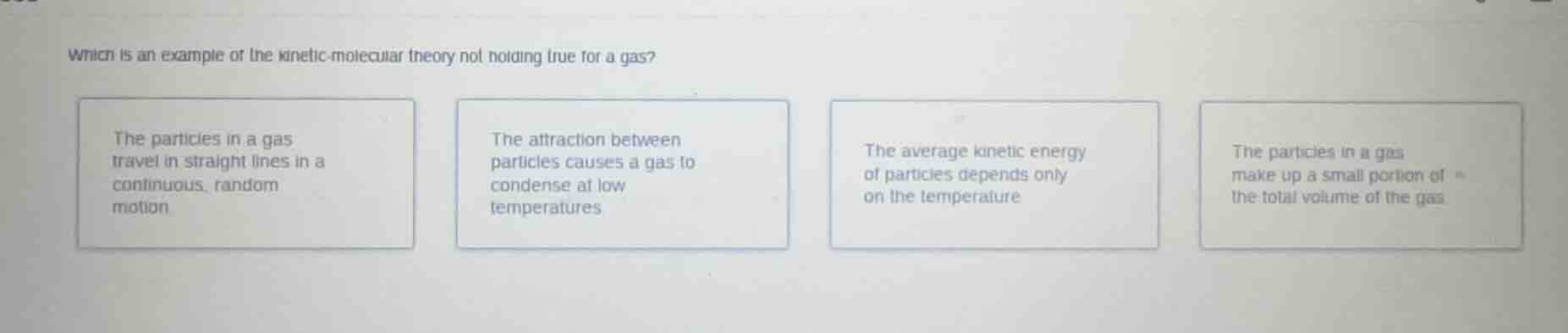
which is an example of the kinetic-molecular theory not holding true for a gas?
- the particles in a gas travel in straight lines in a continuous, random motion.
- the attraction between particles causes a gas to condense at low temperatures.
- the average kinetic energy of particles depends only on the temperature.
- the particles in a gas make up a small portion of the total volume of the gas.
Identify the core principles of Kinetic Molecular Theory
Using the Kinetic Molecular Theory knowledge point
- Gas particles move in continuous, random, straight-line motion.
- The volume of individual gas particles is negligible compared to the total container volume.
- There are no attractive or repulsive intermolecular forces between gas particles.
- The average kinetic energy of gas particles is directly proportional to the absolute temperature.
Analyze the given options against the theory
Using the Real Gas Deviations knowledge point
- Option 1: "The particles in a gas travel in straight lines in a continuous, random motion." This is a core postulate of Kinetic Molecular Theory (KMT).
- Option 2: "The attraction between particles causes a gas to condense at low temperatures." KMT assumes no intermolecular attractions. In real gases, attractions exist and cause condensation, representing a deviation where KMT does not hold true.
- Option 3: "The average kinetic energy of particles depends only on the temperature." This is a core postulate of KMT.
- Option 4: "The particles in a gas make up a small portion of the total volume of the gas." This aligns with the KMT assumption of negligible particle volume.
Determine the correct choice
Using the Real Gas Deviations knowledge point
- Option 2 describes a real-world behavior (condensation due to intermolecular forces) that directly violates the KMT assumption of zero attractive forces.

Snap & solve any problem in the app
Get step-by-step solutions on Sovi AI
Photo-based solutions with guided steps
Explore more problems and detailed explanations
- (A) The particles in a gas travel in straight lines in a continuous, random motion.
- (B) The attraction between particles causes a gas to condense at low temperatures. (Correct answer)
- (C) The average kinetic energy of particles depends only on the temperature.
- (D) The particles in a gas make up a small portion of the total volume of the gas.