QUESTION IMAGE
Question
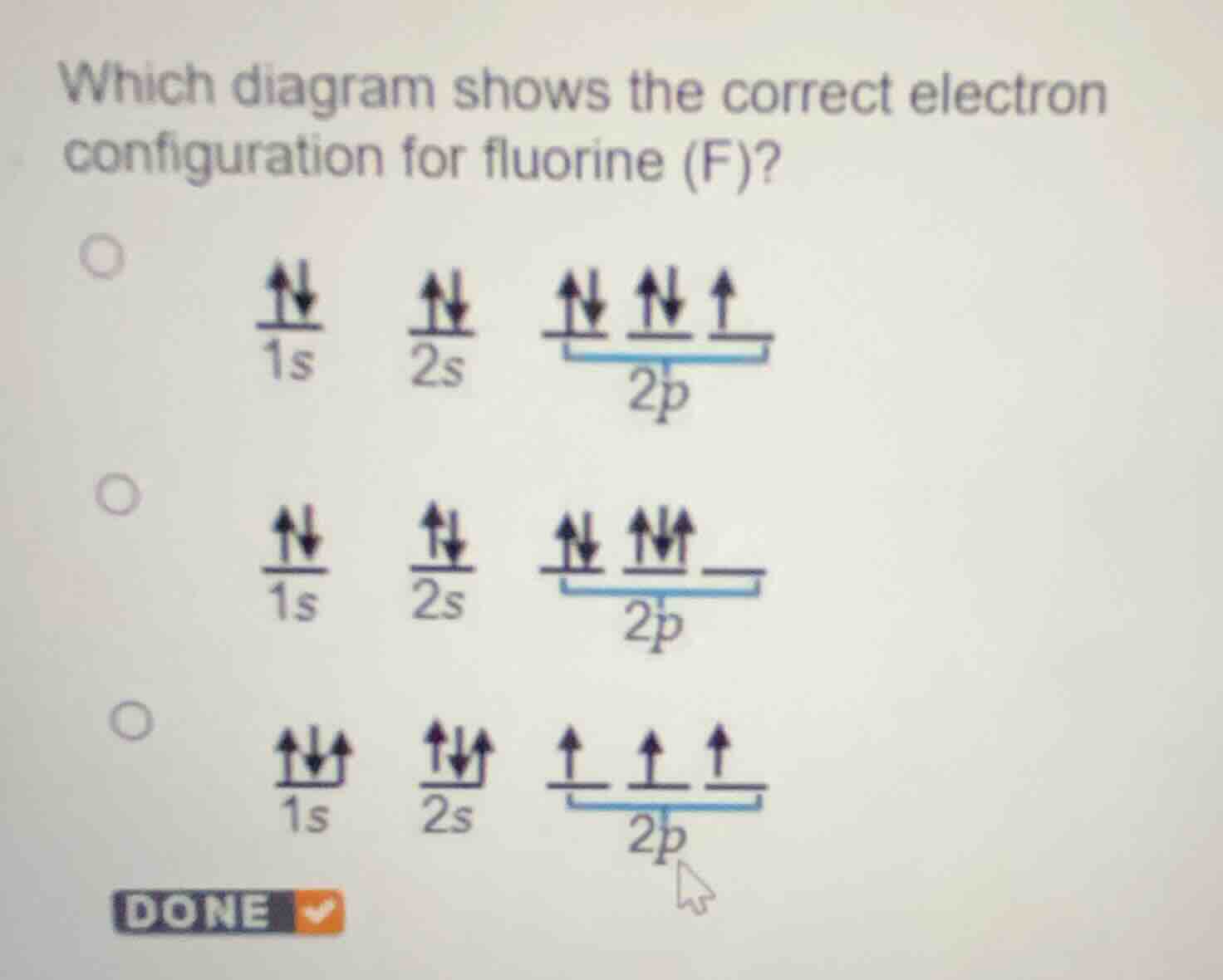
which diagram shows the correct electron configuration for fluorine (f)?
Identify atomic number of fluorine
Fluorine (\(\text{F}\)) has an atomic number of 9, meaning a neutral fluorine atom has 9 electrons.
Determine correct orbital filling
Following the Aufbau principle, Hund's rule, and the Pauli exclusion principle:
- The \(1s\) orbital holds 2 electrons: \(\uparrow\downarrow\)
- The \(2s\) orbital holds 2 electrons: \(\uparrow\downarrow\)
- The remaining 5 electrons fill the three \(2p\) orbitals: two orbitals are fully filled with 2 electrons each, and one orbital has 1 electron: \(\uparrow\downarrow\ \uparrow\downarrow\ \uparrow\)
Match with given options
- Option 1 shows \(1s^2\ 2s^2\ 2p^5\) with two paired \(2p\) orbitals and one unpaired \(2p\) orbital. This is correct.
- Option 2 shows \(1s^2\ 2s^2\ 2p^4\) with one empty \(2p\) orbital, which violates Hund's rule and has only 8 electrons.
- Option 3 shows \(1s^2\ 2s^2\ 2p^3\) with only 7 electrons (nitrogen configuration).

Snap & solve any problem in the app
Get step-by-step solutions on Sovi AI
Photo-based solutions with guided steps
Explore more problems and detailed explanations
- (A) First diagram: 1s with 2 electrons, 2s with 2 electrons, 2p with 5 electrons (two paired, one unpaired) (Correct answer)
- (B) Second diagram: 1s with 2 electrons, 2s with 2 electrons, 2p with 4 electrons (two paired, one empty)
- (C) Third diagram: 1s with 2 electrons, 2s with 2 electrons, 2p with 3 electrons (three unpaired)