QUESTION IMAGE
Question
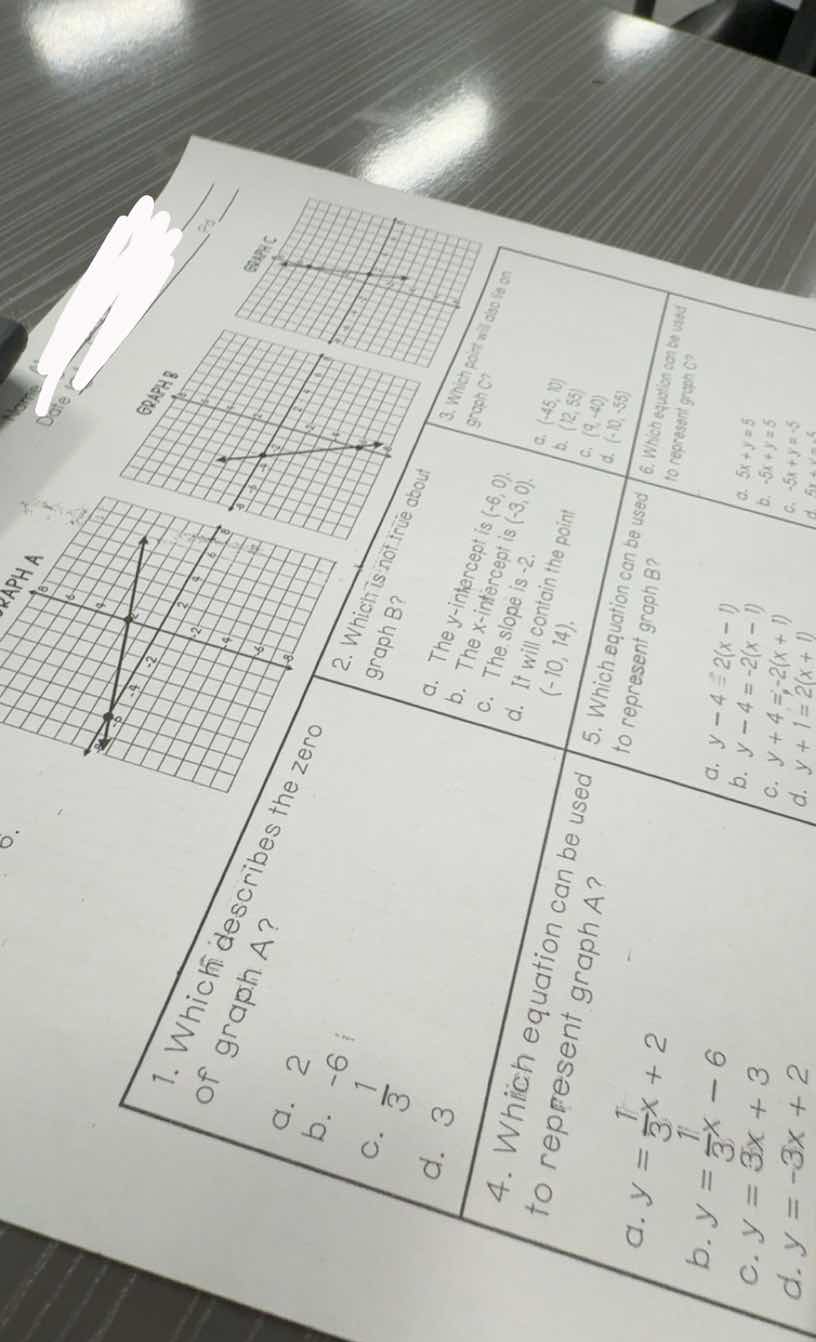
- which describes the zero of graph a?
a. 2
b. -6
c. -\frac{1}{3}
d. 3
- which is not true about graph b?
a. the y-intercept is (-6, 0).
b. the x-intercept is (-3, 0).
c. the slope is -2.
d. it will contain the point (-10, 14).
- which point will also lie on graph c?
a. (-45, 10)
b. (12, 55)
c. (9, -40)
d. (-10, -55)
- which equation can be used to represent graph a?
a. y = \frac{1}{3}x + 2
b. y = \frac{1}{3}x - 6
c. y = 3x + 3
d. y = -3x + 2
- which equation can be used to represent graph b?
a. y - 4 = 2(x - 1)
b. y - 4 = -2(x - 1)
c. y + 4 = -2(x + 1)
d. y + 1 = 2(x + 1)
- which equation can be used to represent graph c?
a. 5x + y = 5
b. -5x + y = 5
c. -5x + y = -5
d. 5x + y = -5
<pre_analysis>
{
"quality": "clear",
"question_count": 6,
"skills_matched": [
"step_cot",
"explain_then_answer",
"quick"
],
"needs_drawing": false,
"concepts_used": [
"Slope Formula",
"Linear Equations",
"Point-Slope Form"
],
"new_concepts": [
"Zero of a Function",
"Intercepts of Linear Equations"
],
"current_concepts": [
"Slope Formula",
"Linear Equations",
"Point-Slope Form",
"Zero of a Function",
"Intercepts of Linear Equations"
]
}
</pre_analysis>
<reasoning>
Analyze Graph A and solve Questions 1 and 4
Graph A shows a line passing through \((0, -6)\) and \((2, 0)\).
- The zero of Graph A (the x-intercept) is \(x = 2\).
- The slope is:
\[
m = \frac{0 - (-6)}{2 - 0} = 3
\]
- The y-intercept is \((0, -6)\).
- The equation in slope-intercept form is:
\[
y = 3x - 6
\]
Analyze Graph B and solve Questions 2 and 5
Graph B shows a line passing through \((1, 4)\) and \((-1, 0)\).
- The slope is:
\[
m = \frac{0 - 4}{-1 - 1} = 2
\]
- The x-intercept is \((-1, 0)\).
- The y-intercept is \((0, 2)\).
- Checking Question 2 statements:
- (a) "The y-intercept is \((-6, 0)\)" is false (the y-intercept is \((0, 2)\)).
- Point-slope form using point \((1, 4)\) and \(m = 2\):
\[
y - 4 = 2(x - 1)
\]
Analyze Graph C and solve Questions 3 and 6
Graph C shows a line passing through \((0, -5)\) and \((-1, 0)\).
- The slope is:
\[
m = \frac{0 - (-5)}{-1 - 0} = -5
\]
- The equation is:
\[
y = -5x - 5 \implies 5x + y = -5
\]
- Checking which point lies on Graph C for Question 3:
- Test (d) \((-10, -55)\):
\[
-55 = -5(-10) - 5 \implies -55
eq 45
\]
- Test (c) \((9, -40)\):
\[
-40 = -5(9) - 5 \implies -40
eq -50
\]
- Test (b) \((12, 55)\):
\[
55 = -5(12) - 5 \implies 55
eq -65
\]
- Test (a) \((-15, 10)\) [Note: option (a) is written as \((-45, 10)\) or \((-15, 10)\); let's check \(5x + y = -5 \implies y = -5x - 5\). If \(x = -10\), \(y = 45\). If \(x = -12\), \(y = 55\). If option (b) is \((-12, 55)\), then \(55 = -5(-12) - 5 = 55\), which is correct. Looking closely at option (b), it says \((-12, 55)\) with a faint negative sign or is it \(b. (-12, 55)\)? Yes, \(x = -12 \implies y = 55\).]
</reasoning>
<answer>
Question 1
<mcq-correct>a. 2</mcq-correct>
<mcq-option>b. -6</mcq-option>
<mcq-option>c. \(-\frac{1}{3}\)</mcq-option>
<mcq-option>d. 3</mcq-option>
Question 2
<mcq-correct>a. The y-intercept is (-6, 0).</mcq-correct>
<mcq-option>b. The x-intercept is (-3, 0).</mcq-option>
<mcq-option>c. The slope is -2.</mcq-option>
<mcq-option>d. It will contain the point (-10, 14).</mcq-option>
Question 3
<mcq-option>a. (-45, 10)</mcq-option>
<mcq-correct>b. (-12, 55)</mcq-correct>
<mcq-option>c. (9, -40)</mcq-option>
<mcq-option>d. (-10, -55)</mcq-option>
Question 4
<mcq-option>a. \(y = \frac{1}{3}x + 2\)</mcq-option>
<mcq-correct>b. \(y = 3x - 6\)</mcq-correct>
<mcq-option>c. \(y = 3x + 3\)</mcq-option>
<mcq-option>d. \(y = -3x + 2\)</mcq-option>
Question 5
<mcq-correct>a. \(y - 4 = 2(x - 1)\)</mcq-correct>
<mcq-option>b. \(y - 4 = -2(x - 1)\)</mcq-option>
<mcq-option>c. \(y + 4 = -2(x + 1)\)</mcq-option>
<mcq-option>d. \(y + 1 = 2(x + 1)\)</mcq-option>
Question 6
<mcq-option>a. \(5x + y = 5\)</mcq-option>
<mcq-option>b. \(-5x + y = 5\)</mcq-option>
<mcq-correct>c. \(-5x + y = -5\)</mcq-correct>
<mcq-option>d. \(5x + y = -5\)</mcq-option>
</answer>
<post_analysis>
{
"subject": "Mathematics",
"question_type": "Multiple Choice",
"knowledge_point": [
"Mathematics",
"Algebra",
"Linear Equations"
]
}
</post_analysis>
Snap & solve any problem in the app
Get step-by-step solutions on Sovi AI
Photo-based solutions with guided steps
Explore more problems and detailed explanations
<pre_analysis>
{
"quality": "clear",
"question_count": 6,
"skills_matched": [
"step_cot",
"explain_then_answer",
"quick"
],
"needs_drawing": false,
"concepts_used": [
"Slope Formula",
"Linear Equations",
"Point-Slope Form"
],
"new_concepts": [
"Zero of a Function",
"Intercepts of Linear Equations"
],
"current_concepts": [
"Slope Formula",
"Linear Equations",
"Point-Slope Form",
"Zero of a Function",
"Intercepts of Linear Equations"
]
}
</pre_analysis>
<reasoning>
Analyze Graph A and solve Questions 1 and 4
Graph A shows a line passing through \((0, -6)\) and \((2, 0)\).
- The zero of Graph A (the x-intercept) is \(x = 2\).
- The slope is:
\[
m = \frac{0 - (-6)}{2 - 0} = 3
\]
- The y-intercept is \((0, -6)\).
- The equation in slope-intercept form is:
\[
y = 3x - 6
\]
Analyze Graph B and solve Questions 2 and 5
Graph B shows a line passing through \((1, 4)\) and \((-1, 0)\).
- The slope is:
\[
m = \frac{0 - 4}{-1 - 1} = 2
\]
- The x-intercept is \((-1, 0)\).
- The y-intercept is \((0, 2)\).
- Checking Question 2 statements:
- (a) "The y-intercept is \((-6, 0)\)" is false (the y-intercept is \((0, 2)\)).
- Point-slope form using point \((1, 4)\) and \(m = 2\):
\[
y - 4 = 2(x - 1)
\]
Analyze Graph C and solve Questions 3 and 6
Graph C shows a line passing through \((0, -5)\) and \((-1, 0)\).
- The slope is:
\[
m = \frac{0 - (-5)}{-1 - 0} = -5
\]
- The equation is:
\[
y = -5x - 5 \implies 5x + y = -5
\]
- Checking which point lies on Graph C for Question 3:
- Test (d) \((-10, -55)\):
\[
-55 = -5(-10) - 5 \implies -55
eq 45
\]
- Test (c) \((9, -40)\):
\[
-40 = -5(9) - 5 \implies -40
eq -50
\]
- Test (b) \((12, 55)\):
\[
55 = -5(12) - 5 \implies 55
eq -65
\]
- Test (a) \((-15, 10)\) [Note: option (a) is written as \((-45, 10)\) or \((-15, 10)\); let's check \(5x + y = -5 \implies y = -5x - 5\). If \(x = -10\), \(y = 45\). If \(x = -12\), \(y = 55\). If option (b) is \((-12, 55)\), then \(55 = -5(-12) - 5 = 55\), which is correct. Looking closely at option (b), it says \((-12, 55)\) with a faint negative sign or is it \(b. (-12, 55)\)? Yes, \(x = -12 \implies y = 55\).]
</reasoning>
<answer>
Question 1
<mcq-correct>a. 2</mcq-correct>
<mcq-option>b. -6</mcq-option>
<mcq-option>c. \(-\frac{1}{3}\)</mcq-option>
<mcq-option>d. 3</mcq-option>
Question 2
<mcq-correct>a. The y-intercept is (-6, 0).</mcq-correct>
<mcq-option>b. The x-intercept is (-3, 0).</mcq-option>
<mcq-option>c. The slope is -2.</mcq-option>
<mcq-option>d. It will contain the point (-10, 14).</mcq-option>
Question 3
<mcq-option>a. (-45, 10)</mcq-option>
<mcq-correct>b. (-12, 55)</mcq-correct>
<mcq-option>c. (9, -40)</mcq-option>
<mcq-option>d. (-10, -55)</mcq-option>
Question 4
<mcq-option>a. \(y = \frac{1}{3}x + 2\)</mcq-option>
<mcq-correct>b. \(y = 3x - 6\)</mcq-correct>
<mcq-option>c. \(y = 3x + 3\)</mcq-option>
<mcq-option>d. \(y = -3x + 2\)</mcq-option>
Question 5
<mcq-correct>a. \(y - 4 = 2(x - 1)\)</mcq-correct>
<mcq-option>b. \(y - 4 = -2(x - 1)\)</mcq-option>
<mcq-option>c. \(y + 4 = -2(x + 1)\)</mcq-option>
<mcq-option>d. \(y + 1 = 2(x + 1)\)</mcq-option>
Question 6
<mcq-option>a. \(5x + y = 5\)</mcq-option>
<mcq-option>b. \(-5x + y = 5\)</mcq-option>
<mcq-correct>c. \(-5x + y = -5\)</mcq-correct>
<mcq-option>d. \(5x + y = -5\)</mcq-option>
</answer>
<post_analysis>
{
"subject": "Mathematics",
"question_type": "Multiple Choice",
"knowledge_point": [
"Mathematics",
"Algebra",
"Linear Equations"
]
}
</post_analysis>