Sovi.AI - AI Math Tutor

Scan to solve math questions

QUESTION IMAGE

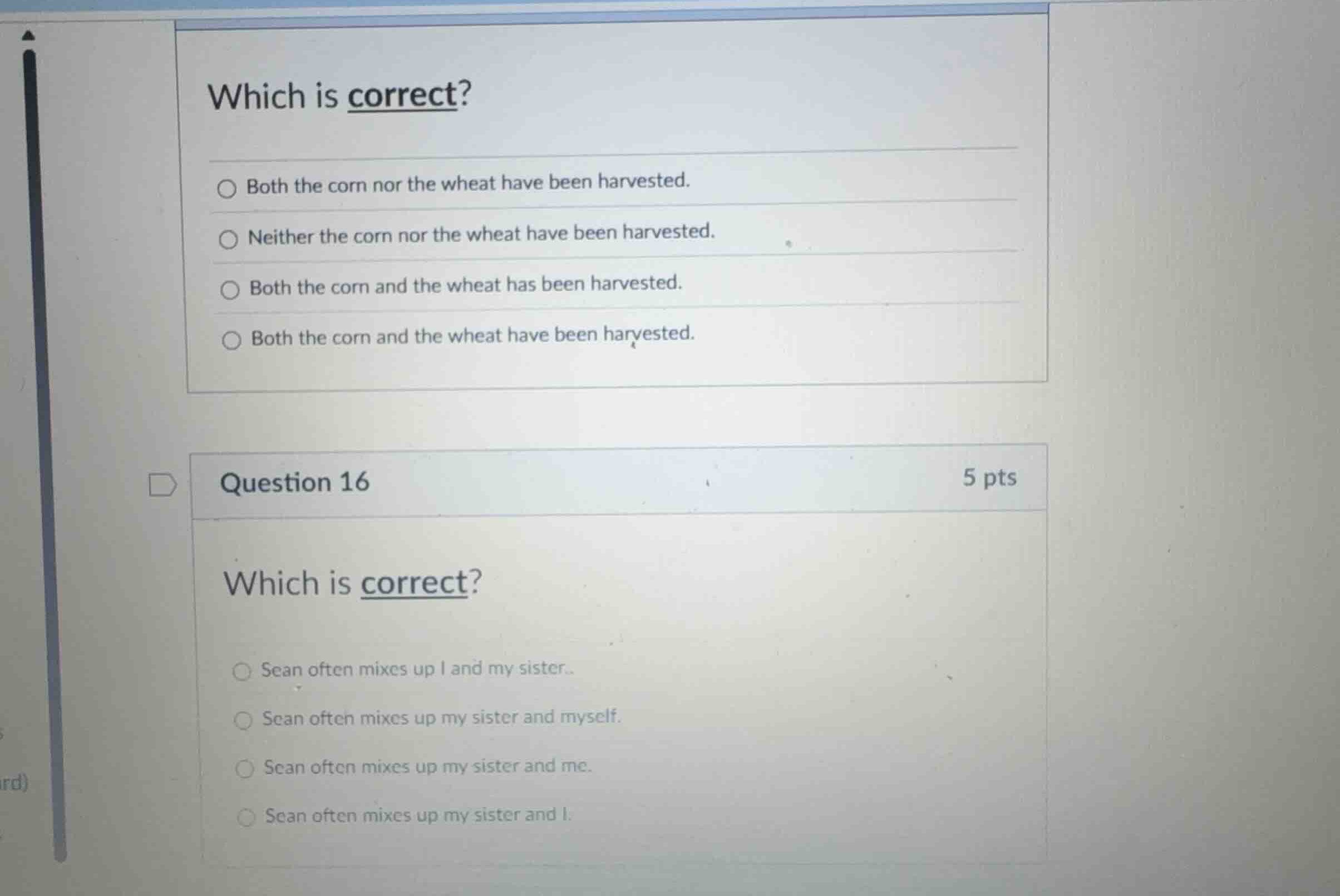
which is correct? both the corn nor the wheat have been harvested. neit…

Question

which is correct?

both the corn nor the wheat have been harvested.
neither the corn nor the wheat have been harvested.
both the corn and the wheat has been harvested.
both the corn and the wheat have been harvested.

question 16
5 pts

which is correct?

sean often mixes up i and my sister.
sean often mixes up my sister and myself.
sean often mixes up my sister and me.
sean often mixes up my sister and i.

Explanation:

Response

<pre_analysis>
{
"quality": "clear",
"question_count": 2,
"skills_matched": [
"direct_cot",
"multiple_choice_formatter",
"explain_then_answer",
"quick"
],
"needs_drawing": false,
"concepts_used": [
"Subject-Verb Agreement"
],
"new_concepts": [
"Correlative Conjunctions",
"Pronoun Case"
],
"current_concepts": [
"Subject-Verb Agreement",
"Correlative Conjunctions",
"Pronoun Case"
]
}
</pre_analysis>

<reasoning>

Analyze correlative conjunctions and subject-verb agreement

  • "Both... nor" is grammatically incorrect; "both" pairs with "and", while "neither" pairs with "nor".
  • "Neither the corn nor the wheat have been harvested" is incorrect because when singular subjects are joined by "neither... nor", the verb must be singular ("has").
  • "Both the corn and the wheat has been harvested" is incorrect because subjects joined by "both... and" are plural and require a plural verb ("have").
  • "Both the corn and the wheat have been harvested" is grammatically correct.

Analyze pronoun case in compound objects

  • The pronoun in "mixes up [my sister and...]" serves as the object of the phrasal verb "mixes up". Therefore, objective case pronouns must be used.
  • "I" is a subjective pronoun, making "I and my sister" and "my sister and I" incorrect in the object position.
  • "Myself" is a reflexive pronoun, which is incorrect here because there is no preceding "I" in the clause to reflect back to.
  • "Me" is the correct objective pronoun, making "my sister and me" the correct compound object.

</reasoning>

<answer>

Question 1

<mcq-option>Both the corn nor the wheat have been harvested.</mcq-option>
<mcq-option>Neither the corn nor the wheat have been harvested.</mcq-option>
<mcq-option>Both the corn and the wheat has been harvested.</mcq-option>
<mcq-correct>Both the corn and the wheat have been harvested.</mcq-correct>

Question 2

<mcq-option>Sean often mixes up I and my sister.</mcq-option>
<mcq-option>Sean often mixes up my sister and myself.</mcq-option>
<mcq-correct>Sean often mixes up my sister and me.</mcq-correct>
<mcq-option>Sean often mixes up my sister and I.</mcq-option>
</answer>

<post_analysis>
{
"subject": "Others",
"question_type": "Multiple Choice",
"knowledge_point": [
"Others",
"English Grammar",
"Subject-Verb Agreement and Pronoun Case"
]
}
</post_analysis>

Answer:

<pre_analysis>
{
"quality": "clear",
"question_count": 2,
"skills_matched": [
"direct_cot",
"multiple_choice_formatter",
"explain_then_answer",
"quick"
],
"needs_drawing": false,
"concepts_used": [
"Subject-Verb Agreement"
],
"new_concepts": [
"Correlative Conjunctions",
"Pronoun Case"
],
"current_concepts": [
"Subject-Verb Agreement",
"Correlative Conjunctions",
"Pronoun Case"
]
}
</pre_analysis>

<reasoning>

Analyze correlative conjunctions and subject-verb agreement

  • "Both... nor" is grammatically incorrect; "both" pairs with "and", while "neither" pairs with "nor".
  • "Neither the corn nor the wheat have been harvested" is incorrect because when singular subjects are joined by "neither... nor", the verb must be singular ("has").
  • "Both the corn and the wheat has been harvested" is incorrect because subjects joined by "both... and" are plural and require a plural verb ("have").
  • "Both the corn and the wheat have been harvested" is grammatically correct.

Analyze pronoun case in compound objects

  • The pronoun in "mixes up [my sister and...]" serves as the object of the phrasal verb "mixes up". Therefore, objective case pronouns must be used.
  • "I" is a subjective pronoun, making "I and my sister" and "my sister and I" incorrect in the object position.
  • "Myself" is a reflexive pronoun, which is incorrect here because there is no preceding "I" in the clause to reflect back to.
  • "Me" is the correct objective pronoun, making "my sister and me" the correct compound object.

</reasoning>

<answer>

Question 1

<mcq-option>Both the corn nor the wheat have been harvested.</mcq-option>
<mcq-option>Neither the corn nor the wheat have been harvested.</mcq-option>
<mcq-option>Both the corn and the wheat has been harvested.</mcq-option>
<mcq-correct>Both the corn and the wheat have been harvested.</mcq-correct>

Question 2

<mcq-option>Sean often mixes up I and my sister.</mcq-option>
<mcq-option>Sean often mixes up my sister and myself.</mcq-option>
<mcq-correct>Sean often mixes up my sister and me.</mcq-correct>
<mcq-option>Sean often mixes up my sister and I.</mcq-option>
</answer>

<post_analysis>
{
"subject": "Others",
"question_type": "Multiple Choice",
"knowledge_point": [
"Others",
"English Grammar",
"Subject-Verb Agreement and Pronoun Case"
]
}
</post_analysis>