QUESTION IMAGE
Question
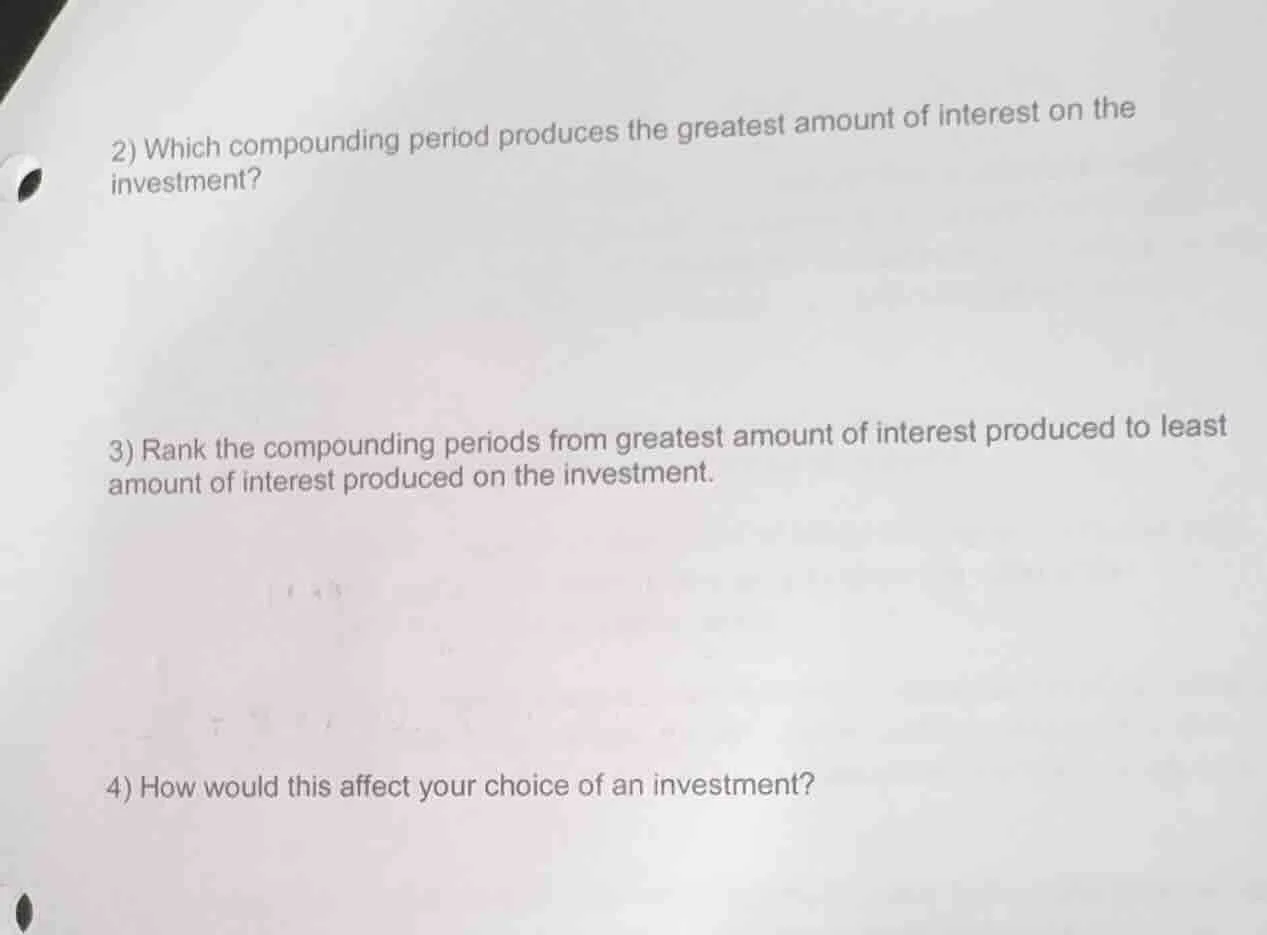
- which compounding period produces the greatest amount of interest on the investment?
- rank the compounding periods from greatest amount of interest produced to least amount of interest produced on the investment.
- how would this affect your choice of an investment?
Brief Explanations
- More frequent compounding generates higher interest, so continuous compounding (where interest is calculated and added to the principal infinitely often) yields the maximum possible interest for a given rate and time, as it uses the limit of compound interest as the number of periods approaches infinity.
- The ranking is based on the frequency of compounding: continuous compounding (greatest), daily compounding, monthly compounding, quarterly compounding, semi-annual compounding, annual compounding (least). This order follows how often interest is reinvested, with more frequent reinvestment leading to higher total interest.
- When choosing an investment, if maximizing returns is the priority, an option with more frequent compounding (ideally continuous, or at least daily/monthly) should be selected, assuming the same annual interest rate and investment term. However, other factors like fees, minimum investment requirements, and liquidity should also be considered alongside compounding frequency.

Snap & solve any problem in the app
Get step-by-step solutions on Sovi AI
Photo-based solutions with guided steps
Explore more problems and detailed explanations
- Continuous compounding produces the greatest amount of interest on the investment.
- From greatest to least interest produced: Continuous compounding > Daily compounding > Monthly compounding > Quarterly compounding > Semi-annual compounding > Annual compounding
- To maximize investment returns (assuming equal annual rates and terms), one would prioritize investments with more frequent compounding periods, while also weighing other practical factors like fees and liquidity.