QUESTION IMAGE
Question
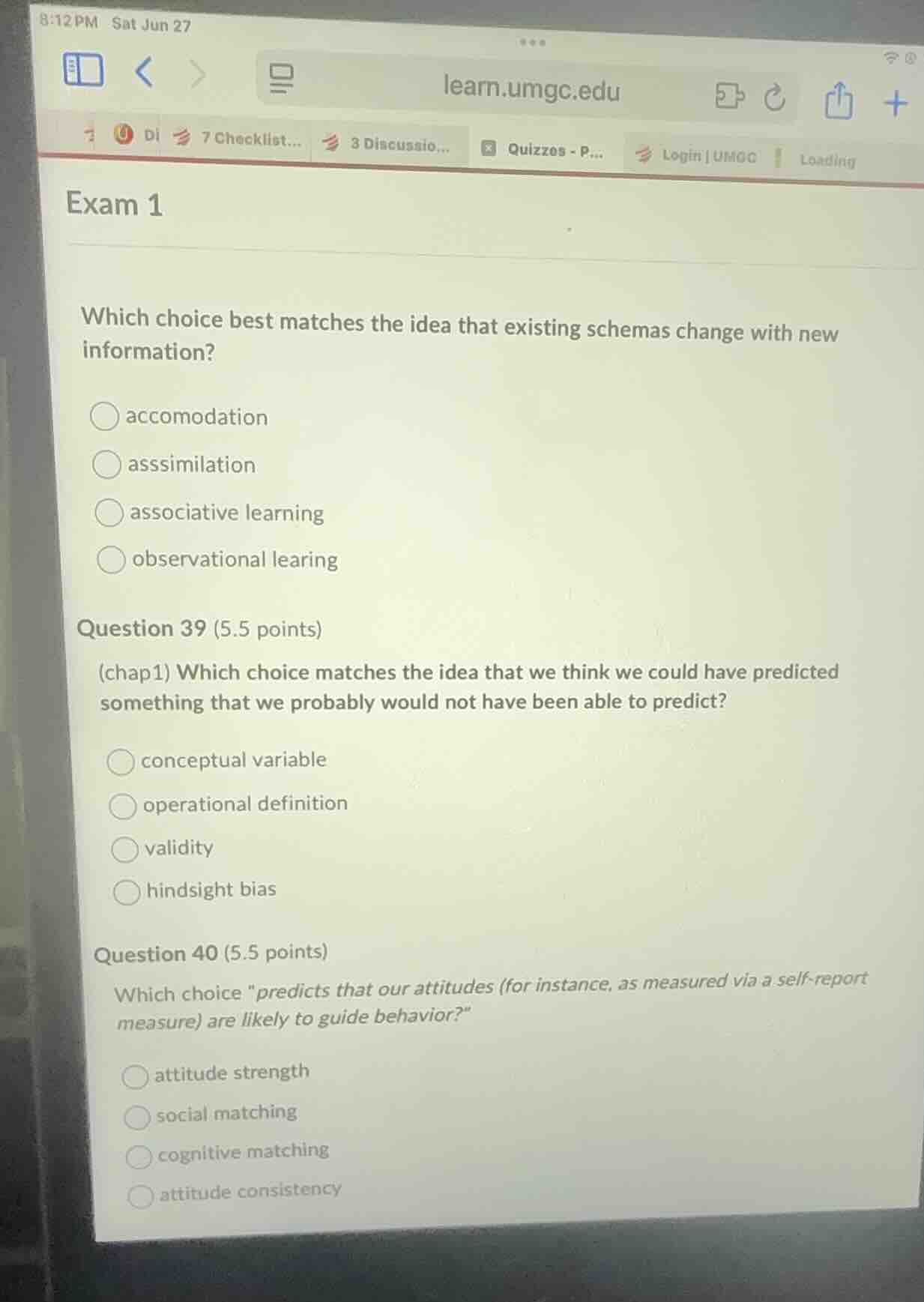
which choice best matches the idea that existing schemas change with new information?
accomodation
asssimilation
associative learning
observational learing
question 39 (5.5 points)
(chap1) which choice matches the idea that we think we could have predicted something that we probably would not have been able to predict?
conceptual variable
operational definition
validity
hindsight bias
question 40 (5.5 points)
which choice \predicts that our attitudes (for instance, as measured via a self-report measure) are likely to guide behavior?\
attitude strength
social matching
cognitive matching
attitude consistency
Analyze the first question
The first question asks: "Which choice best matches the idea that existing schemas change with new information?"
- Accommodation is the cognitive process of revising existing cognitive schemas, perceptions, and understandings so that new information can be incorporated.
- Assimilation is fitting new information into pre-existing schemas without changing them.
- Associative learning and observational learning are general learning theories rather than specific mechanisms of schema modification.
Therefore, accommodation is the correct choice.
Analyze Question 39
Question 39 asks: "Which choice matches the idea that we think we could have predicted something that we probably would not have been able to predict?"
- Hindsight bias (also known as the "knew-it-all-along" phenomenon) is the psychological tendency to believe, after an event has occurred, that one predicting or expecting it was obvious or highly likely.
- Conceptual variable, operational definition, and validity are methodological terms related to research design rather than cognitive biases.
Therefore, hindsight bias is the correct choice.
Analyze Question 40
Question 40 asks: "Which choice 'predicts that our attitudes (for instance, as measured via a self-report measure) are likely to guide behavior?'"
- Attitude consistency refers to the degree of alignment or consistency between a person's attitudes and their actual behavior. When attitude consistency is high, attitudes reliably predict and guide behavior.
- Attitude strength influences how stable an attitude is, but the specific prediction that attitudes guide behavior is defined by attitude consistency.
- Social matching and cognitive matching do not directly define this predictive relationship.
Therefore, attitude consistency is the correct choice.

Snap & solve any problem in the app
Get step-by-step solutions on Sovi AI
Photo-based solutions with guided steps
Explore more problems and detailed explanations
Question 1
- (A) accomodation (Correct answer)
- (B) asssimilation
- (C) associative learning
- (D) observational learing
Question 39
- (A) conceptual variable
- (B) operational definition
- (C) validity
- (D) hindsight bias (Correct answer)
Question 40
- (A) attitude strength
- (B) social matching
- (C) cognitive matching
- (D) attitude consistency (Correct answer)