QUESTION IMAGE
Question
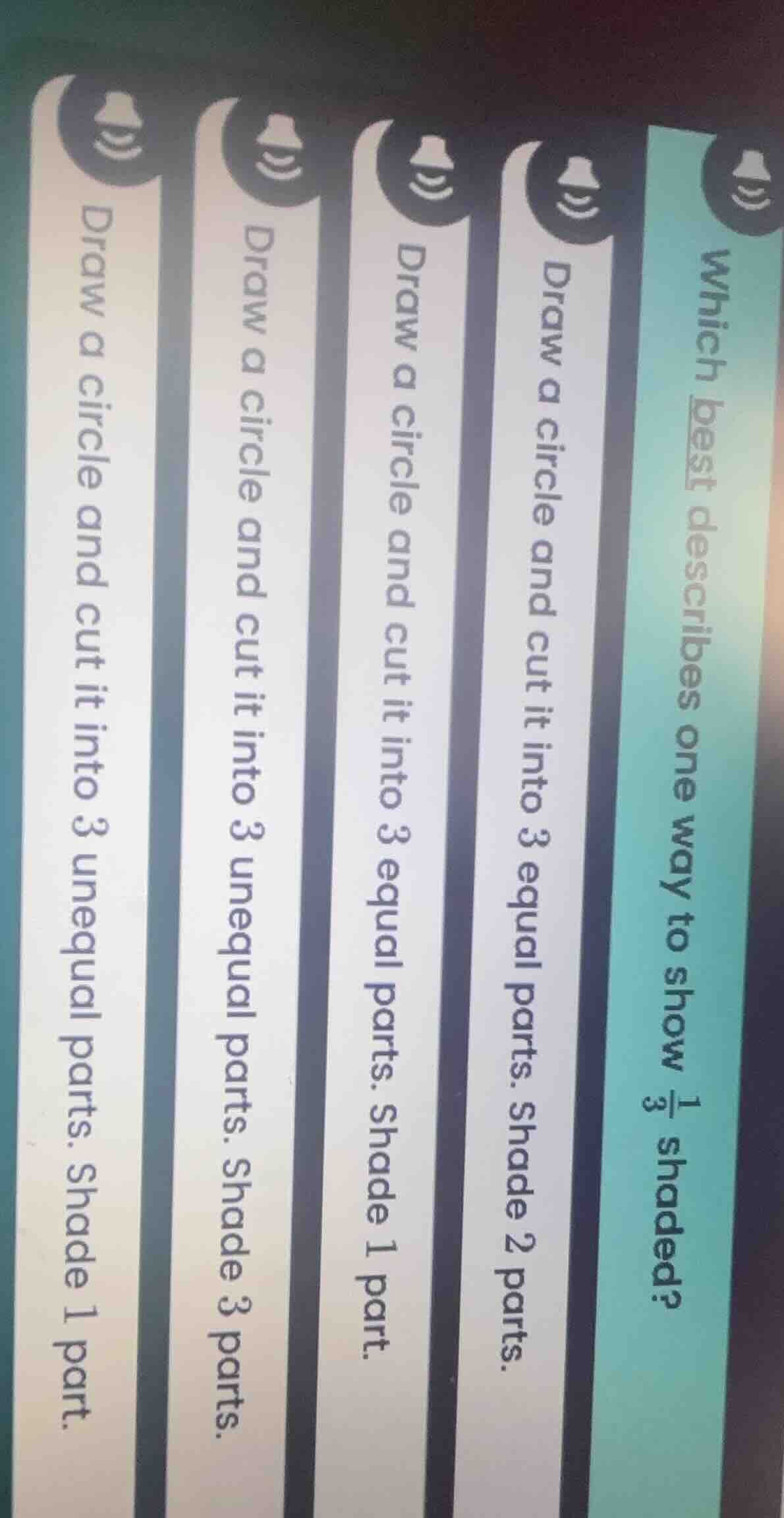
which best describes one way to show \\(\frac{1}{3}\\) shaded? draw a circle and cut it into 3 equal parts. shade 2 parts. draw a circle and cut it into 3 equal parts. shade 1 part. draw a circle and cut it into 3 unequal parts. shade 3 parts. draw a circle and cut it into 3 unequal parts. shade 1 part.
To represent \(\frac{1}{3}\) shaded, we need to divide the circle into 3 equal parts (since the denominator is 3, indicating equal parts) and shade 1 of those parts (since the numerator is 1).
Let's analyze each option:
- Option 1: "Draw a circle and cut it into 3 unequal parts. Shade 1 part." Unequal parts don't represent a fraction like \(\frac{1}{3}\) accurately because \(\frac{1}{3}\) requires equal - sized parts.
- Option 2: "Draw a circle and cut it into 3 unequal parts. Shade 3 parts." First, unequal parts are incorrect for representing \(\frac{1}{3}\), and shading 3 parts of 3 unequal parts doesn't represent \(\frac{1}{3}\).
- Option 3: "Draw a circle and cut it into 3 equal parts. Shade 1 part." Dividing the circle into 3 equal parts (so each part is \(\frac{1}{3}\) of the circle) and shading 1 part gives us \(\frac{1}{3}\) of the circle shaded, which is correct.
- Option 4: "Draw a circle and cut it into 3 equal parts. Shade 2 parts." Shading 2 parts of 3 equal parts would represent \(\frac{2}{3}\), not \(\frac{1}{3}\).

Snap & solve any problem in the app
Get step-by-step solutions on Sovi AI
Photo-based solutions with guided steps
Explore more problems and detailed explanations
C. Draw a circle and cut it into 3 equal parts. Shade 1 part. (assuming the options are labeled A, B, C, D in the order they appear, with the third option being C)