QUESTION IMAGE
Question
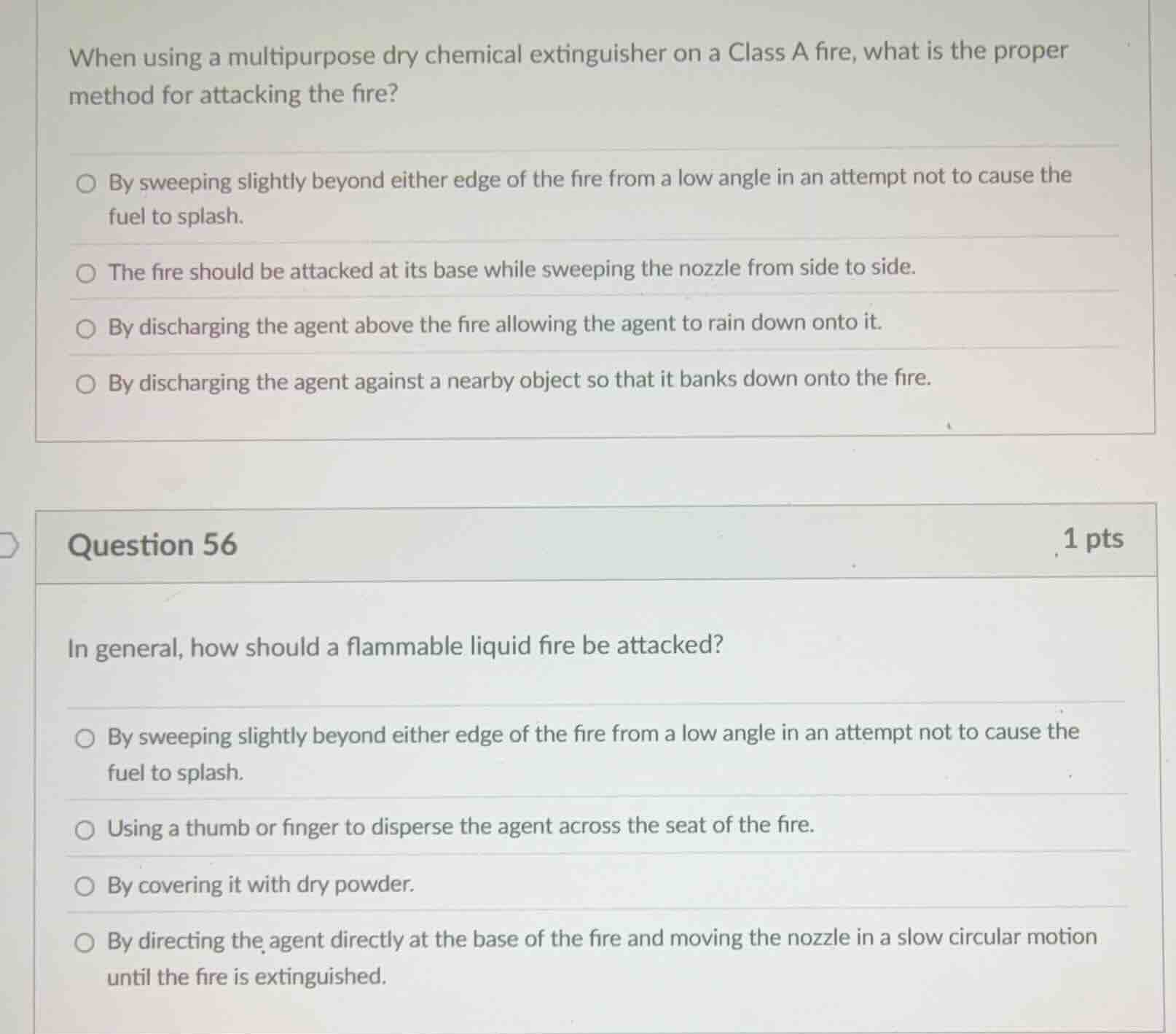
when using a multipurpose dry chemical extinguisher on a class a fire, what is the proper method for attacking the fire?
by sweeping slightly beyond either edge of the fire from a low angle in an attempt not to cause the fuel to splash.
the fire should be attacked at its base while sweeping the nozzle from side to side.
by discharging the agent above the fire allowing the agent to rain down onto it.
by discharging the agent against a nearby object so that it banks down onto the fire.
question 56
1 pts
in general, how should a flammable liquid fire be attacked?
by sweeping slightly beyond either edge of the fire from a low angle in an attempt not to cause the fuel to splash.
using a thumb or finger to disperse the agent across the seat of the fire.
by covering it with dry powder.
by directing the agent directly at the base of the fire and moving the nozzle in a slow circular motion until the fire is extinguished.
Analyze Class A fire attack method
For a Class A (ordinary combustibles) fire, using a multipurpose dry chemical extinguisher requires applying the agent directly to the burning material. According to standard firefighting training and the PASS Method (Pull, Aim, Squeeze, Sweep), the nozzle should be aimed at the base of the fire and swept from side to side to coat the burning fuel and interrupt the chemical chain reaction.
Evaluate Class A options
- Option 1 describes a low-angle sweep to avoid splashing, which is specific to liquid fuels (Class B).
- Option 2 states: "The fire should be attacked at its base while sweeping the nozzle from side to side." This perfectly matches standard PASS Method protocols for ordinary combustibles.
- Option 3 and Option 4 describe indirect application techniques (raining down or banking), which are used for specific agents or situations but are not the standard direct attack method for Class A fires using Dry Chemical Extinguishers.
Analyze flammable liquid fire attack method
A flammable liquid fire (Class B) presents a high risk of splashing, which can spread the fire. Therefore, the stream must not be directed straight into the liquid. Instead, the operator should sweep the agent slightly beyond the edges of the fire from a low angle to avoid splashing the fuel while extinguishing the flames.
Evaluate flammable liquid options
- Option 1 states: "By sweeping slightly beyond either edge of the fire from a low angle in an attempt not to cause the fuel to splash." This is the correct, standard technique for attacking Class B liquid fires.
- Option 2 suggests using a finger to disperse the agent, which is unsafe and incorrect.
- Option 3 mentions dry powder, which is used for Class D (combustible metal) fires, not standard flammable liquids.
- Option 4 suggests directing the agent directly at the base with a circular motion, which can cause dangerous splashing in a liquid pool.

Snap & solve any problem in the app
Get step-by-step solutions on Sovi AI
Photo-based solutions with guided steps
Explore more problems and detailed explanations
Question 1
- By sweeping slightly beyond either edge of the fire from a low angle in an attempt not to cause the fuel to splash.
- The fire should be attacked at its base while sweeping the nozzle from side to side. (Correct answer)
- By discharging the agent above the fire allowing the agent to rain down onto it.
- By discharging the agent against a nearby object so that it banks down onto the fire.
Question 2
- By sweeping slightly beyond either edge of the fire from a low angle in an attempt not to cause the fuel to splash. (Correct answer)
- Using a thumb or finger to disperse the agent across the seat of the fire.
- By covering it with dry powder.
- By directing the agent directly at the base of the fire and moving the nozzle in a slow circular motion until the fire is extinguished.