QUESTION IMAGE
Question
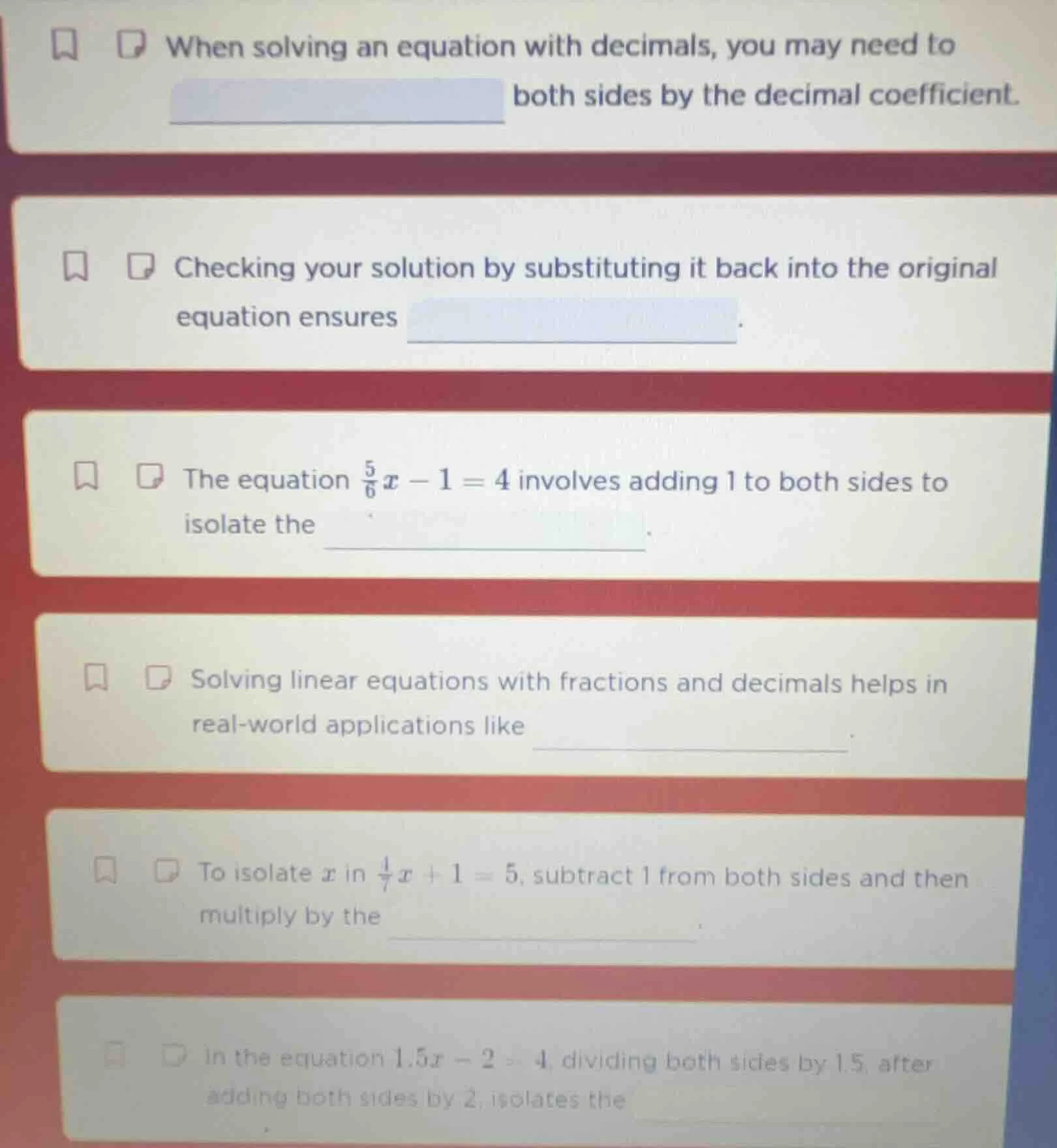
when solving an equation with decimals, you may need to
both sides by the decimal coefficient.
checking your solution by substituting it back into the original
equation ensures
the equation \\(\frac{5}{6}x - 1 = 4\\) involves adding 1 to both sides to
isolate the
solving linear equations with fractions and decimals helps in
real - world applications like
to isolate \\(x\\) in \\(\frac{4}{7}x + 1 = 5\\), subtract 1 from both sides and then
multiply by the
in the equation \\(1.5x - 2 = 4\\), dividing both sides by 1.5, after
adding both sides by 2, isolates the
First Question:
When solving an equation with a decimal coefficient (like \(ax = b\) where \(a\) is a decimal), to isolate the variable, we perform the inverse operation of multiplication (since the coefficient is multiplying the variable). So we divide both sides by the decimal coefficient.
Substituting the solution back into the original equation checks if the value satisfies the equation, ensuring that the solution is correct (it makes the equation a true statement).
In the equation \(\frac{5}{6}x - 1 = 4\), the term with the variable is \(\frac{5}{6}x\). By adding 1 to both sides (\(\frac{5}{6}x - 1 + 1=4 + 1\)), we isolate the term containing the variable (\(\frac{5}{6}x\)) on one side.

Snap & solve any problem in the app
Get step-by-step solutions on Sovi AI
Photo-based solutions with guided steps
Explore more problems and detailed explanations
divide