QUESTION IMAGE
Question
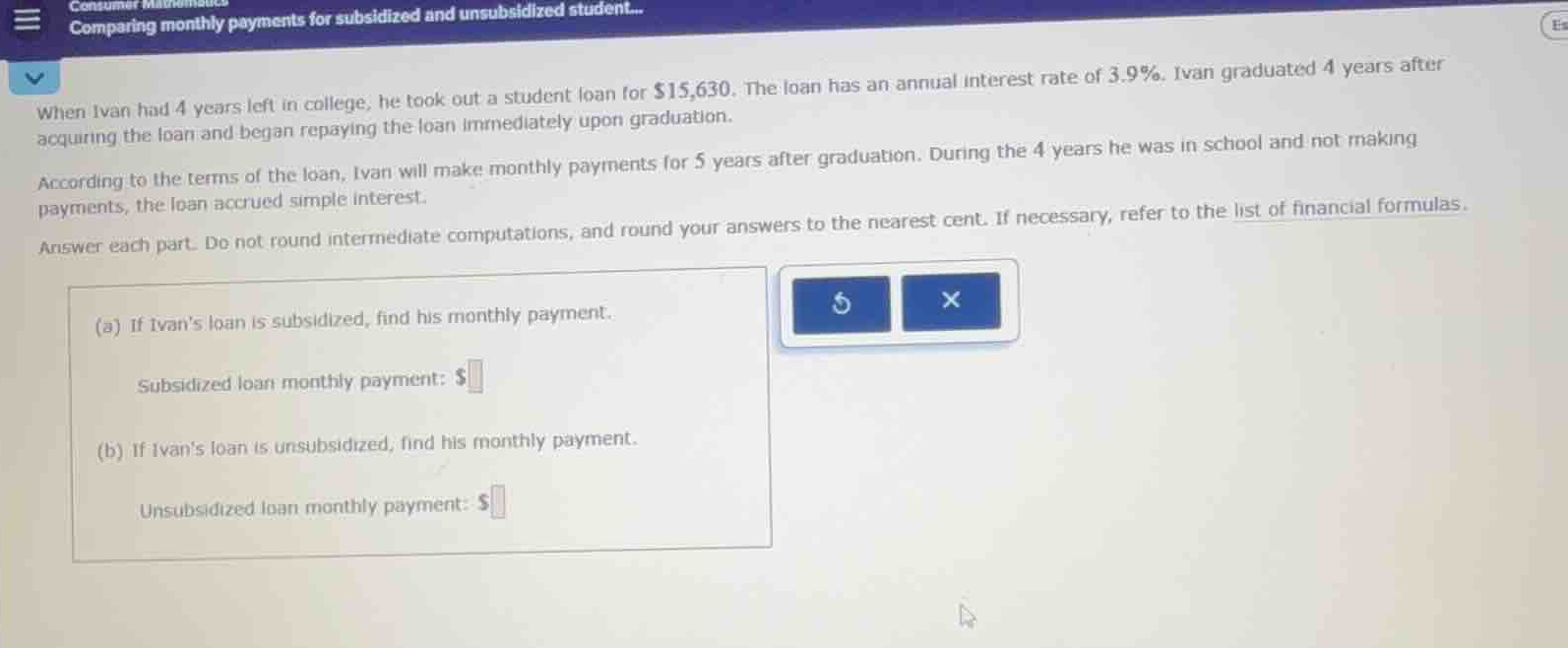
when ivan had 4 years left in college, he took out a student loan for \\$15,630. the loan has an annual interest rate of 3.9\\%. ivan graduated 4 years after acquiring the loan and began repaying the loan immediately upon graduation.
according to the terms of the loan, ivan will make monthly payments for 5 years after graduation. during the 4 years he was in school and not making payments, the loan accrued simple interest.
answer each part. do not round intermediate computations, and round your answers to the nearest cent. if necessary, refer to the list of financial formulas.
(a) if ivans loan is subsidized, find his monthly payment.
subsidized loan monthly payment: \\$
(b) if ivans loan is unsubsidized, find his monthly payment.
unsubsidized loan monthly payment: \\$
Identify given parameters and loan terms
We are given the following details from the problem statement:
- Principal loan amount: \(P = \$15,630\)
- Annual interest rate: \(r = 3.9\% = 0.039\)
- Time in school (no payments made): \(t_{\text{school}} = 4\text{ years}\)
- Repayment period after graduation: \(t_{\text{repay}} = 5\text{ years}\)
- Payment frequency: Monthly (\(n = 12\) payments per year)
- Total number of payments: \(N = n \times t_{\text{repay}} = 12 \times 5 = 60\)
- Monthly interest rate during repayment: \(i = \frac{r}{12} = \frac{0.039}{12} = 0.00325\)
Calculate subsidized loan monthly payment
Using the Future Value concept, we analyze the subsidized loan. For a subsidized student loan, the government pays the interest while the student is in school. Therefore, no interest accrues during the 4 years in school.
The loan balance at graduation is equal to the original principal:
To find the monthly payment \(PMT\), we use the standard loan amortization formula:
Substituting the values:
Rounding to the nearest cent:
Calculate unsubsidized loan balance at graduation
For an unsubsidized loan, interest accrues while the student is in school. The problem states that during the 4 years in school, the loan accrued simple interest.
We calculate the accrued simple interest over \(t_{\text{school}} = 4\text{ years}\):
The total loan balance (principal + accrued interest) at the time graduation repayment begins is:
Calculate unsubsidized loan monthly payment
We now calculate the monthly payment \(PMT\) for the unsubsidized loan using the new balance as the present value:
Using the same amortization factor calculated in Step 2:
Rounding to the nearest cent:

Snap & solve any problem in the app
Get step-by-step solutions on Sovi AI
Photo-based solutions with guided steps
Explore more problems and detailed explanations
Question 1
Subsidized loan monthly payment: $<blank>287.23</blank>
Question 2
Unsubsidized loan monthly payment: $<blank>332.04</blank>