QUESTION IMAGE
Question
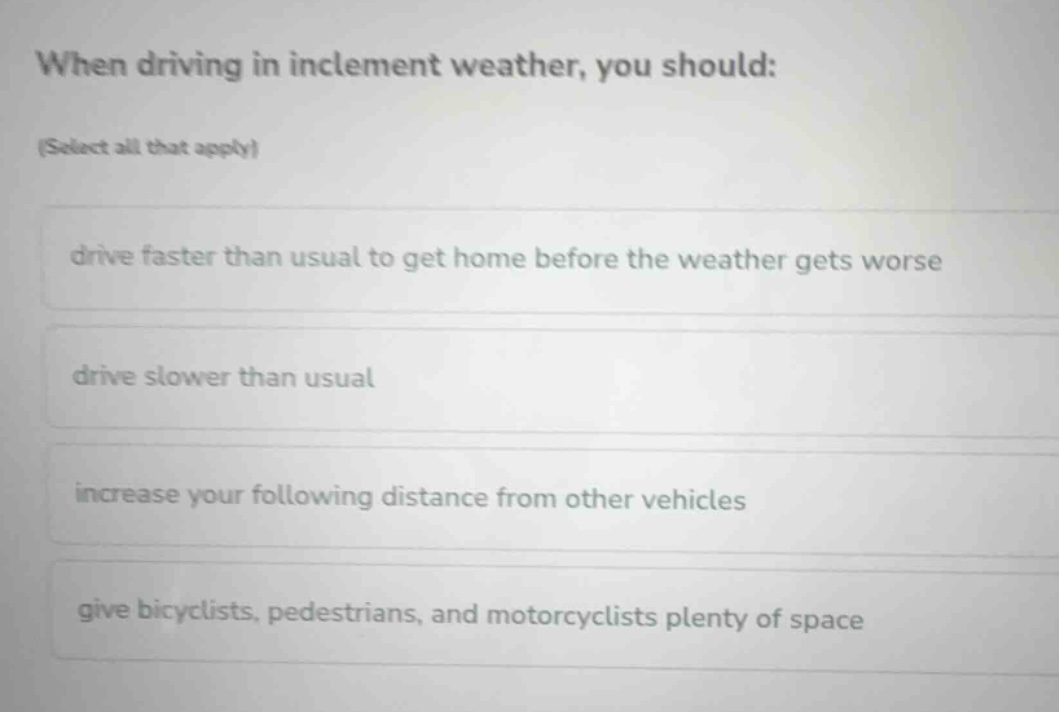
when driving in inclement weather, you should:
(select all that apply)
- drive faster than usual to get home before the weather gets worse
- drive slower than usual
- increase your following distance from other vehicles
- give bicyclists, pedestrians, and motorcyclists plenty of space
🆕 New Concept Discovered: Defensive Driving in Adverse Conditions
Adjusting vehicle control and spacing for safety in poor weather.
Step 1: Analyze speed adjustments
Inclement weather (such as rain, snow, ice, or fog) reduces tire traction and visibility.
- Driving faster than usual increases the risk of losing control and hydroplaning. Therefore, the first option is incorrect.
- Driving slower than usual gives you more time to react to hazards and helps maintain traction. Therefore, the second option is correct.
Step 2: Analyze following distance
Because wet or icy roads significantly increase the distance required to bring a vehicle to a complete stop, you must maintain a larger gap between your vehicle and the one in front of you.
- Increasing your following distance provides a crucial safety buffer. Therefore, the third option is correct.
Step 3: Analyze space for vulnerable road users
Bicyclists, pedestrians, and motorcyclists are much more vulnerable in bad weather. They are harder to see, and they can easily slip or lose balance on slick surfaces.
- Giving them plenty of extra space ensures safety if they slip or make sudden movements. Therefore, the fourth option is correct.

Snap & solve any problem in the app
Get step-by-step solutions on Sovi AI
Photo-based solutions with guided steps
Explore more problems and detailed explanations
- drive slower than usual
- increase your following distance from other vehicles
- give bicyclists, pedestrians, and motorcyclists plenty of space