QUESTION IMAGE
Question
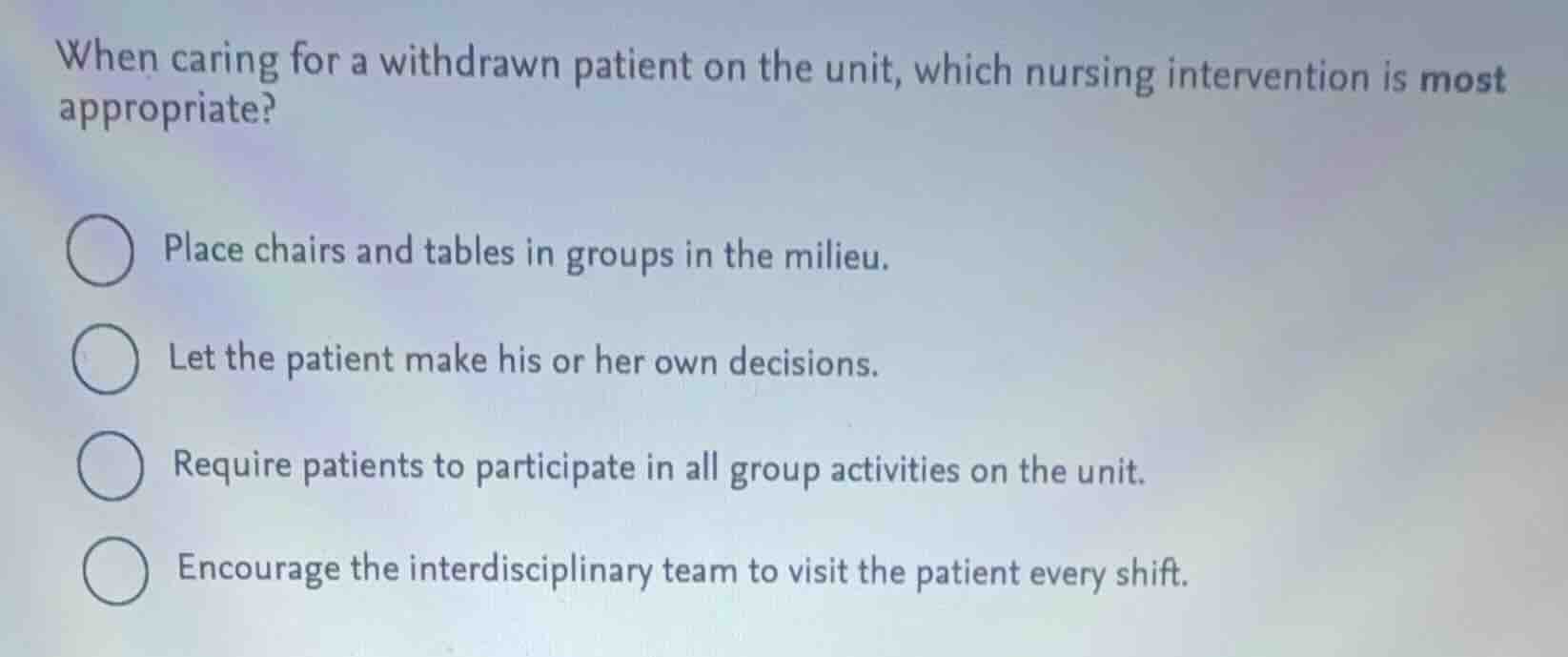
when caring for a withdrawn patient on the unit, which nursing intervention is most appropriate?
place chairs and tables in groups in the milieu.
let the patient make his or her own decisions.
require patients to participate in all group activities on the unit.
encourage the interdisciplinary team to visit the patient every shift.
Analyze the needs of a withdrawn psychiatric patient
A severely withdrawn patient often experiences low self-esteem, psychomotor retardation, or severe depression, making decision-making difficult and overwhelming. Forcing participation or overloading them with social/interdisciplinary interactions can increase anxiety and cause further withdrawal.
Evaluate the intervention options
- Option 1: Placing furniture in groups encourages socialization but does not directly address individual therapeutic care for a severely withdrawn patient.
- Option 2: Allowing the patient to make their own decisions (even simple ones, like choosing between two outfits or activities) fosters a sense of control, self-worth, and autonomy without overwhelming them.
- Option 3: Requiring participation in all group activities is too demanding and can cause the patient to withdraw further due to performance anxiety or cognitive overload.
- Option 4: Having the entire interdisciplinary team visit every shift is overwhelming and intrusive for a withdrawn individual.
Select the most appropriate nursing intervention
Allowing the patient to make their own decisions supports patient autonomy, builds self-esteem, and helps them gradually re-engage with their environment at their own pace.

Snap & solve any problem in the app
Get step-by-step solutions on Sovi AI
Photo-based solutions with guided steps
Explore more problems and detailed explanations
- Place chairs and tables in groups in the milieu.
- Let the patient make his or her own decisions. (Correct answer)
- Require patients to participate in all group activities on the unit.
- Encourage the interdisciplinary team to visit the patient every shift.